



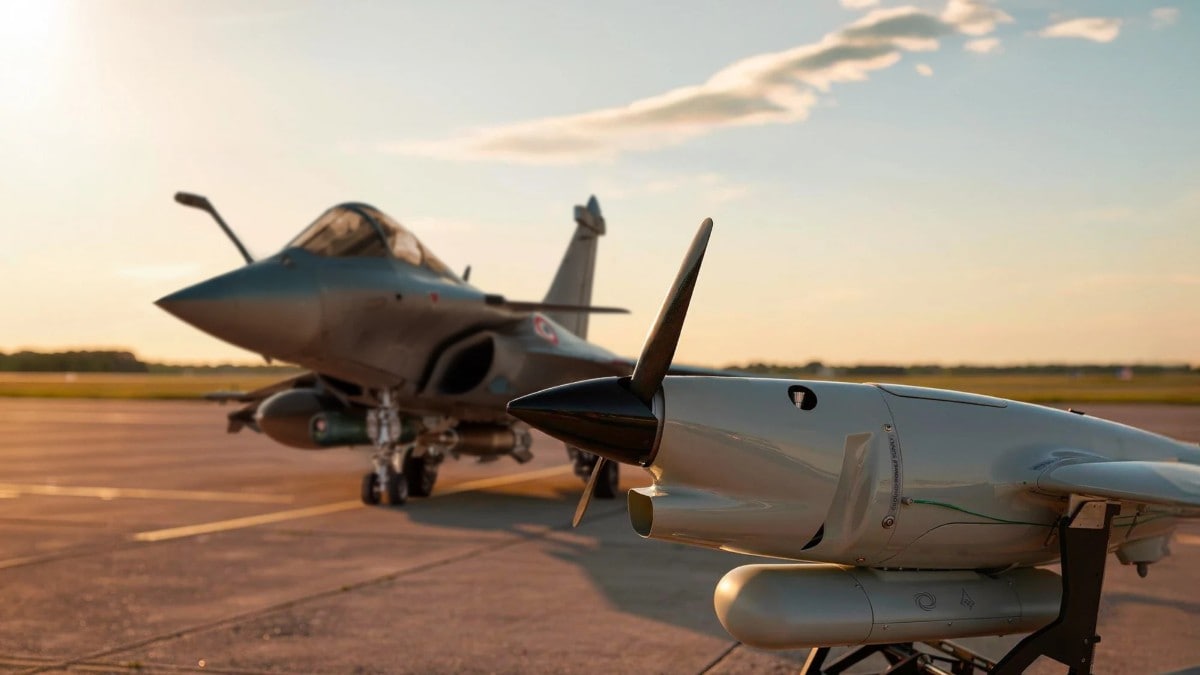
As India plans to procure 114 customised Rafale F4* fighter jets, 18 of which will be delivered in flyaway condition, to the country, the aircraft has received a significant electronic warfare upgrade with the successful demonstration of a new unmanned collaborative combat capability.
Dassault Aviation and Harmattan AI on Monday announced the successful execution of a collaborative in-flight engagement involving a Rafale F4 fighter jet and an unmanned aerial system equipped with NAMIB, a newly developed electronic warfare payload.
The demonstration showcased the Rafale's ability to work alongside unmanned systems in combat. During the flight, the NAMIB payload detected, identified and precisely geolocated electromagnetic emissions from an air defence radar located several dozen kilometres away. The target's location was then transmitted to the Rafale, which simulated a strike on the radar, a press statement from the company said.
According to Dassault Aviation, NAMIB is an electronic warfare payload capable of detecting, identifying and geolocating electromagnetic emissions, particularly those from air defence systems. It can be carried by tactical drones, including quadcopters, as well as longer-endurance fixed-wing unmanned aircraft.
The development of NAMIB began in January 2026 as part of the strategic partnership between Dassault Aviation and Harmattan AI to integrate advanced autonomous capabilities into next-generation air combat systems.
Describing the trial as a milestone, Dassault Aviation Chairman and CEO Eric Trappier said, "This flight demonstrates the Rafale's real and tangible multi-domain collaborative combat capabilities."
He said the F4-standard architecture enables seamless communication with a broad range of operational assets, including ground forces, allowing the aircraft to exploit new capabilities such as NAMIB's electromagnetic detection and geolocation functions.
Trappier added that the demonstration highlighted the Rafale's ability to continuously adapt to evolving operational requirements, particularly through a "high-low mix" that combines highly sophisticated fighter aircraft with autonomous and expendable unmanned systems.
Harmattan AI Co-Founder and CEO Mouad M'Ghari said electronic warfare has become a decisive factor in achieving operational superiority.
"Through NAMIB, we are demonstrating that these capabilities can now be deployed on lightweight autonomous systems operating close to the threat," he said.
According to M'Ghari, the demonstration underlines the complementary strengths of Dassault Aviation and Harmattan AI in accelerating the integration of autonomous technologies and embedded intelligence into future collaborative combat architectures.
