



She smiled warmly when I walked into the room 1636 that she was admitted in.
“Good morning, doctor.”
“Good morning,” I replied.
We chatted for a few minutes. She told me about her grandchildren, her love for gardening, and how her husband insisted on making tea every morning despite being spectacularly bad at it.
Then I stepped outside to review her scans.
When I returned less than 10 minutes later, she smiled again.
“Good morning, doctor.”
Exactly the same smile.
Exactly the same greeting.
And then she introduced herself as though we had never met.
Her husband lowered his eyes. “This has been happening for a few weeks,” he said quietly. “Every few minutes, the conversation starts again.”
She was 63, intelligent, cheerful, and completely unaware that time itself had begun slipping through her fingers. She could describe her childhood in remarkable detail, recall the colour of the sari she wore at her wedding 40 years earlier, and vividly remember the birth of her first child. Yet she could not remember what she had eaten for breakfast or that we had spoken only moments before. Every encounter was a first encounter. Every conversation a new beginning. Watching it unfold was strangely beautiful and profoundly heartbreaking. Memory is not simply storage. It is continuity. It is the invisible thread that stitches one moment to the next, allowing us to become the same person from one day to another.
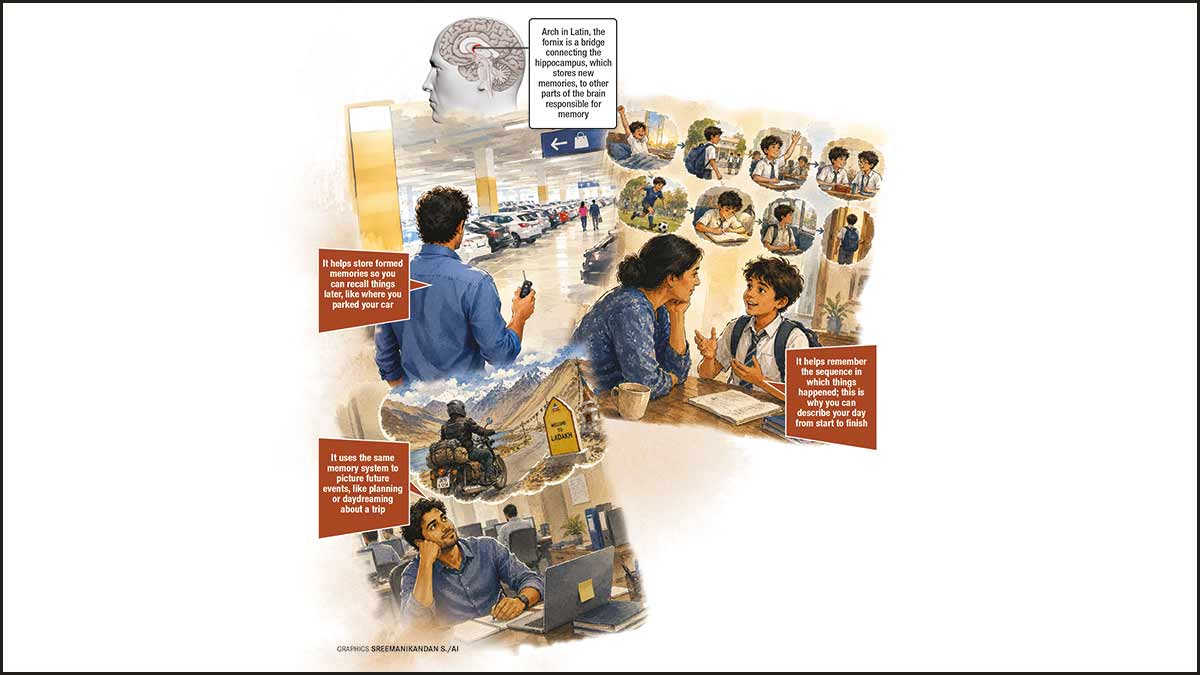
Her MRI revealed a small tumour nestled deep beneath the corpus callosum, pressing gently upon a structure few people have ever heard of: the fornix. The name comes from the Latin word for “arch”, an elegant description of its graceful curved shape. It is a slender bridge of white matter connecting the hippocampus—the brain’s library of new memories—to the mammillary bodies and the deeper circuits responsible for consolidating experience into lasting recollection. It is astonishing that something no thicker than a pencil can hold together the narrative of an entire human life. Damage the frontal lobe and a personality may change. Damage the cerebellum and balance may falter. But interrupt the fornix, and yesterday quietly dissolves. We often imagine memory as books stored on shelves. The fornix is less like the library and more like the librarian carrying those books to where they belong. Without the journey, the stories are never shelved. They simply disappear. As Milan Kundera observed, “The struggle of man against power is the struggle of memory against forgetting.” Neurosurgery teaches you that biology has been fighting that same battle long before literature gave it words.
Operating in this region demands extraordinary restraint. The fornix lies in the very centre of the brain, suspended beneath the corpus callosum and bordering the ventricles, surrounded by veins and structures that tolerate very little disturbance. To reach the tumour, we entered through the interhemispheric corridor, gently separating the two cerebral hemispheres along the natural midline, preserving every bridging vein that emptied into the superior sagittal sinus. Beneath the corpus callosum, the roof of the lateral ventricle slowly came into view. There is a peculiar silence to these deep operations. Every movement under the microscope is measured in millimetres. Every decision carries consequences that may echo through a lifetime of memories. The tumour had compressed the fornix rather than invaded it, a small act of biological mercy. Piece by piece, it was carefully removed until the delicate white fibres were once again free to conduct their quiet conversations. Surgery in this region never feels like removing a tumour. It feels like protecting a person’s autobiography.
The next morning I entered her room.
“Good morning,” I said.
She looked up.
“Doctor,” she smiled, “you have already been here today.”
It was only one sentence.
But her husband began to cry.
Medicine often celebrates dramatic victories: the paralysed limb that moves, the blind eye that sees, the tumour that disappears on a scan. Yet some of the greatest triumphs are almost invisible. A remembered conversation. A familiar face. The ability to carry the present into the future instead of watching it vanish every few minutes. Over the following weeks her short-term memory improved steadily. She began remembering visitors, conversations, meals, television programmes, the little unremarkable details that quietly accumulate into an ordinary life. We rarely appreciate memory until it falters. We assume tomorrow will naturally know about today. The brain works tirelessly to make that assumption true.
At her final follow-up, she handed me a notebook.
“I have started journaling,” she said.
“To help your memory?”
She smiled.
“No.”
She paused.
“To help me remember how precious memory is.”
The author is consultant neurosurgeon at Wockhardt Hospital, Mumbai.
mazdaturel@gmail.com @mazdaturel
