



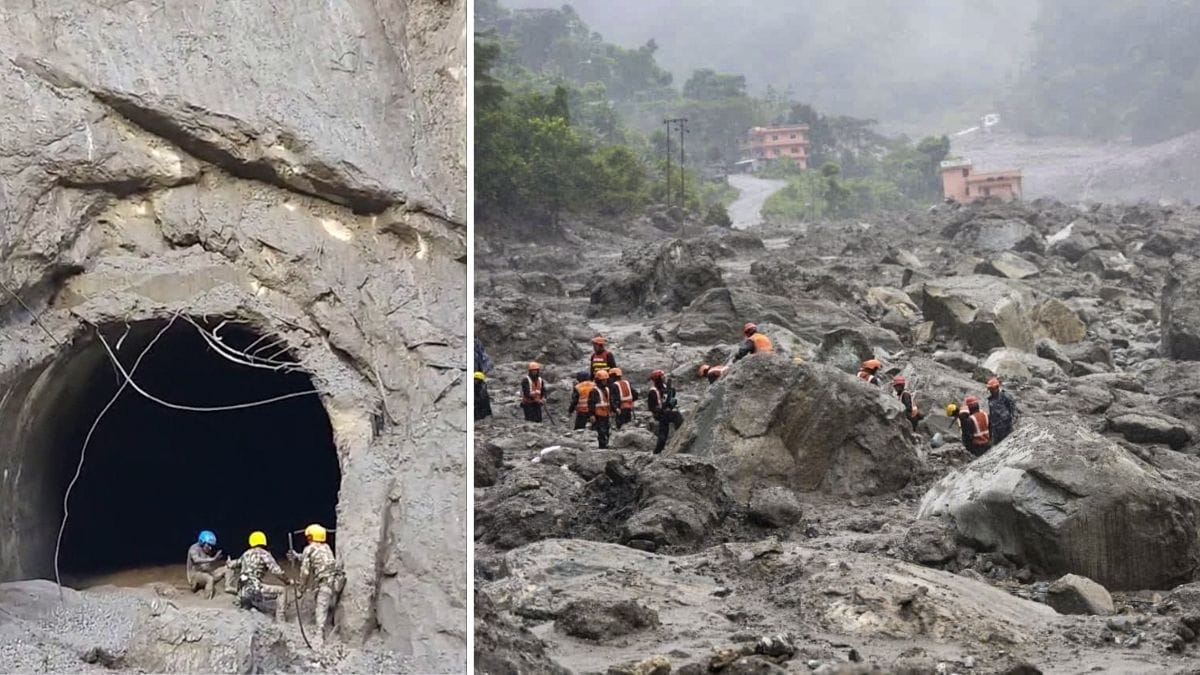
Rescue workers are racing against time to locate around 900 workers believed to be trapped at various hydropower projects after the deluge at the Bhotekoshi River on Wednesday in Nepal.
According to the Country’s Independent Power Producers Association, about 361 workers have been rescued so far. An estimated 898 workers remain unaccounted for.
Most of the trapped workers are believed to be in the Upper Trishuli-1 and Trishuli-3A hydropower projects in Rasuwa district, near the Nepal-Tibet border.
At one hydropower project along the Trishuli River, they pumped air into a tunnel and plan to drill a manhole to send teams inside to look for survivors.
Biraj Bhakta Shrestha, Nepal’s Minister of Energy, Water Resources and Irrigation, said on Saturday night, “There has been some success in the ongoing rescue efforts at the Trishuli–3 ‘A’ Hydropower Project tunnel, which was buried under mud and sludge following the flood.”
“The plan is now to enlarge the existing hole and create a manhole so that the rescue operation can proceed further,” he wrote. “The current target is to reach the main tunnel through the existing tunnel route by tomorrow.”
Two thermal drones used by the Nepal army, however, have “not detected any signs of life”, according to Raja Ram Basnet, an army spokesman who spoke to The New York Times. He also said that could be because of the distance and that they were not sure “how far the people might have been from the area where the drones were used.”
To get to the workers, rescuers have to dig through dense mud and debris and then bore through thick tunnel doors and walls or blast them open with explosives.
Footage from an earlier rescue showed rescue teams dragging out workers from the tunnels, caked in mud after the entrances were unblocked.
Nepal’s hydroelectric industry harnessed the fast-flowing water from the Himalayas to generate electricity. The projects were constructed along the Bhote Kosi and Trishuli rivers.
Sudan Gurung, the home minister of Nepal, said on social media that rescuers had reached the crown of the Trishuli 3A tunnel on Saturday. The government also said that teams from India and China would provide technical assistance for the search.
“We have already started supplying air through that small hole,” he said, “and we will now begin excavation work and send the rescue team inside.”
According to the latest updates, 750 people have been confirmed dead, and around 3000 people remain missing after the deluge, officials from Nepal and China said on Sunday.
The death toll in Nepal climbed to 734 from 670 on Sunday, and at least 2,498 people remain missing, including 589 foreign nationals. Meanwhile, in the Tibet Autonomous Region, the death toll was updated to 16 people, and 546 people remain missing, Chinese authorities said. 261 people were foreigners.
