



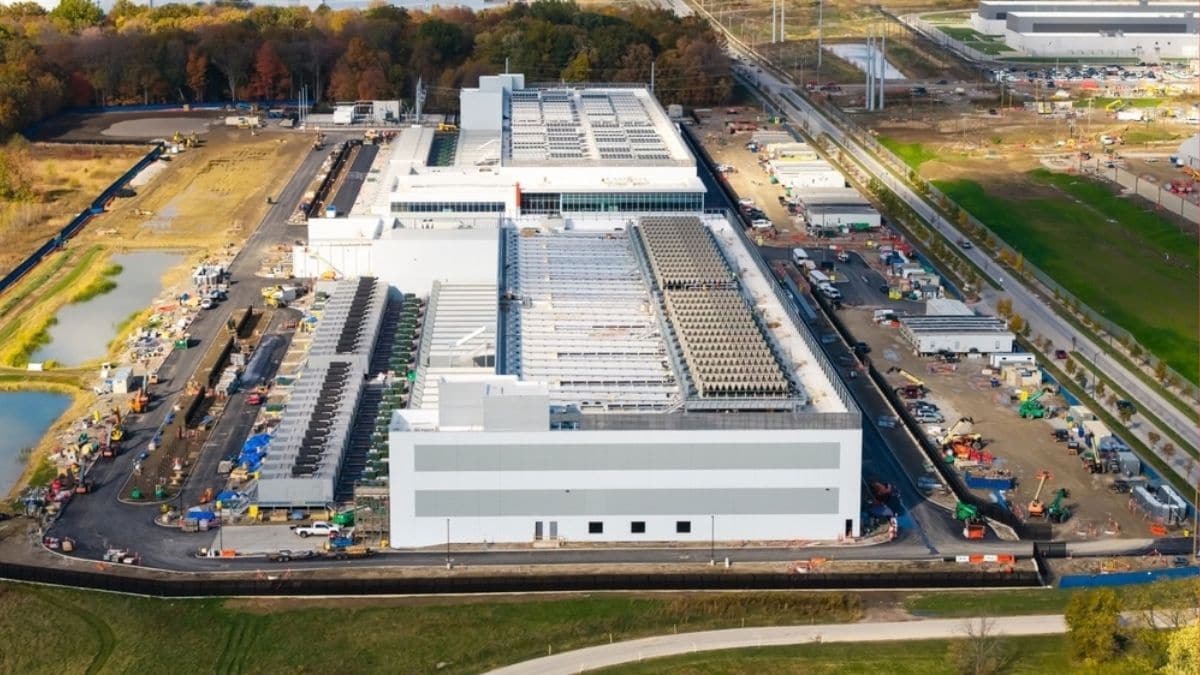
India is attracting $50–70 billion in AI data centre investments, with a projected capital of $25 billion by 2030, over the next 5–7 years. Sounds like victory? On the surface, everyone is thinking about good jobs, foreign capital, digital sovereignty, but one look beneath this optimism reveals a question not many are ready to ask: can India’s water and power systems actually sustain this? A thought that most industry leaders are yet to conjure and complicated for policymakers to realise.
A typical large AI data centre consumes 100–300 megawatts of continuous electricity, enough to power an entire medium-sized city. To maintain the heat generated from these centres, they require water consumption equal to the annual needs of 100,000 households. By 2030, India’s data centre capacity is projected to reach 5GW, with AI driving 95 per cent of incremental demand.
Why is this a matter of concern? India, today, is facing a massive water crisis. As per reports, India's annual per capita water availability has dropped below the threshold of 1,500 cubic meters, entering the "water-stressed" category and moving fast toward extreme scarcity.
According to assessments by government bodies like NITI Aayog and international metrics, availability falls near 1,486 cubic meters or lower, threatening severe power and water resource depletion.
This creates an economic paradox that deserves a serious conversation, beginning with: What is India’s advantage?
Unlike mature economies in Europe and North America, which are struggling with ageing infrastructure requiring expensive retrofits, India has a great structural advantage because a massive wave of construction and digital growth is just beginning. We can design AI infrastructure with sustainability embedded from day one, not retrofitted at triple the cost later.
But this window will not remain open forever. Once inefficient plans are in place for grid-dependent data centres in water-stressed regions that will rely on fossil fuel power and conventional cooling technologies, changing course will become structurally difficult and economically impossible.
India, today, still has the choice!
Structural shifts that must happen
Renewable-backed campuses must replace grid dependency. Every data centre should integrate captive solar, wind, hybrid power purchase agreements, battery storage, and open-access power systems; clean power is no longer aspirational; it is India's biggest challenge. Data centres must become water-positive through treated sewage water, closed-loop cooling, air-cooled systems, liquid cooling technologies, and zero groundwater extraction. Desalination and recycled water must become standard infrastructure, not exceptions.
Data centres must be treated as critical infrastructure requiring mandatory power and water impact assessments before any approval. Lastly, city-specific strategies are non-negotiable; for example, Chennai must lead on desalination, recycled water systems, and heat-resilient cooling technologies; Vizag must protect groundwater reserves while unlocking renewable energy potential without competing with domestic and agricultural demand; Mumbai must solve grid congestion through dedicated renewable substations, energy banking systems, and distributed satellite campus planning.
This is strategic infrastructure planning, not real estate development.
India's cost advantage is genuine. Construction costs are significantly lower than mature Asia-Pacific markets. Competitive renewable energy and expanding clean capacity create a real structural advantage.
As data centres and digital infrastructure drive growth and demand, a projected ₹3 lakh crore grid modernisation cycle is expected to accelerate investments in transmission, smart grids, renewable integration, and energy infrastructure. This opportunity will flow to those who get infrastructure right. Those who depend on grid power in water-stressed regions will face regulatory delays, community opposition, and stranded assets.
India is still in the running to become a global benchmark for sustainable digital infrastructure, if they learn from the inefficiencies of the earlier industrialisation cycles.
The AI infrastructure buildout will happen. The question is not whether India builds data centres. The question is whether we build them intelligently, sustainably, and responsibly.
This requires integrated policy action across energy, water, transmission, and environmental ministries, coordinated now, not later.
The real competition will not be measured in computing capacity. It will be measured in energy resilience, water sustainability, and carbon performance. The countries that master this balance will lead the AI economy.
India has the talent, renewable energy potential, and engineering capability to achieve this. The challenge is ensuring every data centre is planned as part of a broader national infrastructure strategy, not as an isolated project.
The window is open. But it won't stay that way.
The author is president (infrastructure and facility management) at Sattva Group.
The opinions expressed in this article are those of the author and do not purport to reflect the opinions or views of THE WEEK.
