



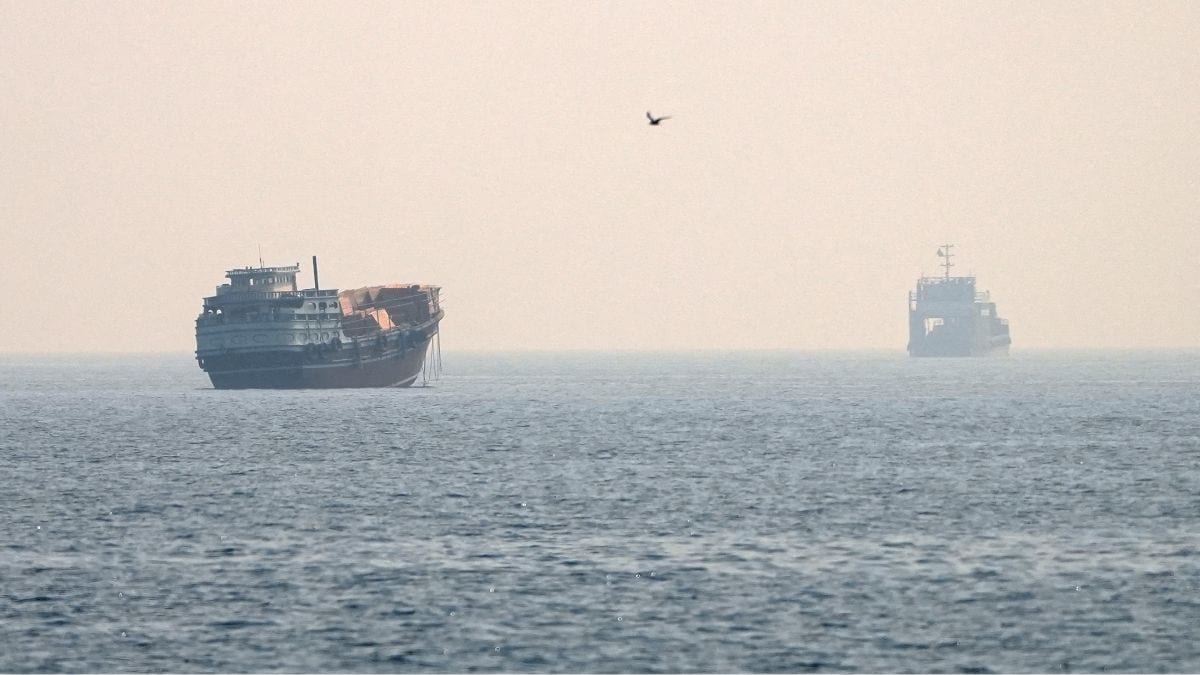
With fighting flaring in Yemen between Saudi-backed forces and the Ansar Allah — the Houthis — the world’s attention has snapped to the Bab el-Mandeb, the 29-km-wide gateway between the Arabian Sea and the Red Sea that leads to the Suez Canal.
It is the world’s third busiest strait after Malacca and Hormuz, and for India, it became the Plan B when Plan A collapsed. After US-Iran hostilities choked the Strait of Hormuz, it was through Bab el-Mandeb and Saudi Arabia’s Red Sea port of Yanbu — via the East-West pipeline — that Saudi crude kept reaching Indian refineries.
That alternative is now flickering.
Intelligence assessments accessed by Indian agencies last week flag a sharp Houthi advance along Yemen’s Red Sea coast, including the capture of the port of Mokha and moves towards Perim Island. Crossings through Bab el-Mandeb fell from 30 to 15 ships in a single day in September. For India, the timing could not be worse.
Why it hurts India twice
India lives by these two straits. According to ICRA and the National Maritime Foundation, about 35 per cent of India’s total foreign trade — roughly $450 billion worth of exports and imports — transits the Suez-Red Sea corridor. More than 80 per cent of merchandise trade with Europe moves through it.
Hormuz is the energy tap. Before the current conflict, 40-45 per cent of India’s crude, about 50 per cent of its LNG and 90 per cent of its LPG came through it.
The two chokepoints hurt differently. A Hormuz closure cuts supply. A Bab el-Mandeb closure inflates cost.
If ships are forced around the Cape of Good Hope, it adds 6,500 km and 14 days to every voyage from India to Europe. Freight and war-risk insurance have already jumped three to five times during the Houthi campaign since late 2023, when Suez traffic fell from 26,000 ships to 12,700. CareEdge Ratings estimates a simultaneous, multi-week closure of both straits could push Brent to $130-135 a barrel, adding $3-5 billion a month to India’s crude import bill alone.
The pain will be visible in Indian kitchens and factory floors within weeks. Exports that will take the first hit: textiles, basmati rice, tea, marine products and pharmaceuticals — all high-volume, low-margin goods where a $1,000 hike in container freight wipes out profit.
The human cost is already here. The ministry of external affairs confirmed last month that a Panama-flagged vessel attacked off Oman had 14 Indian nationals on board; 13 were rescued, and one remains missing.
Mecca Pact adds a new layer
While India grapples with the commercial fallout, the strategic map has shifted.
On October 5, Saudi Arabia, Turkiye and Pakistan activated the Mecca Joint Defence Agreement — signed on August 7 in Mecca as an extension of the Saudi-Pakistan Strategic Mutual Defence Agreement of September 2025. Its core promise is NATO-like: an armed attack on one is an attack on all.
After Houthi attacks targeting Saudi cities and holy sites in Makkah and Madinah, the pact’s Strategic Political and Defence Committee, chaired by Saudi Defence Minister Prince Khalid bin Salman, agreed to “activate collective deterrence measures” and to “provide military forces and capabilities for rapid deployment in the Kingdom.”
If Houthi attacks persist, Pakistani and Turkish forces could deploy to Saudi Arabia — bringing a Turkiye-Pakistan military footprint to the mouth of the Red Sea, perilously close to India’s western seaboard and its energy routes. It also gives Pakistan, for the first time, a formal security guarantee backed by Saudi money and Turkish technology — including the very nuclear umbrella that Pakistani Defence Minister Khawaja Asif alluded to.
IMEC in limbo
The dual chokepoint threat and the Mecca Pact together put a question mark over the India-Middle East-Europe Economic Corridor (IMEC). Envisaged to run from India to the UAE, Saudi Arabia, Jordan and Israel onwards to Europe, IMEC depends precisely on the stability of the Arabian Peninsula and the Red Sea that is now unraveling.
The possibility of escalation in the conflict at the mouth of the Red Sea will make the ground much more fertile for the region’s civil wars to be in further turmoil—across Ethiopia, Somalia, Sudan and South Sudan.
For India, this is no longer a distant West Asian war. It is a two-front squeeze — economic today, strategic tomorrow.
