



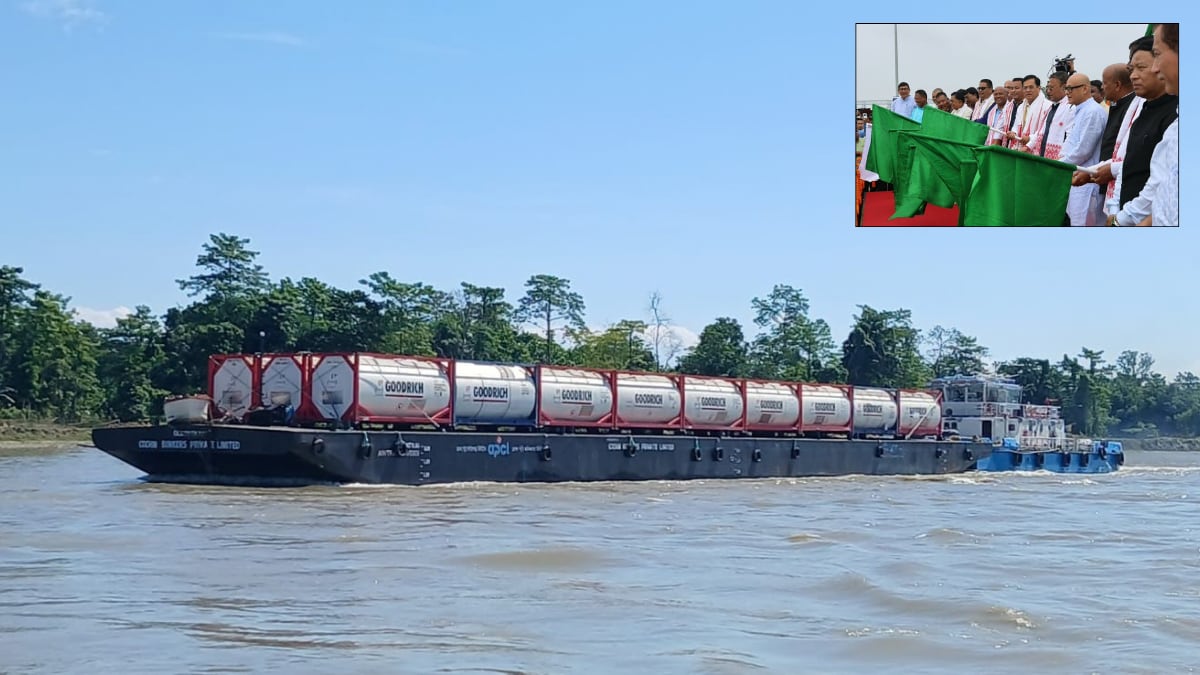
The barge DLB Patkai on Monday set sail for the Pangaon Port in Bangladesh after departing from Assam's revamped Bogibeel Inland Water Transport (IWT) Terminal.
This vessel carries not just 540 metric tonnes (MT) of industrial methanol from Assam Petro-Chemicals Ltd. (APCL) at Namrup, but also a piece of independent India's maritime and trade legacy.
Touted as the first inland cargo transport from upper Assam to a foreign port since 1947, the DLB Patkai will travel about 768km down National Waterway-2 (NW-2) on the Brahmaputra River in India to the Indo-Bangladesh border, after which it will continue along the Indo-Bangladesh Protocol Route (IBPR) for the remainder of the 1,300km-long journey.
This marks the revival of a historic riverine trade corridor that once connected Upper Assam with markets beyond the region, with more methanol shipments to Bangladesh planned for the future.
The Monday voyage serves as a test for the Inland Waterways Authority of India (IWAI) and the Ministry of Ports, Shipping and Waterways (MoPSW) of whether the the Brahmaputra can serve as a commercially viable freight corridor linking the Northeast to overseas markets.
Built in 2023, the Bogibeel terminal is equipped to accommodate vessels of up to 1,000MT, which translates to an annual cargo throughput of about 6 lakh MT.
It supports multimodal transit for crude oil and petroleum reserves from Dibrugarh, as well as tea, coal, stone aggregates and cement shipments, and is also vital for the transit of heavy Over-Dimensional Cargo (ODC), which facilitates the ongoing capacity expansion of the the Numaligarh Refinery.
Even then, it was after the Bogibeel IWT terminal was revamped that it became fully ready for the milestone methanol export by the DLB Patkai.
The changes include a new customs and immigration complex and fixed-schedule cargo services under the Jalvahak Scheme, a 2024 programme that aims to incentivise the movement of cargo via India's inland waterways.
In general, more than 6,800 crore is being invested in waterways across the Northeast. This includes investments in the development of NW-2, a ship repair facility at Pandu, and boosting last-mile connectivity to the Pandu Port.
These efforts have contributed to cargo handling on India's national waterways rising from 18 million metric tonnes in FY 2013-14 to 218 million metric tonnes in FY 2025-26.
"Today, as cargo leaves Dibrugarh for a foreign port once again, the town's proud past and its promising future meet on the same river,” said Union Minister (MoPSW) Sarbananda Sonowal, who is himself from Dibrugarh, at the flag-off event.
