



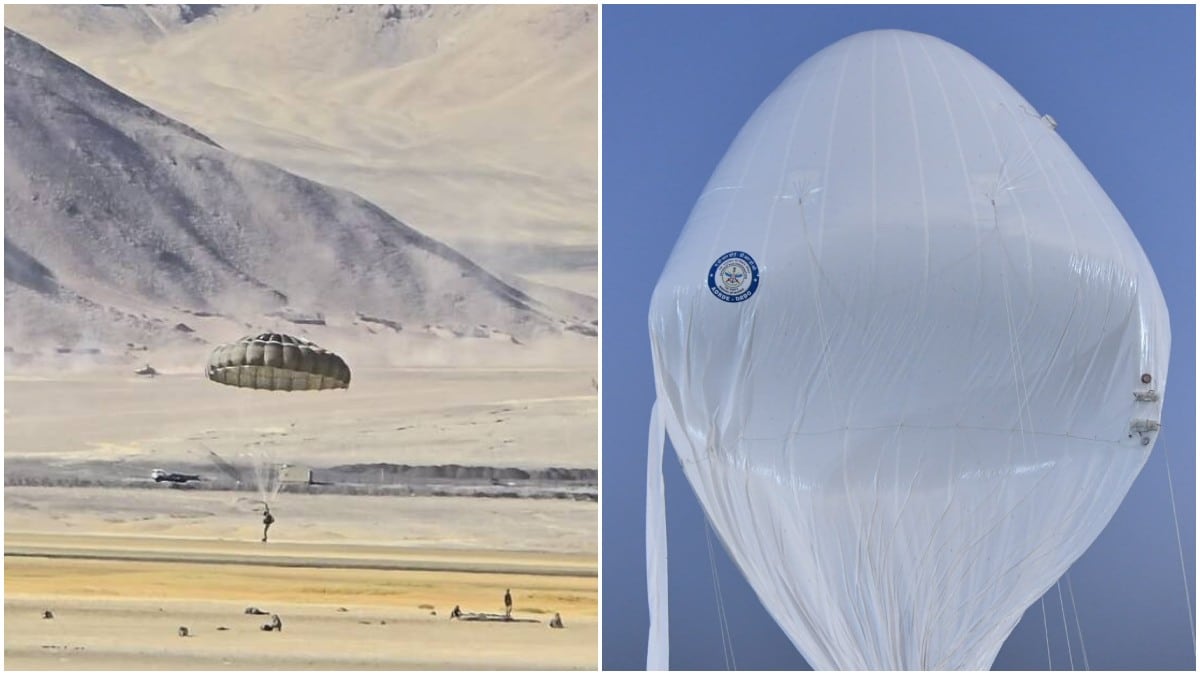
The Defence Research and Development Organisation (DRDO) has recorded two advances in high-altitude technologies, successfully flying an indigenous surveillance platform at 21 km above mean sea level and conducting the maiden live jump of a new parachute system at Nyoma in Ladakh.
Both systems have been designed and developed by the Aerial Delivery Research and Development Establishment (ADRDE), Agra. While the High-Altitude Platform (HAPS) is being developed as a long-endurance stratospheric aerial surveillance platform, the Advanced High-Altitude Parachute (AHAP) is intended for mass deployment of paratroopers in high-altitude terrain.
HAPS reaches 21 km altitude
During its experimental flight, the indigenously developed HAPS reached an altitude of 21 km above mean sea level (AMSL), according to a defence ministry release. It remained at 20 km AMSL for more than 30 minutes before being commanded to descend.
The system was successfully recovered, following which its flight performance data was analysed.
Real-time video and other vehicle parameters were received at the Ground Control Station throughout the flight. According to DRDO, the data showed that the platform delivered the intended flight performance.
The system carried several instrumentation and control electronic packages, including an inertial measurement unit, GPS receiver, onboard cameras and an altitude control mechanism.
HAPS is a lighter-than-air system designed to serve as a long-endurance aerial surveillance platform in the stratosphere.
The DRDO, the Indian Air Force, CEMILAC, DGCA, Airports Authority of India and other civil authorities were involved in the trials.
New parachute tested at Nyoma
In another development, DRDO conducted the maiden live jump of the Advanced High-Altitude Parachute at Nyoma's Mudh drop zone, one of the highest-altitude drop zones.
The jump was carried out from 16,000 feet AMSL. The parachute was deployed at 15,500 feet before the paratrooper landed at Nyoma, situated at an altitude of 13,700 feet.
According to DRDO, the jump demonstrated the efficacy and tactical employability of AHAP in extremely high-altitude terrain.
AHAP is a static-line parachute system designed for the mass drop of paratroopers. It offers multiple deployment modes and can operate at altitudes of up to 18,000 feet.
The system has also been designed to provide a safe rate of descent suited to the tactical requirements of Indian defence forces operating in high-altitude terrain, according to a defence ministry statement.
Static-line parachute jumps at such altitudes are particularly complex and inherently risky because of high opening shock and descent rates.
AHAP has been manufactured by Ordnance Parachute Factory, Kanpur, inspected by DGAQA and certified by CEMILAC, RCMA Kanpur.
