



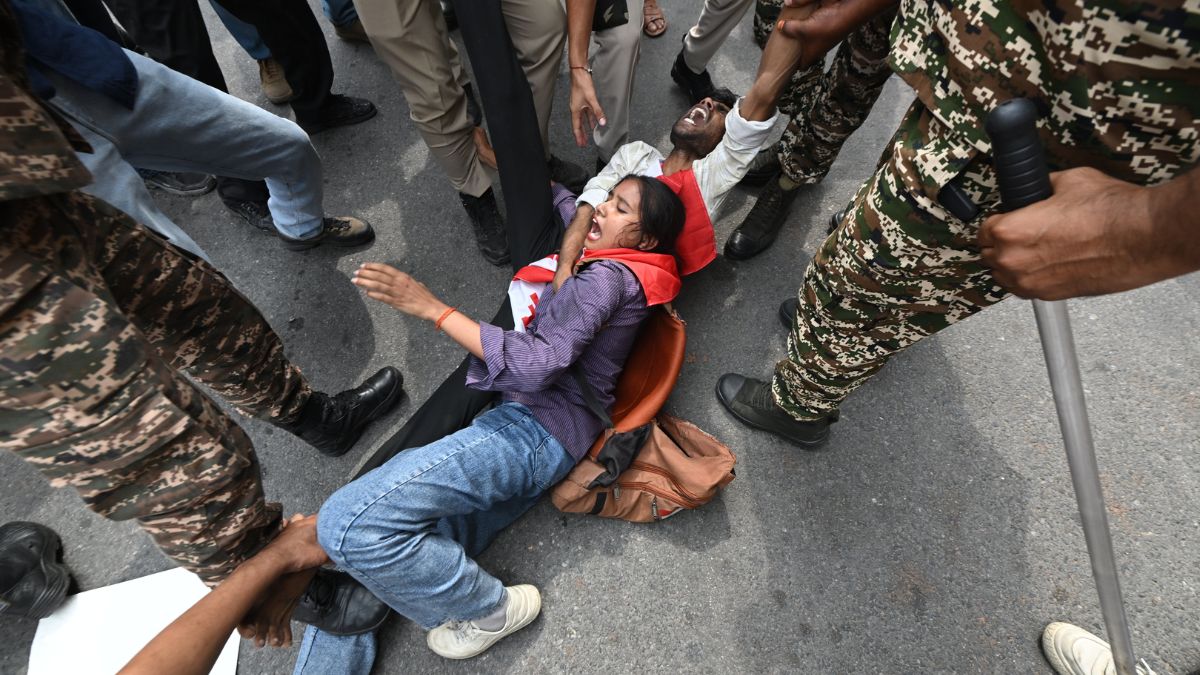
The Supreme Court on Monday agreed to hear pleas on Tuesday seeking action over the alleged assault and detention of lawyers during protests in Delhi against Chief Election Commissioner (CEC) Gyanesh Kumar, with Chief Justice of India (CJI) Surya Kant asserting that while peaceful democratic activities must be allowed, the functioning of the court cannot be obstructed or drawn into political activity.
“You must also see that all democratic activities take place smoothly. There is no difficulty with that. But at least the functioning of the Supreme Court must not be affected,” the CJI told lawyers who mentioned the matter before a bench comprising Justices Joymalya Bagchi and V. Mohana.
“We are not on any political party. The institution is performing institutional duties,” he said, adding that protesters, irrespective of their political affiliations, should ensure that the court is not dragged into political activity. There should be no incitement or obstruction affecting the movement of lawyers, court staff and litigants, he said.
The bench agreed to hear a petition filed by the Supreme Court Bar Association (SCBA), represented by senior advocate Pradeep Rai, along with a similar plea filed by another lawyer.
The developments come amid mounting concerns over police action against demonstrators protesting against the CEC and alleging irregularities in electoral processes.
Leader of the Opposition Rahul Gandhi said the Opposition would file a petition in the Supreme Court against CEC Gyanesh Kumar. He made the announcement during a press conference amid the Opposition’s allegations against the Election Commission.
The SCBA's petition states that lawyers walking near the Supreme Court on October 10 were allegedly manhandled and forcibly detained by police personnel as part of the crackdown on protesters. They were reportedly taken several kilometres away before being released following a representation to the CJI.
The Bar body has described the incident as a matter of grave concern, arguing that those entrusted with protecting the law cannot be permitted to act in violation of it.
It has sought a status report from the authorities detailing the police action, the detentions carried out and the identities of the officers involved. The petition also seeks details of prohibitory orders imposed under Section 163 of the Bharatiya Nagarik Suraksha Sanhita, including the reasons for their issuance and the restrictions imposed on access to courts.
Among its other demands are the preservation of CCTV footage, detention records and any available body-camera recordings, besides directions to ensure uninterrupted internet services and reasonable access to courts for lawyers and citizens.
Separately, senior advocate Gopal Sankaranarayanan alleged that the police continued to disregard the Supreme Court's directions on handling peaceful protesters.
Referring to senior advocate Shadan Farasat allegedly being dragged along the streets, Sankaranarayanan said the incident was unacceptable and urged the Bench to send a clear message to the police to exercise restraint.
He also alleged that two other senior advocates, Dwivedi and Uttara Babbar, had been detained in buses. Raising concerns about selective enforcement, he claimed that individuals carrying sticks and lathis were being allowed to operate while peaceful demonstrators faced police action.
The court had, in an order passed on Sunday, cautioned authorities against disrupting internet services in Delhi or obstructing journalists, lawyers and other professionals.
The CJI reiterated that lawyers had the right to participate in peaceful protests at designated locations.
“Every lawyer, every member of the Bar, has the right to be part of peaceful activities, wherever the identified locations are,” he said.
The developments coincide with a separate controversy over the CJI's decision to decline a meeting requested by Congress president Mallikarjun Kharge and Leader of Opposition in the Lok Sabha Rahul Gandhi.
The Opposition leaders had sought an appointment to submit a memorandum raising concerns about alleged electoral irregularities, demanding Kumar's resignation, a halt to the Special Intensive Revision (SIR) of electoral rolls and a return to paper ballots.
The CJI declined the request, citing judicial propriety and the pendency of related matters before the Supreme Court in its judicial capacity. The concerns raised by the Opposition, including issues relating to electoral processes and police action, would have to be pursued through appropriate legal channels rather than a separate meeting with the head of the judiciary.
The refusal, however, does not mean the court has closed its doors to legal challenges. The CJI has maintained that the Supreme Court remains committed to protecting fundamental rights.
