



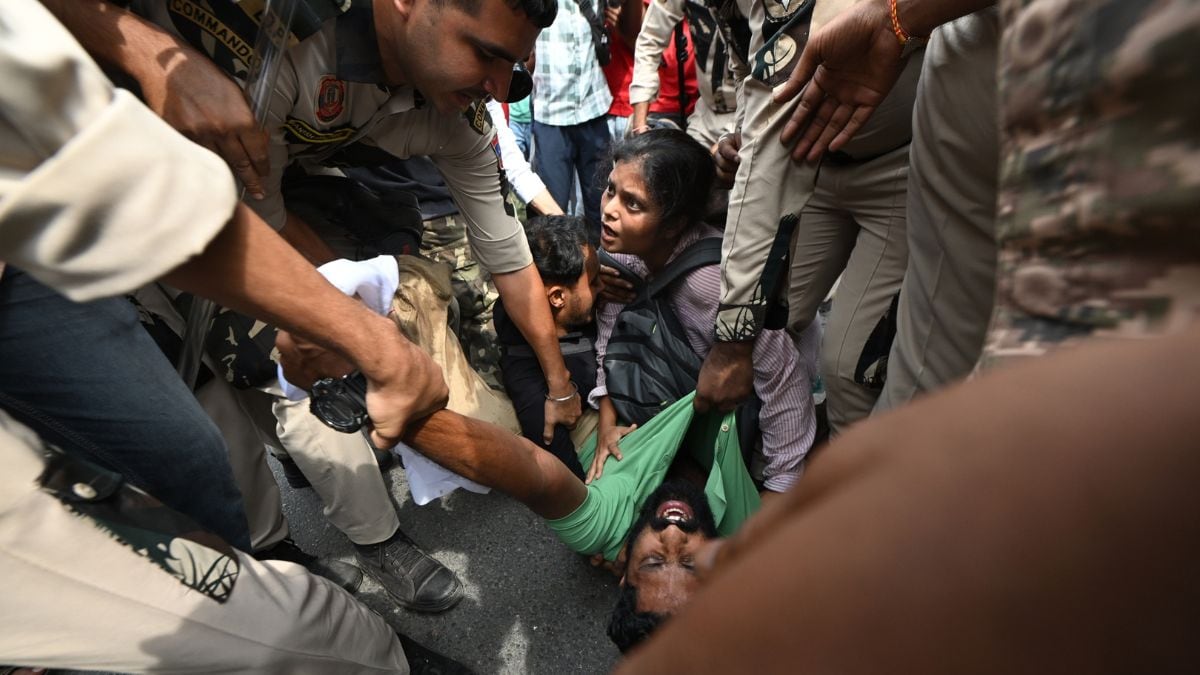
For the second day running, a four-kilometre radius in the heart of the national capital—the very seat of India’s governance—resembled a war zone. There was no declared curfew. But it felt like one.
Rows of barricaded roads, parked police buses, anti-riot vehicles, and hordes of uniformed men. On one side, Cockroach Janta Party (CJP) activists, Left student groups and Congress workers. On the other, a police force under orders not to let anyone reach Jantar Mantar.
Jantar Mantar itself, the designated nerve centre of the protest, was sealed. Every entry and exit was blockaded. So the protesters did what modern, leaderless movements do best—they decentralised.
Reports of face-offs trickled in from everywhere and nowhere—Raisina Road, R K Ashram, Connaught Place, Patel Chowk, Barakhamba. If you could not reach Jantar Mantar, you made Jantar Mantar where you stood.
That was Ajinkya Shinde’s line after founder Abhijeet Dipke and co-convenors Saurav Das and Ashutosh Ranka were lifted from inside an aircraft at IGI airport on October 10: “Wherever police stop you, turn that spot into Jantar Mantar.”
The Delhi Police had prepared for one Jantar Mantar. It got a dozen.
On paper, it is simple streetcraft. In concept, it is close to what military strategists call the ‘mosaic defence’—a doctrine Iran refined for a decapitation strike scenario.
The idea: When top leadership is eliminated and communications are cut, survival depends on small, self-contained units—remnants of the IRGC, the Basij, regular army formations—each with its own command and control, but united by ideology. No single head to cut off. No central node to bomb.
The CJP is attempting a civilian version.
With its top leadership under priority surveillance, effective communication to the CJP followers are an issue. Yet the protest continued. Not because instructions came from the top, but because ideology did.
Each group of 15-20 became a mosaic tile—independent, disposable, but part of a larger picture. That picture, amplified by creator ecosystems, live feeds and social media, is harder to censor than one stage with one mic.
The tactic is effective for two reasons. First, it stretches the state. A police force already running 15 detention centres, checking buses at every possible entry point to Delhi and inside Delhi, cannot be everywhere. Second, it inverts the cost. The disruption is no longer caused by protesters reaching the centre; it is caused by the state trying to stop them from reaching it.
Sunday, October 11, was still the easier day. A Sunday, the city half-asleep, is forgiving of barricades. The real test is Monday, October 12.
The INDIA bloc—Congress and its allies—have announced a march in Delhi. Monday is a working day. Two crore people will step out for offices, schools, hospitals, airports. In a sea of office-goers, how does one identify a protester? How to tell a college student with a backpack from a college student with a placard?
That logistical nightmare is precisely what a mosaic strategy banks on.
One would expect October 12 to be fought not in one rally but in dozens of flashpoints. Small groups will assemble, disperse, reassemble a lane away. Venue changes will be announced on the fly, keeping an already fatigued force on its toes, forcing it to thin out. Each such speck, magnified by media platforms, becomes a template for other state capitals.
It is a model built for replication.
But every mosaic has a flaw. Decentralisation means loss of control. Absolute command over small groups is impossible. One stone thrown near Akashvani Bhawan—as reported on October 10 when two policemen were injured—one scuffle with a commuter, one video of journalists being beaten and taken to detention centres, and the narrative flips from “vote theft” to “law and order".
And that is what the security establishment is waiting for. The Home Secretary’s letter to all states on October 9 already framed the CJP mobilisation as a “grave law & order and public order” threat. A single breakdown gives legal cover for graver measures and a total clampdown.
For now, Delhi is balanced on that razor's edge between enforcing order and retaining legitimacy. And on a razor's edge, even a small tilt is enough.
