



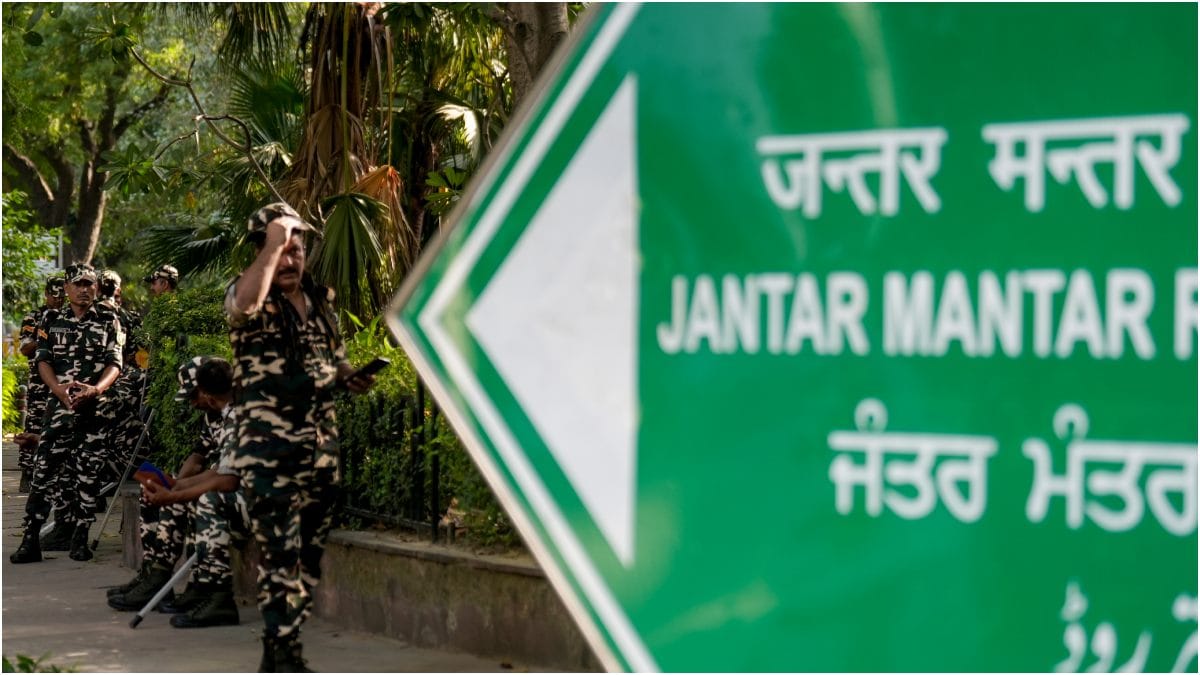
A day before a planned protest in the national capital over the Election Commission of India’s functioning and alleged irregularities in the Special Intensive Revision (SIR) of electoral rolls, N Balaji, a close associate of activist Neha Bora, has accused the government of using an overwhelming security deployment and restrictions to prevent young people from demanding accountability.
Drawing parallels with the Quit India Movement of 1942, Balaji said the planned mobilisation represented a generational struggle to defend democracy and the right to vote. He alleged that the deployment of around 40,000 security personnel within a 10-kilometre radius, along with restrictions on public movement, reflected an attempt to suppress dissent.
“The generation that is fighting to liberate democracy from the hands of fascists is going to feel it first-hand,” Balaji told THE WEEK, adding that he had not witnessed such a scale of government mobilisation in response to a protest demanding accountability from the poll body.
The protesters, he said, were demanding accountability from the Election Commission, action over what they describe as flaws in the SIR exercise, the resignation of Chief Election Commissioner Gyanesh Kumar and the repeal of the 2023 law governing the appointment of election commissioners.
Balaji also alleged that restrictions imposed ahead of the protest, including orders under Section 163 of the Bharatiya Nagarik Suraksha Sanhita (BNSS), internet curbs, the closure of metro stations and restrictions affecting train services, were reminiscent of colonial-era measures to curb public mobilisation.
“Unfortunately, we are not subjects; we are citizens,” he said. “What young people are demanding and fighting for is the future of our democracy.”
Balaji said the Supreme Court had asked the authorities to explore an alternative venue, but maintained that Jantar Mantar remained central to the protesters’ plans.
He argued that the choice of venue was about more than a physical location. Jantar Mantar, he said, had become a symbol of public accountability, allowing citizens to raise issues without demonstrating outside Parliament, the Prime Minister’s Office or the Home Ministry.
“By denying Jantar Mantar, they have made the streets of Delhi Jantar Mantar,” Balaji said. “Every voter whose vote has been deleted, every household that has seen deletions, has turned into Jantar Mantar.”
He added that shifting the protest to another designated site would not diminish the movement. “Jantar Mantar is a spirit. You can take away Jantar Mantar. You can give an alternative site. But that alternative site will become Jantar Mantar.”
Balaji said Neha Bora, along with other students and members of the Generation Democracy initiative, would participate in the planned demonstration. He maintained that the protesters were prepared for possible arrests or detentions and would continue to raise concerns over electoral integrity.
Asked about preparations to prevent clashes with the police, Balaji said maintaining peace was the responsibility of the security forces. Referring to what he described as violence during an earlier protest on July 20, he alleged that police personnel had instigated confrontations and cited the alleged use of pellet guns, individuals carrying sticks with iron nails and plainclothes personnel. The allegations could not be independently verified.
Balaji said the scale of the security deployment risked escalating tensions rather than reassuring the public. He also accused the Union government and the Delhi Police of signalling that they were prepared to use force to prevent mobilisation.
Despite the possibility of detentions, he predicted that the protest would draw continued public support, particularly from young people concerned about the integrity of electoral processes.
“Student leaders, student activists and members of civil society might be detained,” he said. “But one thing is very clear: the people of this country are going to come onto the streets and protect their democracy and their right to vote.”
