



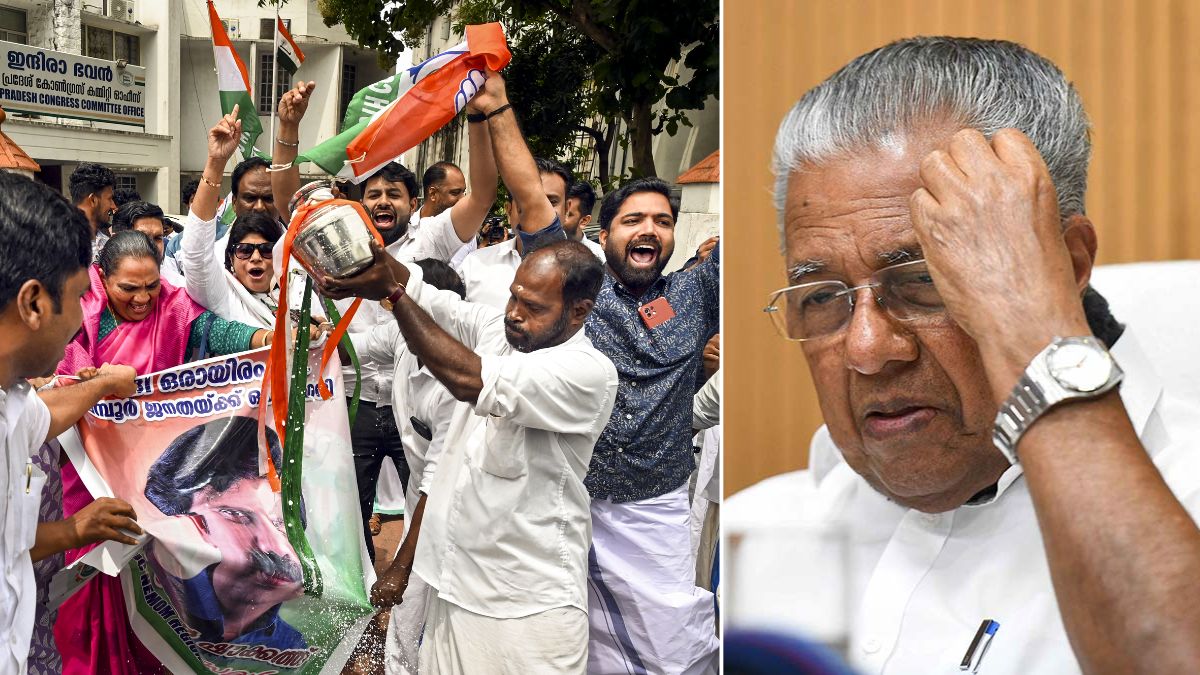
The loss in the Nilambur by-election has delivered a significant blow to the Pinarayi Vijayan-led Left Democratic Front (LDF), particularly given the stature of LDF candidate M. Swaraj, a CPI(M) state secretariat member. With the LDF government nearing the end of its second consecutive term, the bypoll was widely seen as a referendum on CM Vijayan’s nine-year rule.
The Congress-led United Democratic Front (UDF) has already positioned the election result as a verdict against “Pinarayism”—a term now commonly used by political opponents to critique Vijayan’s style of governance. UDF candidate Aryadan Shoukath won by a margin of 11,077 votes, a result the opposition is projecting as a clear sign of growing public dissatisfaction with the government ahead of the 2026 assembly elections.
The by-election was triggered by the resignation of P.V. Anvar, the LDF-backed independent MLA who had a public fallout with Vijayan. Contesting again as an independent, Anvar secured nearly 20,000 votes—many of which, he claimed, came from the LDF’s core voter base. Anvar, in his post-poll remarks, claimed that the votes he garnered were themselves a rejection of “Pinarayism”. Notably, the CPIM had conducted an intensive campaign, with Vijayan personally camping and campaigning for Swaraj.
However, the verdict was against the LDF, and the defeat also breaks the LDF’s claim that it has not lost any sitting seats in by-elections of late. Unlike past bypoll losses, which the party attributed to sympathy waves for deceased Congress leaders or poor candidate selection, Nilambur offers no such excuse. Swaraj could not lead even in his own polling booth and even in most of the traditional CPI(M) strongholds.
In the wake of this loss, the CPI(M) and LDF are likely to adopt a multi-pronged strategy to reframe the defeat. One of the key narratives expected is the alleged alliance between the UDF and the Jamaat-e-Islami-backed Welfare Party of India (WPI). The CPI(M) may argue that the UDF’s victory was powered by communal vote-bank politics, not a genuine swing in public sentiment. The Left leaders are likely to highlight the WPI’s grassroots mobilisation efforts in Muslim-majority areas and accuse the UDF of compromising its secular credentials to win the seat.
The party is also expected to dismiss the loss as a result of local dynamics rather than a reflection of widespread anti-incumbency. Pointing to Nilambur’s history of closely fought contests, CPI(M) leaders may argue that bypolls are not always reliable indicators of future assembly outcomes.
To counter the UDF’s “anti-Pinarayism” campaign, the CPI(M) will likely double down on the LDF government’s accomplishments in welfare delivery, infrastructure development, and crises responses.
Internally, however, the party will be forced to confront uncomfortable questions. A possible flashpoint is the controversy sparked by CPI(M) state secretary M.V. Govindan’s remarks on the party’s past interactions with the RSS and Jan Sangh during the Emergency. Though Govindan has since downplayed the significance of his comments, their timing—just ahead of the bypoll—had raised concerns within party ranks.
As internal reviews begin, there is a possibility that the party may pin the blame for the loss on Govindan’s remarks, rather than attribute it to broader anti-incumbency against the government. If criticism from the grassroots and within the party escalates, Govindan could even become a convenient scapegoat—his comments offered up as a distraction that cost the party a crucial election.
