



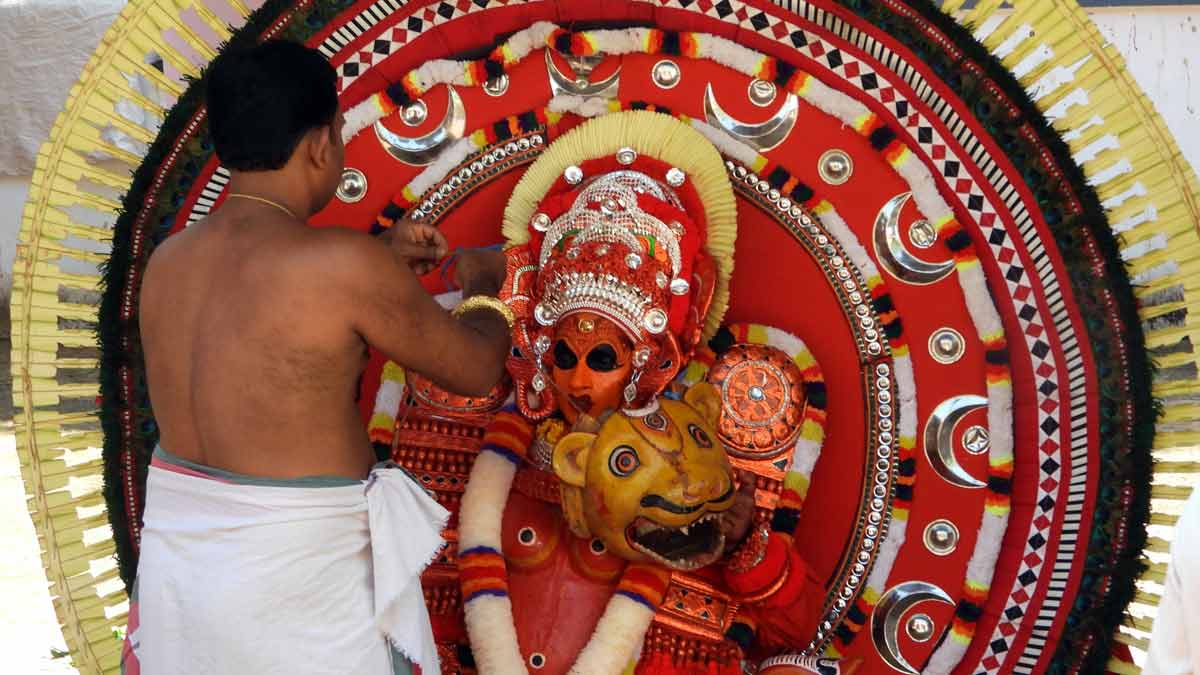
Watching a real theyyam performance had been on my bucket list for a while, and a recent trip to Bekal helped me tick it off.
Flying into Mangalore, the landscape is an ode to nature. Expansive lush green landscapes that hug the ocean make for a picture-perfect start to the trip. I am headed to Bekal, and the first thing I notice at the property, Gateway Bekal, is signage that reads, ‘Experience Theyyam, The Dancing Gods of Kerala’. I excitedly sign up for the same and find out it is conducted by an experience provider, Polika, who conducts ‘Theyyam Trails’.

I am told that the exact schedule of the performance is usually known the evening before, and sure enough, I get a slot at 11:00am. Heading out to the 700-year-old Sri Vishnumurthy Devasthanam in Madikai Kakkat, Puthiyavittil, takes me on a drive that is over an hour. When I arrive, I notice there is a flurry of activity around the small temple.
Sangeeth, my guide and storyteller, explains that this is because the local villagers have gathered to ensure they celebrate the performance with meals – breakfast was underway, and lunch was being made too. Interestingly, the older women were busy at a large mortar and pestle beating roasted rice to help them pop. This, I am told, is the offering to the Theyyam.
The temple, with a small spire, has two small idols of Raktha Chamundi and Vishnumurthy, indicating the kind of theyyam performances that happen here. Interestingly, the day I was here, I saw the Raktha Chamundi performance (more on that later.) Apart from the set of main idols, there is also one dedicated to the Guru – the person who started this temple. A sacred grove that adjoins the temple is home to a smaller shrine where the weapons are worshipped. I walked through the grove and saw this small shrine that has been recently renovated.
As I make my way back to the main temple, the unmistakable drumming of the chenda, a cylindrical percussion instrument, signals that the theyyam is about to begin. I look for a vantage spot to view the proceedings. The instructions are simple. Stand up when the theyyam approaches you, and do not take pictures at that time.
My first glimpse of the artiste is arresting – a bright orange painted face with ornate headgear and large anklets. The priests then attach the mudi (headgear), wooden breastplate (as this is the Raktha Chamundi), and waist gear. As the drum beats intensify, the theyyam starts moving around the temple, circumambulating the structure. The theyyam keeps moving, and the expressions on the face sometimes change. The dance form is all about blurring the lines between man and God, and it is believed that the man becomes God as he continues his dance.
At one point, the theyyam also holds a mask that resembles the head of a boar. “A common belief is that, especially during processions, the deity's energy level is at its peak. It is believed that one should not look directly at it at that time, which is why the procession is conducted with the face covered with a mask,” explains Sangeeth.
The theyyam hands over grains of rice as blessings to the people around even as he approaches the crowd that dutifully stand and bow to him. At the end of the performance, the theyyam also blesses the people who approach him with an offering. I too went and was touched by the kind words he had for me.
Incidentally, there are more than 400 documented forms of theyyam, and no two theyyams are alike.
The ritual shows how man becomes God but also signals how societal hierarchies of the past have changed. The communities from a lower caste are only allowed to perform theyyam and are worshipped by all others. What makes the performance real is also the audience – I saw all age groups and children, in particular, keenly watching the ritualistic dance. As I left the temple to head back to the resort, I was served the sadhya, the traditional vegetarian meal, and I couldn’t help but think how perfect the day had been.
