


There was a time when doomscrolling wasn’t a thing. Situationships, breadcrumbing, ghosting—words uncommon even today—had not yet been invented. Love revealed itself through effort. It was measured in patience, in waiting, in words that crossed oceans. Emotions were spilled, sealed and sent.
Letters carried emotions people could never say aloud. They carried hearts willing to wait weeks for a reply. Life was simple, and simply beautiful.

Fragments of that world still survive in some corners. One such corner hides in the bustle of Delhi—a workshop at Nehru Place that smells faintly of dust, oil and memory.
Famous for computers and electronics, Nehru Place is where you go if you need anything that has wires, chips or screens. But among the glow of monitors and the blinking of hardware is a shop proudly generations behind—Rajesh’s typewriters.

An occasional click-clack… ting echoes through the shop. Rajesh Palta guides me into a dim storage room, where the guarded silence feels as if it were protecting secrets from another age. Shafts of light fall through high windows, turning drifting dust into a quiet ballet of gold. The room is crowded with typewriters. As I stand in awe, Rajesh walks straight to a forgotten shape in the corner, draped in a brown cloth. He brushes his fingers across it, and pulls the cloth away. Dust rises—an exhale after decades. When it settles, the curves of a Remington shimmers faintly.
The room feels alive. The machine seems to stretch its iron bones. The carriage sags, the keys resist, the brittle ribbon feels heavy with words it once carried. “Ah,” Rajesh sighs, as he runs a hand along its frame, “this feeling… this is what it’s all about.”

Typewriters have always been part of his life. Rajesh’s grandfather sold Remingtons in Lahore under Universal Typewriter Co. “I’ve been seeing typewriters since pre-school,” he says. “It’s safe to say we have been breathing typewriters.”
After the partition, his father started the business in Bombay from scratch. The machine became more than livelihood for the Palta family—it became their identity.
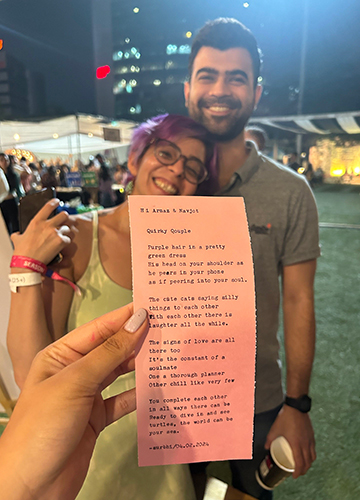 A poem Surbhi Dhoot wrote | Courtesy Surbhi
“Back in the day, Godrej used to make both refrigerators and typewriters,” Rajesh says, laughing softly. “Their technicians used to say, ‘Our giant refrigerators have 270 parts.’ But this tiny typewriter has more than 2,000. That’s how intricate these machines are… and so are the men who repair them.”
He gestures towards his senior technician, bent over a tangled metal skeleton. The man has worked here for 40 years. “That’s the dedication these machines demand,” Rajesh says.
When computers came in the 1990s, Rajesh’s family thought it was the end. “But somehow, we survived,” he says.
Manufacturers across the world gradually stopped making typewriters. Ironically, that was when his fascination deepened. “In the west, typewriters were found not just in offices; people bought them for personal use. Even the US president had one in his room. That culture is finding its way here, too,” Rajesh says.
Today, most of his customers are young—collectors, writers, romantics drawn to the wistful click-clack of keys. “Some come in to restore family typewriters,” he smiles. “Those are my favourites.”
Outside Delhi’s courts, the last manual typists still sit their ground. Once there were over 500. Now fewer than 15 remain. Among them, Balram and Vijay Pal Singh—work neighbours for more than 30 years—still hammer out rent agreements and affidavits on their Remingtons.
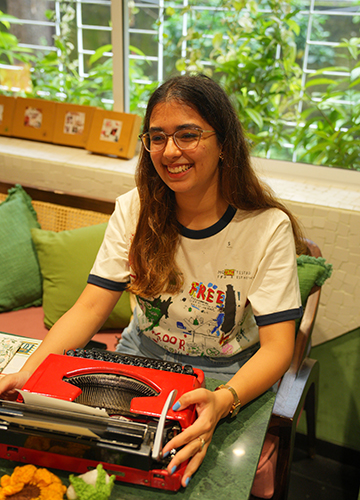 Red-hot verse: Poet Surbhi Dhoot attends small gatherings in Mumbai with her red Brother Deluxe 220, typing out poems for strangers on the spot | Courtesy Surbhi
Back in his workshop, Rajesh dusts his hands and leans against a shelf.
“Typewriters are the means of survival for a few people,” he says. “But for me, it’s a heartbeat.”
Rajesh hosts workshops and exhibitions, and curates visits to his private museum—a 4,000sqft rooftop overlooking the Lotus Temple. More than 500 typewriters rest here—a wartime German Mercedes, an Urdu typewriter that writes backward, Hindi and Tamil machines, even the world’s largest typewriter. “This room is the summary of my life,” he says.
Somehow, the heartbeat travels beyond his workshop—through people like Vipul and Surbhi.
In Delhi, Vipul Choudhary sits on a wide veranda, hammock swaying gently. On his lap rests an old Brothers typewriter, a handmade sheet resting on its platen.
Each keystroke lands with weight—a pause, a breath, a heartbeat that time once silenced.
In Mumbai, poet Surbhi Dhoot attends small gatherings with her red Brother Deluxe 220, writing poems for strangers on the spot.
“I stumbled onto typewriter poetry,” she says. “It never starts with the poem; it starts with the conversation. Someone sits, we talk, and in those minutes, something real emerges.”
She types:
The garden slows me down,
maybe that’s why the typewriter belongs here.
Each letter lands with weight,
a heartbeat I almost forgot.
The typewriter, like me,
isn’t chasing perfection—just presence.
An effort to save how it felt;
this sun, this wind, this moment that won’t return.
Her fingers glide across keys; ink fixes fleeting conversations.
“In a time of AI and vanishing attention spans,” Surbhi says, “these poems become small anchors; little moments that stay.”