


On a charged evening in Basabo, home to Dhaka’s first Buddhist monastery, a candidate stood before a swelling crowd and fought back tears just days before Bangladesh went to polls. Habibur Rashid Habib of the Bangladesh Nationalist Party—his salt-and-pepper beard and sharp features lending him an air older than his fifty-odd years—recalled his arrest in 2014. He spoke of days of interrogation and torture. Yet, rather than vow vengeance against his political opponents, he called for the restoration of democratic rights, political unity and the secular spirit of the nation. “I came home injured,” he told the crowd, his voice wavering as he described the arrest. “The first call I received was from bhaiya (Tarique Rahman). At that moment, my pain vanished. I knew he was with me.”
Rahman, who spent 17 years in exile, commands intense loyalty among the BNP’s rank and file. That sentiment is echoed by people like Rabiul Islam Nayan, a Jubo Dal (the BNP’s youth wing) leader who recently broke down during a podcast while describing Rahman’s leadership. “It is hard to put into words,” Nayan said, “how he managed to look after us and our families from far away.”
Today, the mood within the BNP after winning a two-thirds majority in the February 12 elections is to turn away from hostilities. It wants to focus on building roads, bridges, health centres, educational institutions and jobs, and on improving the day-to-day lives of people—outlined by Rahman as “The Plan”. In neighbourhoods such as Basabo, which has some of the worst roads in the country, chronic infrastructure deficits are a recurring complaint. Habib, who is now state minister for roads, transport and bridges in Rahman’s cabinet of 25 ministers and 24 state ministers, is expected to find a solution.
The BNP’s stated ambition to write a new growth story for a stable, sovereign and reform-oriented Bangladesh presents Delhi a moment of opportunity. India considers a stable Bangladesh firmly in its national interest.
India shares its longest land boundary with Bangladesh—longer than its border with China—underscoring both the scale and the sensitivity of the frontier. Historically, India and Bangladesh have shared close ties forged during Bangladesh’s liberation from Pakistan in 1971, laying the foundation for a relationship that has largely withstood political fluctuations over the decades. There have been ups and downs, but the broader relationship has endured.
The BNP was previously in power twice, from 1991 to 1996 and from 2001 to 2006, and Delhi worked with those administrations. Even when Sheikh Hasina and her Awami League were in office in the late 1990s, Indian diplomats cultivated ties with Rahman, reportedly much to Hasina’s displeasure. As one retired diplomat said, “After Hasina lost the election in 2001, she started blaming India for her loss.” Senior Awami League functionaries at the time suggested that, instead of introspection, blaming India became an easy way out.
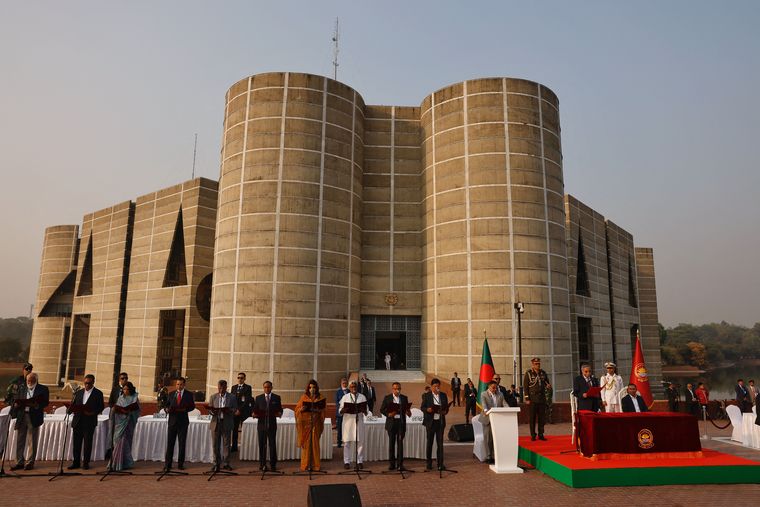 Fresh start: Bangladesh President Mohammed Shahabuddin administers oath of office to new cabinet members at the South Plaza of the parliament building in Dhaka | Reuters
By then, the rawness with which sections of the BNP had viewed India since the assassination of its founder, Ziaur Rahman, had faded considerably. Sustained engagement by Delhi and political recalibration within the BNP—whose chairperson Khaleda Zia was reassessing Dhaka’s regional compulsions after her 1996 defeat—contributed to this shift. It was during this phase that Rahman realised the practical necessity of stable ties with India.
Rahman, now 60, prepares to lead Bangladesh as a more seasoned figure capable of balancing domestic pressures, party expectations, constitutional constraints and the delicate equilibrium with India. For India, this presents an opportunity to recalibrate by moving beyond personality-driven engagements to prioritising people’s interests, aligned with the BNP’s “Bangladesh first” pitch, where Delhi and Dhaka can move forward together in foreign policy, security, trade and people-to-people engagement. “Democracy does not consolidate because rulers change. It stabilises only when institutions function and there is balance between authority, scrutiny, mandate and accountability,” said Rashed Al Mahmud Titumir, adviser to the prime minister.
Economic reconstruction
Bangladesh’s economy is widely acknowledged to be under significant strain. Public debt has risen over the past decade, and many of the loans taken over the past decade are long term commitments. Hasina pursued large-scale projects such as the Padma bridge despite the World Bank raising concerns about economic feasibility. When the World Bank withdrew financing, her government borrowed heavily from multiple sources. While the bridge is widely seen as a landmark achievement, the cost has left a strain on the economy.
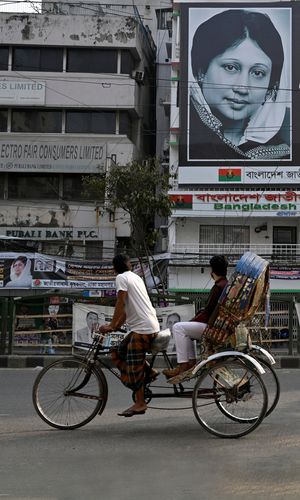 Abiding memory: A man rides his rickshaw past an office of the Bangladesh Nationalist Party displaying a picture of Begum Khaleda Zia in Dhaka a day after the elections | Reuters
China has already stepped in with fresh financial commitments and if India does not participate constructively in Bangladesh’s economic reconstruction, others will. “Bangladesh will naturally diversify its foreign policy options. It may engage Pakistan; it will engage China. There is no need for hyper reactions. An economy that has been financially drained and destabilised will seek help wherever it can,” said Jawhar Sircar, former Rajya Sabha member hailing from Kolkata. “That is pragmatic politics.”
Yet, pragmatic relations that fail to deliver tangible benefits to ordinary people can prove counterproductive. Both Delhi and Dhaka have lessons to draw from recent months. While deteriorating cross-border ties may not significantly affect India’s macroeconomy, it has had a direct impact on communities in West Bengal and along the border. For instance, medical access was disrupted after visa restrictions were tightened. For decades, Kolkata functioned as a medical hub for Bangladeshis. Entire hospital clusters, nursing homes, guest houses and small businesses grew around this demand. “The infrastructure was built keeping that demand in mind,” Sircar said. As diplomatic relations deteriorated, cross-border trade that sustained livelihoods also slowed.
There are both formal and informal trading points along the border. “People share deep cultural and familial links, which explains the existence of ‘border haats’ (temporary markets), which is an inter-governmental arrangement overseen by the Border Security Force and Border Guard Bangladesh in their respective areas,” said D.K. Pathak, former director general of the BSF. “People bring their goods and set up stalls inside. Poor villagers from the Indian side would bring their products and Bangladeshis would buy them and vice versa.”
The political impact of strained relations was visible in the elections. In several border districts, the Bangladesh Jamaat-e-Islami performed strongly. “Look at the electoral map. Almost all the seats the Jamaat has secured are in border districts. That tells us something about how bad relations filter down to the grassroots,” said Sircar. “We need to avoid projecting ourselves as a ‘big brother’, and only then the resentment will die down.”
Another reason India has a stake in Bangladesh’s growth story is the need for institutional stability that can drive regional investment, economic integration and restore democratic confidence in south Asia in a rapidly evolving global order.
Communication is key
After Hasina’s ouster in July 2024, much of the blame for her excesses was redirected at India. The reason was that the BNP, the Jamaat and the newly formed National Citizen Party found themselves bracketed with the interim government amid a growing anti-Hasina sentiment that often translated into an anti-India posture. In Delhi, foreign policy makers were careful to tread on what appeared to be a minefield of conspiracy theories and distrust.
With the BNP’s victory and the restoration of parliamentary democracy, there is now an opportunity to engage parliamentarians and civil society in a more meaningful dialogue to avoid a repeat of unchecked anti-India and anti-Bangladesh rhetoric during moments of strain in both countries. “We need to stop exaggeration and imagination. Sustainable hostility cannot be a policy,” said Asif Bin Ali, a doctoral researcher at Georgia State University. “Symbolism matters. Sending the Lok Sabha speaker [for Rahman’s swearing-in ceremony] was a good decision from the Indian government.”

All eyes are also on the new parliament in Dhaka, where the Jamaat and the NCP now sit in opposition. Since the student-led protests of 2024, constitutional redesign, political reform and electoral integrity have dominated public debate. In that context, a responsible parliamentary opposition is essential for a stable Bangladesh. “It is also a chance for the opposition not to be an accessory, rather a structural pillar in its growth story,” said Titumir. In the past, the opposition existed but rarely functioned meaningfully in parliament. “Political contestation had repeatedly moved to the streets but the July charter marked a historic recognition that democracy cannot endure without an empowered opposition,” he said. “A responsible opposition does not merely resist. It offers alternatives and demonstrates readiness to govern.”
As Dhaka works to implement its vision of parliamentary democracy, Delhi may need to recognise that much of the recent criticism stemmed from the perception that India had backed one political party too heavily. This is an opportunity for broader engagement with all political actors, including the Jamaat.
Interestingly, Bangladesh’s voters have sent nuanced messages. They did not hand a sweeping mandate to Gen Z activists. The Jamaat performed strongly in some border regions. The BNP won on a reform charter. The interim government’s referendum also secured a ‘yes’ vote. “Everyone has found a voice in Bangladesh today. So while an anti-India wave may persist for sometime, recent statements by Muhammad Yunus on seven sisters of India’s northeast are best ignored,” said Asif.
Incidentally, Yunus’s parting speech was reportedly drafted by an anthropologist in his team. “There is a saying that if you want to destabilise a country, you send trained anthropologists—they can deconstruct everything. If you want to build a country, you send economists and communication experts—they design systems,” said a seasoned diplomat.
According to former R&AW special secretary Amitabh Mathur, the interim government that lacked a public mandate limited the scope for long-term engagement. “Any statements made by the former adviser are best ignored now. The focus is on de-securitising the relationship and we are hopeful of the BNP government ensuring peace and security in the region.”
Securing people to secure ties
With a new BNP government in place, Mathur said, India and Bangladesh were part of a broader churn in south Asia, where older dispensations had given way to new governments over time. “The BNP is not the same as it was in 2001. The onus is on both countries to realise the new reality.”
During the first tenure of Khaleda Zia, several northeastern insurgent groups consolidated their presence in Bangladesh, particularly in the Chittagong Hill Tracts. These included the United Liberation Front of Asom, the National Socialist Council of Nagaland (Isak-Muivah), the People’s Liberation Army of Manipur and the United National Liberation Front. These groups used Bangladeshi territory for camps and logistical support, creating serious security challenges for India’s northeast.
There were also concerns at the time regarding the activities of Pakistan’s Inter-Services Intelligence, which was believed to have re-established networks in Bangladesh. Reports suggested linkages between ISI operatives and certain insurgent elements. Additionally, after 2001, Indian agencies raised alarms about infiltration routes allegedly used by operatives of the Lashkar-e-Taiba. Bangladesh was seen as a relatively easier transit corridor for individuals seeking to enter India while avoiding the heavily monitored western border. From India’s standpoint, these were not minor issues. The expectation has consistently been that Bangladesh would remain sensitive to India’s security concerns, particularly regarding insurgency in the northeast and the activities of Pakistan-backed terror networks.
A second area of concern involves strategic balancing and external influence. While India itself is expanding economic engagement with China, the scale and nature of Chinese projects in Bangladesh warrant close scrutiny, according to security experts. Beijing has maintained strong engagement with both Awami League and BNP governments, and several infrastructure and strategic projects have been initiated over the years. India does not object to Bangladesh pursuing diversified partnerships, but developments with potential security implications—especially in ports, defence procurement or dual-use infrastructure—inevitably attract attention. “The concern is not commercial trade,” said a security official, “but long term security implications in a region where trust and transparency are critical.”
A third and more recent concern relates to the activities of certain extremist groups operating within Bangladesh that have regional spillover potential. While these groups may not be directly targeting India, Delhi would prefer Dhaka to rein in elements capable of fuelling instability or radicalisation in the wider region.
Also Read
- ‘No need to worry about Chicken’s Neck’: Kiren Rijiju
- Bangladesh at a crossroads: Can India counter the rising Islamist tide?
- How India and Bangladesh can repair their strained relationship
- ‘Foreign policy under BNP will be pragmatic’: Dr Ziauddin Hyder
- A vote for 1971: How Bengali nationalism secured BNP's election win
- A diplomatic tightrope: Navigating the complexities of India-Bangladesh relations
There is also an opportunity to revisit the Rohingya policy, including proposals such as a humanitarian corridor into Myanmar. Any such initiative would lie at the intersection of humanitarian need, great-power interest and regional security concerns. It is true that the new foreign minister Khalilur Rahman, in his earlier role as national security adviser in the interim government, advocated solutions that drew in American support. “That may not disappear and Washington will remain an important actor,” said Asif. “Therefore, if Dhaka wants to move in solving the Rohingya crisis, it will have to bring Delhi, and ideally ASEAN partners, into the conversation early.” Joint monitoring, clear rules of engagement and verifiable end-use mechanisms could reduce the security anxieties of neighbours while addressing the desperate situation of the Rohingyas, he said.
In other words, the new government has a chance to inject fresh energy into the management of security concerns while balancing political responsibilities with strategic realities. Solutions must be practical rather than alarmist. Rahman is understood to have already conveyed assurances to India. When ambiguity and suspicion are replaced by predictability and trust, India can always win back Bangladesh. All it requires is a firm handshake.