



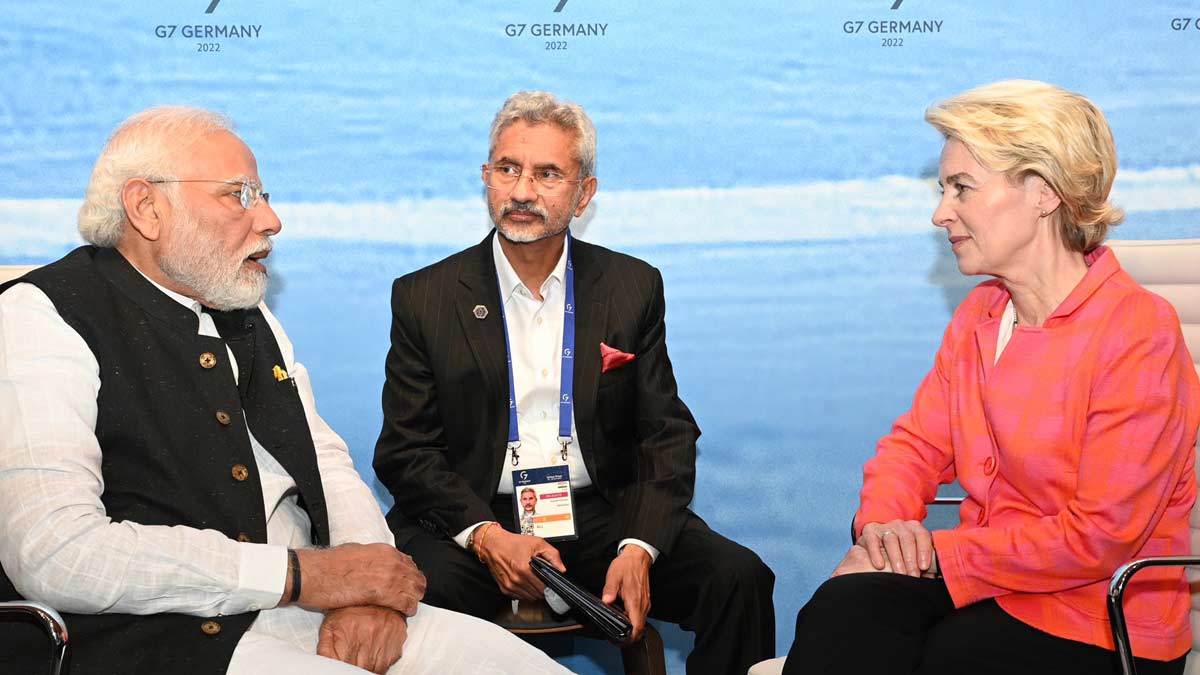
Accompanied by the European Union College of Commissioners, the two-day visit of the European Commission President Ursula von der Leyen to New Delhi, beginning Thursday, has come at an opportune time when the two major EU powerhouses—Germany and France—are standing up to President Donald Trump, indicating that the distance between the US and Europe may indeed be growing.
Soon enough, the EU and India are expected to firm up a pact for a strategic relationship that includes a free trade agreement. But there could be several other advantages for India.
One, a Euro-centric EU with loose ties to the US will mean another multi-polar entity that will offer India another option for close strategic association besides the usual suspects—US and Russia. It can only serve to strengthen India’s policy of 'strategic autonomy'.
Second, EU countries can offer India an entire range of world-class and cutting-edge military equipment and platforms with favourable terms and conditions including genuine transfer of military technology. Already Germany is helping India with the Thyssenkrupp Marine Systems teaming up with the state-owned Mazagon Dock Shipbuilders to build six submarines with technology transfers ranging from 45% to 60%. France too is actively collaborating with India on the Rafale fighter aircraft.
Third, the India-EU trade partnership can be much more favourable to India as the EU nations will seek access to newer markets like India to make up for a loss in the US.
In FY 2023-24, bilateral trade in goods with the EU stood at $135 billion (with exports to the EU at $76 billion and imports from the EU $59 billion) making the EU the largest trading partner for India in goods. Bilateral trade in services in 2023 stood at $53 billion (comprising Indian exports worth $ 30 billion and imports worth $ 23 billion) registering the highest-ever trade in services.
EU investments in India are valued at over $117 billion with around 6,000 European companies present in India while India’s investments in the EU are valued at around $40 billion. In sum, a growing distance between EU and US would definitely serve India favourably.
On Monday, despite the ‘bromance’-like personal bonhomie between Trump and French president Emmanuel Macron in the White House, there were no punches that were held back by the two. On Ukraine, there was a clear difference in positions with France or Europe not being favourably drawn to the Trump-led US position. Macron, after consultations with 30 other European leaders and allies, had stated that any peace deal in Ukraine must “not be a surrender of Ukraine” and has to be backed by security guarantees.
While Trump batted for a ceasefire in Ukraine “as soon as possible”, Macron sought a considered truce first before a broader peace deal saying: "We want peace swiftly but we don't want an agreement that is weak." To add to the discordant positions, Trump also pointed out that the “cost and burden” of securing peace in Ukraine must be paid not only by the US but also by the European nations.
Macron also corrected Trump in his statement on Europe’s support to Ukraine.
Trump had said that all EU aid to Ukraine was in the form of loans that had to be paid back, where Macron butted in by saying during the joint press conference: "No, to be frank, we paid. We paid 60% of the total effort."
The tariff issue on a reciprocal basis—Trump’s pet plank in line with his MAGA ideology—was another sore point that underlined the growing distance.
Macron also voiced his opposition to the US pressure on Europe to increase defence spending. “How do you want us to increase security and defence expenditure if we are in a trade war?” Macron had asked.
He also told Fox News in an interview after meeting Trump: "Come on, you cannot have a trade war with China and Europe at the same time."
For quite some time, the EU has been voicing the need for a more autonomous position that was independent of US positions on issues.
The newly-elected conservative German government headed by Friedrich Merz is expected to kowtow to the line of EU autonomy.
Soon after winning the elections, Merz spoke about the need to replace NATO with an "independent European defence capability" and how it was an "absolute priority to strengthen Europe as quickly as possible so that we achieve independence from the US".
