



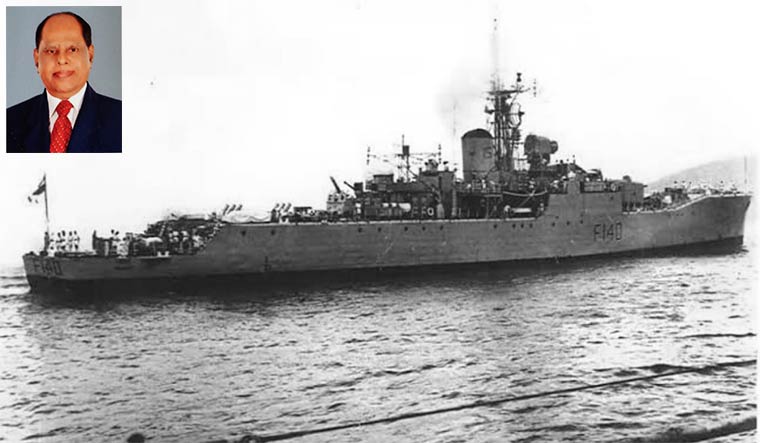
Just two years after joining the Navy, 19-year-old John Philip got to witness history, as an electrical engineer on the deck of the INS Talwar, on the fateful night of December 8 when the Karachi port was set ablaze.
As India celebrates the 50th anniversary of the Indian Armed Forces' victory in the 1971 Indo-Pak War, the memorable attack on Karachi that left Pakistan’s biggest port in flames remains a hallmark of Indian military history.
Such a victory, just days after the war began, left a huge morale impact on Pakistan’s forces. India was already ready for war when Pakistan formally began the conflict with a strike on Indian air fields. Among India’s multi-tiered response was a plan involving recently acquired missile-boats from the Soviet Union. The Western Naval Command, led by Vice Admiral Elenjikal Chandy, looked to strike the Karachi harbour and the Keamari oil farms. Frigates INS Trishul and INS Talwar were tasked with escorting INS Vinash, a missile boat.
John recalls what his Commanding Officer S.S. Kumar had said during his morning prayer session on December 3. "Be alert. We are going to war but you and I don't know when the war will start. But war [will be] there." True to his words, the war began that night. In a good sign for India, PNS Ghazi was sunk that very evening, after the Navy managed to bait it to the eastern coast, far from the Western Fleet that was about to wreak havoc on Pakistan.
The first missile attack took place on the night of December 4 and 5, led by the Indian Naval ships Kiltan, Katchall, Nipat, Nirghat and Veer. The second strike would prove decisive.
The journey to Karachi was eventful. Throughout the journey, John was hard at work ensuring the functioning of the ship’s electricals. INS Trishul proved its mettle early on by sinking a Pakistani patrol craft on the evening of December 8. Its electronic surveillance was able to observe that the radar at Karachi had stopped rotating and was pointing directly at the group.
By midnight, the missile boats were close enough to strike their target. INS Trishul and INS Vinash approached the Karachi harbour and fired missiles that sank three Pakistani ships and oil storage tanks. The blaze was immense, fuelled by the destruction of an oil tanker and an entire oil farm, along with several ships.
John says, "All of us onboard watched the huge fire and I cannot forget the experience. It will never ever be erased from my mind.”
Given the Cold War era dynamics, and the fact that India was fielding Soviet missiles, it is said that Russian naval chief, Admiral Sergey Gorshkov shouted out in joy after seeing satellite images of the battle and helped himself to a lot more vodka than usual.
ALSO READ: How the war changed the Navy's status
The victory was also accompanied by tragedy. On the morning of December 9, John recalls seeing the enemy’s aircraft approaching his ship. But it returned without attacking. That night, however, he saw INS Khukri manoeuvring nearby, before it was sunk by the Pakistani submarine PNS Hangor.
“I cannot forget the pain of losing my friends onboard. Captain M.N. Mulla also went down with his ship in accordance with the age old tradition of the Navy,” he says.
But India went on to dominate the seas during the war. As Vice Admiral Kohli, Flag Officer Commanding-in-Chief, Western Fleet stated: "The Indian Navy is in command of the high seas and we can go wherever we want. The entire coast of Pakistan right up to the border of Iran is now vulnerable to the guns of the Indian Naval ships.”
Philip served on INS Talwar between 1970 and 1972. He left the Navy in 1980 with his head held high, having been part of one of India’s most significant military victories in 3,000 years. He went on to pursue a career as a shipchandler. From his apartment in Fort Kochi, he would wave at the very ships he supplied. “My achievements in the international shipchandling business are solely because of the self-discipline, refined behaviour and a sense of organisation that I imbibed during my Naval days,” he writes.
He retired in 2016. He still watches the ships as they sail past the channel.
