



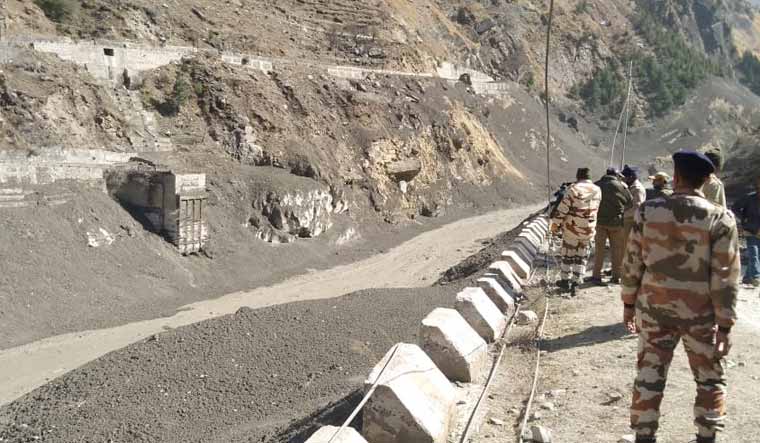
In the aftermath of the massive Uttarakhand floods, two teams of glaciologists will head to Joshimath-Tapovan to study the causes of the incident. The Nanda Devi glacier had broken off in Uttarakhand's Chamoli district, triggering an avalanche and a deluge in the Alaknanda river system that washed away hydroelectric stations, leaving at least seven people dead and 125 missing who are feared dead. The glacier burst led to a massive flood in the Dhauli Ganga river.
The director of the Wadia Institute of Himalayan Geology, Kalachand Sain, said two teams of glaciologists will leave Dehradun on Monday morning. The Wadia Institute comes under the Department of Science and Technology (DST).
The scientists have studied various aspects of the Himalayas, including the glaciers and seismic activities in the region, and had also scrutinised the 2013 flash floods in Uttarakhand that killed nearly 5,000 people.
"The teams will study the reasons behind the incident. Our teams will be looking into different aspects of glaciology," Sain said, adding that it is too early to comment on the development.
A portion of the Nanda Devi glacier broke off in Uttarakhand's Chamoli district on Sunday, triggering an avalanche and a deluge in the Alaknanda river system that washed away hydroelectric stations, leaving at least seven people dead and 125 missing who are feared dead.
What caused the flood
A glacial burst was widely considered the main reason for the incident, with reports citing cloudburst as another possible one, but Sain said that the Sunday's incident was quite "peculiar" as there was no rain or melting of snow.
One of the most widely considered scenarios for the incident is the Glacial Lake Outburst Flood (GLOF). Glacial lakes are formed when a glacier retreats, and are usually dammed in by moraines—deposits of soil and rock and such left behind by a moving glacier. If the dam hemming the lake in bursts, it can cause widespread flooding and destruction downstream. The 2013 floods of Uttarakhand was caused by a GLOF.
IIT Indore's Assistant Professor Mohd Farooq Azam termed the possibility as a rare incident, and said that satellite and Google Earth images do not show a glacial lake near the region, but there is a possibility of a water pocket. "It is a rare incident for a glacial burst to happen. Satellite and Google Earth images do not show a glacial lake near the region, but there is a possibility that there may be a water pocket in the region. We need further analysis, weather reports and data to confirm if this indeed was the case," he said.
Professor A.P. Dimri from the School of Environmental Sciences at Jawaharlal Nehru University told The Indian Express: "Cloudburst would be a rare event during this time of the year. It does look like a GLOF event right now.”
Climate change and the shifting weather patterns caused by global warming have been cited as another possible reason. Azam said the thermal profile of ice is increasing, as earlier the temperature of ice ranged from -6 to -20 degree Celsius, it is now -2 degrees, making it more susceptible to melting. Climate change-driven erratic weather patterns like increased snowfall and rainfall, and warmer winters have led to the melting point of a lot of snow.
Another expert, Anjal Prakash, one of the lead authors of a special report on oceans and cryosphere of the Intergovernmental Panel on Climate Change (IPCC), said while it was too early to explain the cause of the devastation, prima facie it seemed to be due to climate change and global warming which has become an alarming and irreversible situation now.
He also said that Himalayan region is the least monitored region and requires the government to spend more resources in tracking these areas closely so that there is more awareness.
"Himalayan region is the least monitored region and this event actually shows how vulnerable we could be. I would request the government to spend more resources in monitoring the region better so that we have more information about the change process. The result would be that we are more aware and could develop better adaptation practices," Prakash, who is also a Research Director and Adjunct Associate Professor at the Indian School of Business (ISB), Hyderabad, said.
-Inputs from agencies
