


Have you had that moment where you go for a movie of your favourite star or franchise with a friend who tells you in the interval that the movie is rubbish? This more or less epitomises the present condition of Bollywood. Once the staple form of entertainment for the masses, Bollywood is now getting increasingly burdened by stiffer competition from sister industries, piracy concerns and the internet, which has thrown up an array of entertainment options.
From slowing down, it is now close to hitting the breaks hard. The Indian film industry at large is not growing and the fact that many production houses have shut shop is proof of that. Bollywood is most exposed to this risk as it is home to a large number of production houses. There is a slow but constant change these days in the kind of movies that people are more inclined to see. Even the tried and tested formula of a big star, high budget, masala movie is yielding poorer results than before.
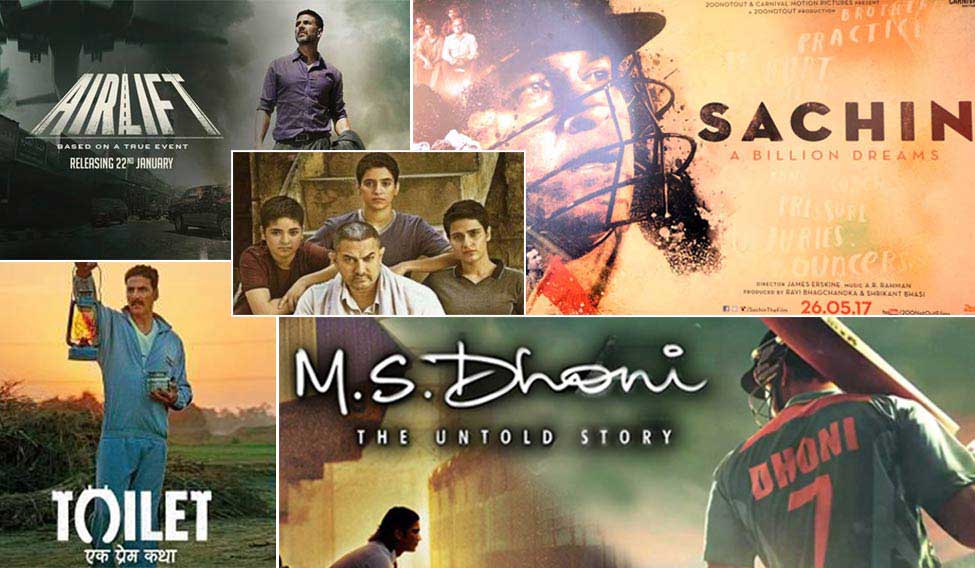
But it isn't just box office success that is troubling the industry, but also the general quality of movies. The typical Hindi film presumes that people will love the star more than the story, resulting in exorbitant pays and much less focus on the actual film. But it seems that the more seasoned filmmakers have realised the shortcomings and have opted for a much safer route when it comes to picking a topic for a film—true stories or biopics. This seems to be the new success formula for filmmakers and actors alike. Much of the better made films were depictions of real life stories or real life problems—Dangal—the struggle of wrestler Mahavir Singh Phogat in putting his two daughters on a wrestling pedestal; Hindi Medium—the story of a couple going to any lengths to get their daughter admitted to a respectable school; Airlift—how a young callous businessman becomes a saviour to thousands of stranded Indians who were left to fend for themselves in Kuwait during the Gulf war; Neerja—true story of a fearless flight attendant Neerja Bhanot who kept her resolve in a moment of crisis when a Pan AM flight was hijacked in Pakistan; Udta Punjab—captures the morbid drug abuse in Punjab which has engulfed its youth; M.S. Dhoni—a journey through the life of former cricket captain M.S. Dhoni and the struggles he faced before he became a cricketing sensation; Sachin: A Billion Dreams—a docudrama-biographical film that captures the life of Sachin on and off the field; Rustom—real life story of Naval officer K.M. Nanavati who shot his wife's alleged lover and the case proceedings that followed; Sarbjit—a biographical drama portraying the life of Sarabjit Singh, an Indian man who was sentenced to death by the Pakistan Supreme Court. Akshay Kumar's most recent release Toilet: Ek Prem Katha and upcoming Padman, both revolve around true stories, too. Shradha Kapoor is also working on a biopic on India's ace badminton player Saina Nehwal.
Call it lack of original ideas or banking on a safe bet, but Bollywood certainly is finding success in stories inspired by real-life incidents than the traditional mainstream masala flicks, which usually orbits around a high-profile star, set in an exotic location. High budget films don't seem to be making money anymore and neither do films that are completely meant for the niche. There are fewer films featuring actors than there are with 'models' playing the lead role. People's appetite for the quintessential Bollywood film that featured a story about the upper middle class or the upper class involving flashy cars and exotic locations is also fading.
Times are changing. The myth that low budget films don't make money anymore is a thing of the past. Hindi Medium proved that this year. Even the notion that the big starrers make money is also not a cemented fact anymore. Salman Khan's Tubelight raked in the moolah but it was far lower than expectations. SRK's Jab Harry Met Sejal, too, has disappointed the box office. Ranbir's Jagga Jasoos also didn't find much success. There is a growing number of low budget films now with a renewed focus on 'actual' stories that the audience can relate to. These movies often focus on small issues that people encounter in everyday life.
Most biopics and other films based on true events have been embraced warmly by the public resulting in more filmmakers to experiment with this new formula. They are not only getting thumbs up from the critics, but are also making the moolah. With internet-based mediums such as Netflix and Hotstar offering a plethora of well-made alternatives, viewing habits are going through a tectonic shift and filmmakers are being forced to buckle up. The past decade has seen big names such as Aditya Birla, Mahindra, Tata, Times Group and Disney throwing in the towel with Disney's appetite satiated with the failures of Mohenjo Daro, Fitoor and Tamasha to name a few. The added pressure of good films from Hollywood and South Indian cinema has studios sounding the bugle.
One can only hope that directors don't overdo biopics and move towards making films where the reel resonates with real life.