



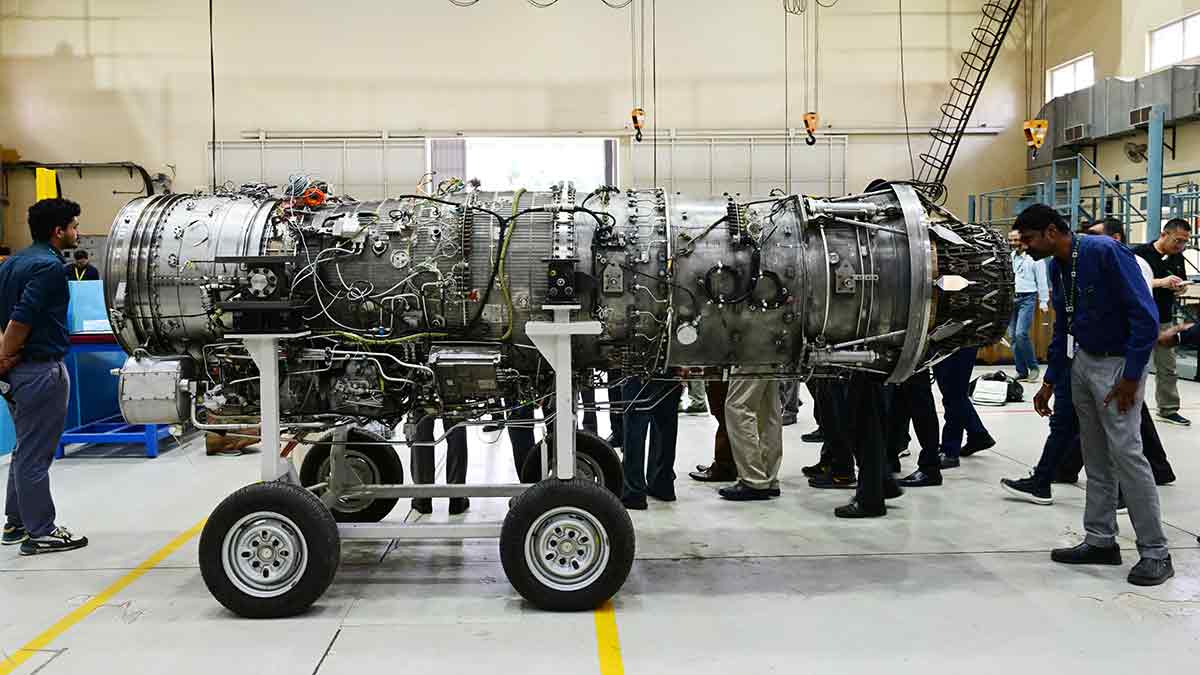
For India, even as it has been making significant progress in defence technology under the Atmanirbhar Bharat initiative, fighter jet engines have always remained a critical gap in its aerospace ecosystem, making the country highly dependent on foreign players. The indigenous Kaveri jet engine, which was developed for powering the Light Combat Aircraft (LCA) project, ran into a hurdle due to thrust-to-weight ratio and combustion instability, among other issues. This setback further dampened the country's fighter engine ambitions.
Now, if reports are to be believed, the Kaveri jet engine, developed by the Defence Research and Development Organisation’s (DRDO) Gas Turbine Research Establishment (GTRE), is in the process of a structural rebirth.
A report by The Business Today revealed that the GTRE is engineering a newly designed 90-kn engine
-kilonewton (kN) core engine, which can replace the foreign engines of the IAF's frontline fighter jets during mid-life upgrades, thus reducing dependency on foreign OEMs for these upgrades.
The report stated that while GTRE is co-developing a 120kN to 140kN engine for the fifth-generation Advanced Medium Combat Aircraft (AMCA) under the Advanced High Thrust Class Engine (AHTCE) programme, it is also developing Kaveri 2.0. This new version targets 55kN to 60kN of "dry" thrust and 90kN to 100kN of maximum "wet" thrust with an afterburner.
The earlier Kaveri Derivative Engine (KDE), or dry Kaveri engine, produced a sea-level static (SLS) dry thrust of about 46 kN, which wasn't enough to power modern fighter jets.
GTRE is redesigning the engine's core, with particular attention to the High-Pressure Compressor, which plays an important role in improving engine efficiency and performance.
The engine is also expected to use single-crystal turbine blades, which can withstand the extremely high temperatures inside a fighter jet engine. This would allow the engine to operate at higher temperatures and improve its overall efficiency.
Developing an indigenous 90kN-class engine could have major strategic significance for the IAF. As the GE F404 engines currently powering LCA Tejas fighters would eventually require replacement and overhaul, Kaveri 2.0 could provide India with a domestic alternative.
