



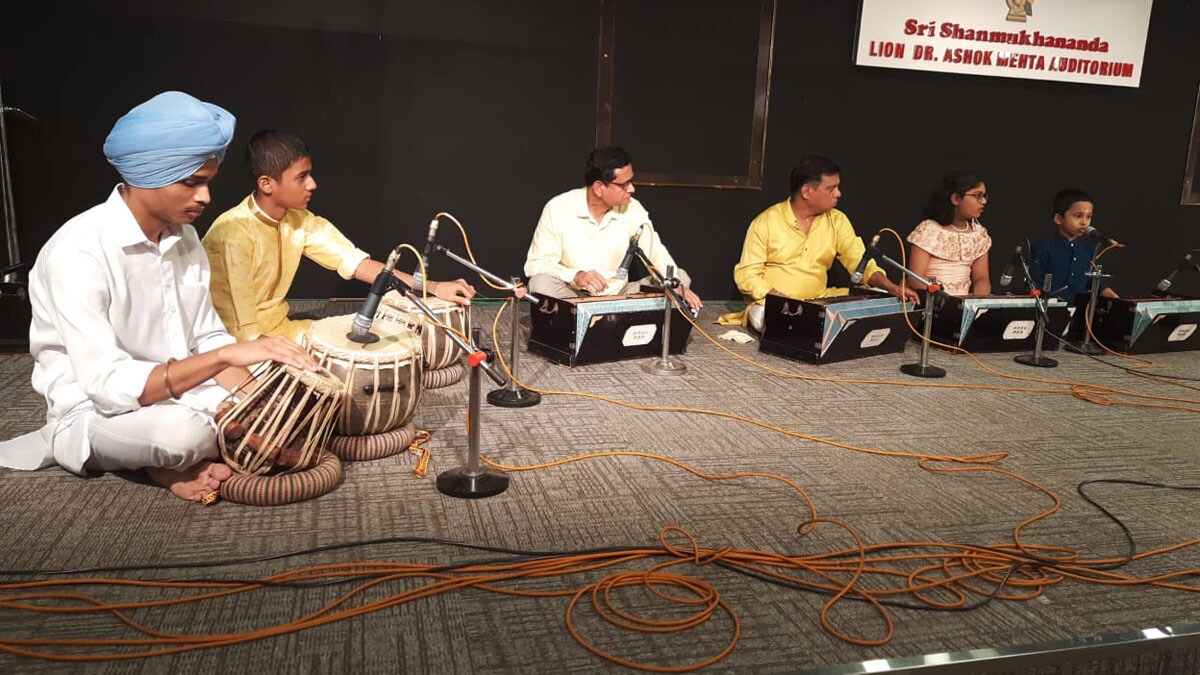
Inside the elegant Lion Dr. Ashok Mehta Auditorium at Matunga's landmark Sri Shanmukhananda Hall, a quiet reverence settled in as students took their places for the annual Guru Purnima celebrations.
Hosted by the Sri Shanmukhananda Bharatiya Sangeetha Vidyalaya and Natya Vidyalaya, under the aegis of the Sri Shanmukhananda Fine Arts & Sangeetha Sabha (Regd.), the event celebrated not just the art of music and dance—but also the sacred bond between the teacher and the taught.
Beginning at 3 PM sharp, the program unfolded with 16 back-to-back performances, each representing the following categories: Carnatic and Hindustani vocals, Veena, Sitar, Harmonium, Tabla, Keyboard, Violin, Mrudangam, Bharatnatyam, and Kathak.
One student from each group stepped forward to introduce the piece and dedicate it to the Guru. The performances—many involving junior and senior students collaborating across levels—were rehearsed with precision: the fruit of weeks of effort.
“This day is more than just an event,” said Shyamala Sajnani, Principal of the Vidyalaya, who took over in September 2023, which also happens to be M.S. Subbulakshmi’s birth anniversary.
“Guru Purnima is about offering yourself—your training, your discipline, your humility—back to your Guru. And we try to ensure students understand that deeply.”
Under Sajnani’s leadership, the Vidyalaya has taken deliberate steps to widen its scope while retaining its commitment to traditional Indian classical forms.
“When I joined, both Carnatic and Hindustani music were already being taught. But I wanted to make sure both streams were equally nurtured—not just in performance, but in the way we design our curriculum and invite guest mentors,” she explained.
This year, the school introduced a host of inter-disciplinary workshops, from a yoga-pranayama session on vocal health to a Dhrupad appreciation class and tabla-focused technique modules.
“Next, we’re bringing in a physiotherapist to talk about how musical practice affects posture and muscular balance, something no one talks about but all artists struggle with,” Sajnani added.
A special milestone this year is the introduction of Mohiniyattam into the curriculum.
“Our academic theme for 2024–25 focuses on Kerala’s musical and artistic heritage, and including Mohiniyattam felt like a natural extension,” she said.
The new course will launch on Vijayadashami (October 2) and is expected to attract students from both music and dance backgrounds.
The Vidyalaya also sets itself apart with its scholarship ethos. The M.S. Subbulakshmi Scholarship, awarded each year on the late icon’s birthday (September 16), grants ₹1 lakh per year (for three years) to 50 deserving students to support advanced classical music training: a rare gesture in the classical arts circuit.
“That’s ₹3 lakhs per student. It’s not just financial help, it’s encouragement; a way to say ‘we believe in you’,” Sajnani said.
Other scholarships, such as those supporting Nagaswaram artists from the South, help sustain endangered art forms by funding both education and livelihood.
“The Sabha is deeply committed to this cause. We’re not just preserving heritage in theory—we’re investing in its future,” she added.
One of the key Carnatic vocal teachers, Bharatula Bhanumati Sharma, who holds an MA in Music from Chennai, and has over 25 years of teaching experience, echoed that sentiment.
“Every student is encouraged to perform on Guru Purnima. I don’t believe in picking a few and leaving out others,” she said. “We began rehearsing over a month ago. I even take Sunday classes over Google Meet so everyone can learn at their pace.”
Her first, second, and third-year students prepared a structured composition, rehearsed separately, and then in combined batches.
“They are confident because they feel connected—not just to the music, but to the values we teach along with it,” Sharma said.
This year also marked a new level of creative independence for senior Hindustani vocal students (years 5 to 7) under Swastrishi Joshi.
“Unlike previous years where teachers selected the compositions, I gave my students the responsibility to develop their own piece,” said Joshi. “They chose the raga, built the structure, and planned their transitions. It’s part of growing up: they’re no longer just singers; they’re becoming artists.”
Teachers were instructed not to wait for latecomers, and students who performed were asked to stay back and support their peers, instilling discipline alongside devotion. The event drew an attentive audience of parents, alumni, faculty, and well-wishers, many of whom stayed until the final Mrudangam and Violin recitals concluded at around 6:30 PM.
Behind the success of the event was a clear, well-coordinated schedule, precise communication, and an institution-wide sense of purpose.
From first-year vocal students nervously waiting backstage to seasoned seventh-years fine-tuning last-minute notes, the day unfolded as a mosaic of learning, legacy, and love for the arts.
“Western music will always be popular, and that’s wonderful,” said Sajnani. “But someone has to preserve what is ours—and pass it forward with integrity.”
At the close of the event, as students bowed one last time before their gurus, the audience offered its own applause—not just for the performances, but for a tradition that continues to thrive, one generation at a time.
