


Mumbai-based multidisciplinary visual artist Priyesh Trivedi once broke the internet with his Adarsh Balak illustrations. His wildly popular Facebook page, started in 2014, actively put out painted comic panels lampooning the government-sponsored educational posters and charts featuring the ideal schoolboy. These posters served as moral science lessons in primary school textbooks back in 1980s and 90s India. Trivedi rejigged the iconology of these posters and subverted the concept of 'Adarsh' by showing kids smoking joints, chugging alcohol or emptying out LSD cans in overhead water tanks. At an ongoing exhibition on myth-making and parafiction titled Babur Ki Gai, three oil paintings from this famed comic series are on display.
While pointing out the self-explanatory nature of the oil-on-canvas, curator Adwait Singh informs how members of the right-wing, Hindu nationalist group RSS used to send congratulatory messages to Trivedi in his inbox, appreciating the resurrection of the ideal boy imagery in these wretched times in the same original art style. By missing the mockery and the subversive messaging, the RSS perhaps unwittingly participated in an artificial mythology of their own making.
There is no Adarsh Balak just like Mughal emperor Babur never made a 'wasaya' or will which banned cow slaughter. The purported will has been proven to be a 17th century forgery by historians. But that did not stop Rajasthan BJP president Madan Lal Saini from distorting historical facts and father-son relations to claim in July this year: "When Humayun was dying, he called Babur and told him: 'If you want to rule Hindustan, you must keep three things in mind—respect cows, Brahmins and women.'"
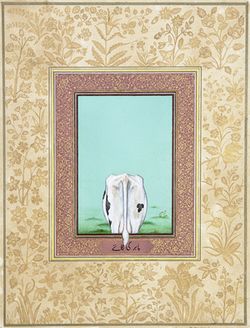 Lost Pages from the Baburnama Folio; Priyanka D'Souza
Priyanka D'Souza's eponymous work Babur Ki Gai is premised on this episode in current history on misrepresentation of facts. In a way, it distills the essence of the entire group show which brings together works by 19 artists from the Indian subcontinent and beyond. They embody and critique the rampant circulation of certain shared beliefs and myths as if they were actual facts of history. In Babur ki Gai the artist uses gouache on wasli paper recalling the style of Mughal miniatures to depict the posterior of a cow sauntering in and out of an intricately carved frame with gilded borders, almost like a gilded cage treasuring a prized animal. Through this artwork, D'Souza claims to have recovered the lost pages from the Baburnama folio, pages which supposedly support the ban on cow slaughter in the Mughal empire. These lost miniatures bear the inscription, Babur ki Gai, Humayun ki Gai and Meri/Kiski Gai respectively. "The artist wanted to perpetuate this myth that somehow she has managed to find these original, missing pages from Baburnama, pages which supports the statement of the BJP president from Rajasthan," says Adwait Singh.
"I was interested in this particular phenomenon of parafiction which is essentially a fictional entity but circulated in society in a way that it can acquire the semblance of a fact," says Singh highlighting the show's curatorial premise which has resonance in age of fake news and disinformation. "Certain statements or even certain artistic strategies which try to pass off something as a fact. It's been used on both ends. Politically by politicians and demagogues to put forth their agendas but equally subverted by artists to meet their ends, to counter-critique those political agendas," adds Singh who has attempted to break the cold formality of wall texts and labels with handwritten notes to serve as information plaques in the exhibition.
Yogesh Ramkrishna's watercolour on paper 'Don’t Look In Anger, It May Catch Fire' presents a series of 10 paintings with accompanying text translated from Marathi to Hindi. In this work, Ramkrishna has combined horror stories, recollections, hearsay, superstitions, popular beliefs and a fair bit of creative conjecturing from material gathered in a research trip last year to a small village in Maharashtra by the name of Dhotre where a house was burnt down years ago with a lone child survivor who went missing. The artist brings to life the missing child and the charred house in a series of eerily evocative paintings which recount the events leading to the tragedy.
In 'If Myths Are Real, Why Did You Not Stop The Destruction?', Goa-based Kedar Dhondu goes back to the 16th century where extreme religious persecution by the Portuguese made Goa a hostile environment for Hinduism to thrive, where hundreds of temples were razed to the ground. In a set of 25 panels, he shows gods which were displaced and looted from temples and now exist as museum pieces as mute witnesses to destruction and displacement. In 'Kolkatar Kissu Hobe Na', a hand-constructed book with board, acid-free handmade paper, water and dust colour, ink, pencil and paper collage collate into a book art to encapsulate Kolkata's most popular dialogues, idioms, verses and ideas floating in the city's consciousness like Netaji phire ashben (Netaji will come back) or Kolkata kissu hobe na (Kolkata is doomed).
Babur ki Gai is on view at Gallery Latitude 28 and Art District XIII in Delhi till November 21.
