



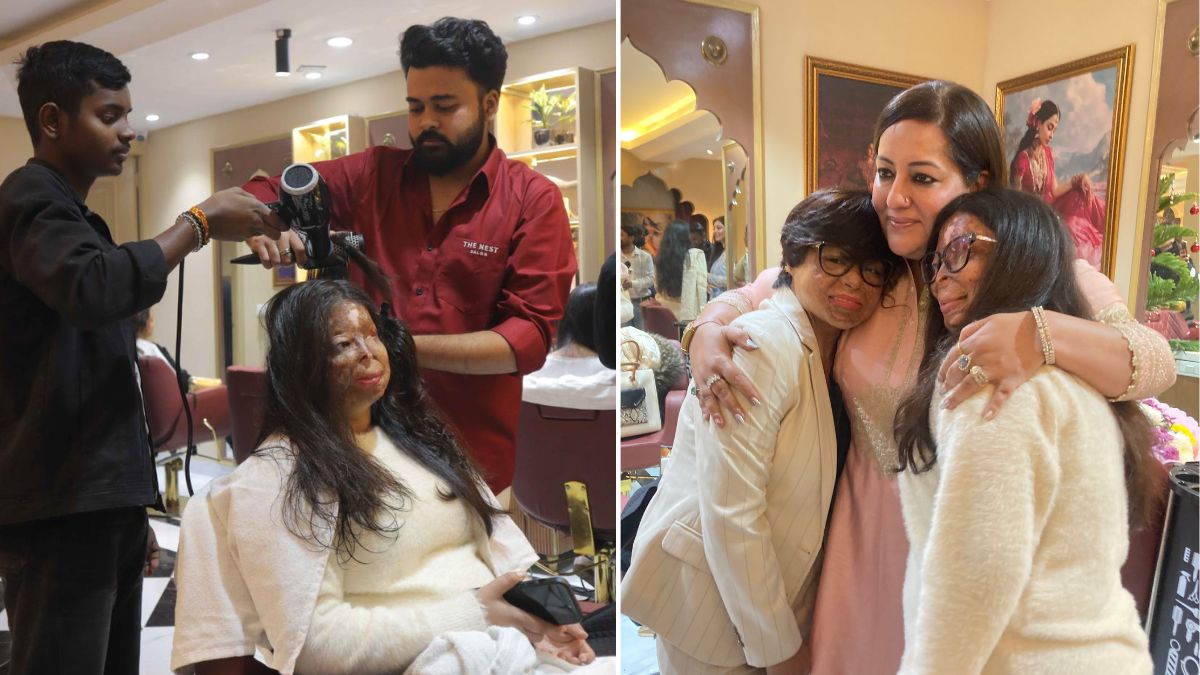
For years, Anshu Rajput avoided beauty salons altogether. At 27, she knows the choreography too well: the double takes, the sudden hush, the stylist who doesn't quite know where to look. She was 15 when a 55-year-old man threw acid on her after she rejected his advances. The attack scarred her face, but it was the everyday aftermath-the staring, the silence, the discomfort-that slowly taught her to stay away from public spaces meant for care.
“Salons are supposed to make you feel beautiful,” she says quietly. “But for women like us, they often do the opposite.”
Mausami, 30, from West Bengal, echoes the same unease. A kitchen fire left her with severe burn injuries. During her long recovery, her husband remarried. Like many burn survivors, she learned that visibility comes with a cost. “People ask questions. The whisper. Sometimes they are kind, but even kindness can hurt when it reminds you that you are different, she says. Beauty, she insists, is not a frivolous desire. “We also want to feel good. We also want care.”
It is this ordinary, often denied desire that The Nest Salon in Delhi’s Green Park Market places at its centre.
At The Nest, acid attack and burn survivors can walk in and access any beauty or wellness service-free of cost, throughout the year. More importantly, they can do so without explanation. Private VIP rooms shield them from unwanted attention. The staff is trained not to stare, not to ask, not to turn survival into spectacle. For many survivors present at the launch, this was the first salon where they felt safe enough to sit in front of a mirror without bracing themselves.
“This feels like a space where I don't have to prepare myself,” Mausami says. “I can just be.”
The salon is the vision of Harita Mehta, Senior Advocate at the Delhi High Court and a long-time women's rights advocate, whose work with survivors spans years through the Meher Foundation. She has seen how violence does not end with survival. “Families distance themselves in the name of beauty”, she says, “Society steps back. These women are made into the living dead.”

Mehta is unsparing in her critique of how India treats survivors after the headlines fade. “They are hidden away, veiled behind the scenes, as if their presence is uncomfortable,” she says. “I want them to come forward, to participate in normal experiences-because they too are women, and they too have desires.”
For Mehta, survivors are not defined by loss. “I see them as phoenixes,” she says. “Women who rise from the ashes-not once, but every single day.” The line has become a quiet philosophy at The Nest, where beauty is framed not as correction or concealment, but as recovery and entitlement.
The Nest appears, at first glance, like any premium salon-elegantly designed, drawing on Rajasthani royal aesthetics, offering personalised hair, skin, spa, and holistic wellness services. But beneath the marble and mirrors lies a deliberate reimagining of luxury. Here, dignity is built into the infrastructure.
Survivors like Anshu and Mausami are not invited as symbols. They are the reason the space exists. Both are associated with the Chhanv Foundation, which works toward the economic independence of survivors through initiatives such as Cafe Sheros Hangout. Their presence at the launch underscored that resilience is not something to be romanticised -it is something practised daily, often without applause.
Mehta’s vision extends beyond care to livelihood. Survivors who wish to enter the beauty industry will be trained and employed at The Nest. Profits from the salon are redirected toward survivor support, including medical treatment, facial reconstruction, education, and long-term rehabilitation. The salon, in that sense, functions less as a business and more as an ecosystem of care.
The launch was attended by Dr Jai Madaan as the Chief Guest, along with former MP and three-time MLA Ramesh Bidhuri and Delhi MLA Satish Upadhyay. Yet the emphasis remained firmly on the women whose presence often makes rooms uneasy elsewhere. Here, they occupied the space without ceremony, without distance.
At The Nest, mirrors no longer judge. They simply reflect women who survived--and who still want what all women want: care, dignity, and the freedom to be seen.
In a society that abandons survivors midway through healing, that refusal to look away may be the most radical beauty practice of all.
