


One afternoon, Raina Sethi, 42, a mother to a cheerful 10-year-old girl in New Delhi’s Lajpat Nagar, found herself googling, “Why am I angry all the time?”
The possibility of being pregnant again was gnawing at her. Her husband and in-laws had been hinting at a second child. She regretted not speaking her mind earlier, when the conversation might have been easier. Now, just as her career had stabilised and her daughter had grown a bit independent, the pressure resurfaced.
Every day between her last period and the next was clouded in anxiety and uncertainty. To the outside world, her marriage appeared secure and comfortable. But within the privacy of her home, expectations lingered. “There is no one I can say this to without being judged,” she said. “Everyone assumes this is normal.”
Hundreds of kilometres away, a woman in her late 50s from Madhya Pradesh attempted suicide in her son’s apartment in Bengaluru. She had moved in with him and her daughter-in-law after her husband’s retirement. One afternoon, she swallowed two bottles of prescription pills. In a telephonic conversation with THE WEEK, she described the act as the culmination of months of feeling “unseen”. “I suddenly felt invisible in my own house,” she said. “It felt like a man’s world. Both my son and my husband would slight me for little things. I had no voice.”
For decades, she had run her household and raised her children. But in recent years, as she began experiencing menopause, she found herself struggling with mood swings, irritability, crying spells and insomnia. She did not have the language to articulate what was happening to her body and mind. When she tried, she was told she was “overreacting”. She survived the attempt but the loneliness, she said, remained. She has since moved back to Madhya Pradesh and now lives alone.

Anaaya B., 17, a first-year college student from Pune, began skipping lunch during her second semester. At first, it was subtle. She would tell her mother Kranti she had eaten at the canteen. Soon, dinner portions shrank, too. She began spending more time in front of the mirror and adjusting camera angles before posting photographs online.
Kranti noticed the shift. “Her friends, all teenage girls, were discussing calorie counts and ‘clean eating’, posting gym selfies and ‘what I eat in a day’ videos,” she said. “Instead of focusing on studies, she became obsessed with skin, thighs, jawlines, waistlines. If a photo didn’t get enough likes, she assumed it was because she looked bad.”
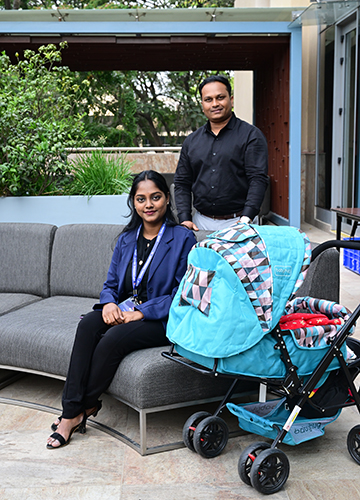 Baby blues: Laveena Sharon with her husband and infant after a session on post-partum at the Mpowering Minds Summit 2026 | Bhanu Prakash Chandra
The anxiety escalated into panic attacks before social events and intense guilt after meals. “She felt like her entire worth was her body,” her mother said.
Laveena Sharon, a budding lawyer, gave birth to a baby boy three months ago. At the Mpowering Minds Summit 2026 in Bengaluru, which was organised by Mpower, an initiative of the Aditya Birla Education Trust, Sharon spoke about how society and people around you want to play a role in your family planning. Three years into her marriage, her mother-in-law told her not to wait and plan for a baby but rather to let it happen naturally. “In mid-2024, we decided to have a baby and I conceived naturally the very next month,” she said. “Unfortunately, I ended up having a miscarriage after seven weeks. The baby didn’t develop a heartbeat. I didn’t have any symptoms. I just had cramps and when I went to the scanning centre, they told me the baby was no longer there.” And then came a barrage of ‘I told you so’. It took a couple of challenging months for her to get over it.
These women do not know one another. They differ in age, geography and circumstance. Yet their distress is not incidental. Across India, women are disproportionately vulnerable to and affected by common mental health issues and disorders, often triggered or compounded by gendered violence, hormonal and biological transitions, societal expectations and social invisibility.
According to the National Mental Health Survey conducted by NIMHANS in 2019, mental health disorders are more prevalent among women than men. Women in India are found to be more prone to conditions like depression, anxiety and physical complaints compared to men. Globally, the World Health Organization has consistently found that depression is about 1.5 times more common among women than among men. Worldwide, more than 10 per cent of pregnant women and women who have just given birth experience depression.
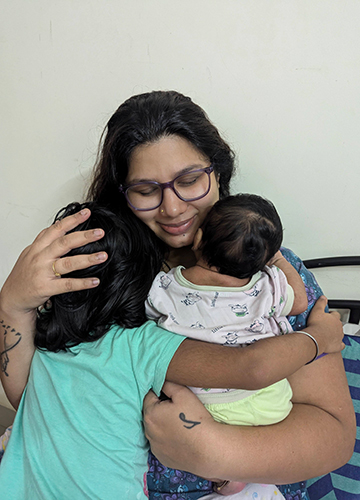 Shruthi Viswanathan (in pic with her children)
At the Mpowering Minds Summit, some stark statistics came to light. Women aged 15 to 34 years account for more than 63 per cent of female suicide deaths in the country, and 39 per cent of maternal deaths are linked to suicide. One in five mothers experiences a perinatal mental health disorder. Among women aged 18 to 49 years, anxiety and depression are the most common mental health conditions, and burnout has doubled in the years following the pandemic.
Data from the AIMA-KPMG Women Leadership in Corporate India 2026 report show that 43 per cent of women have stepped back from leadership roles owing to work-life imbalance and burnout, and 38-40 per cent cite caregiving responsibilities, while 70 per cent continue to face bias and inclusion gaps.
Yet, 70 to 80 per cent of Indians who need mental health support never receive it. India has just 0.75 psychiatrists per one lakh people, and the economic cost of untreated mental illness is projected to cross $1 trillion by 2030.
As per the National Crime Records Bureau (NCRB) data, “family problems” and “marriage-related issues” were routinely listed among the leading causes of suicide deaths among women. The 2020 NCRB report stated that 22,372 housewives had died by suicide—an average of 61 suicides every day or one every 25 minutes.
Behind these numbers are women navigating layered roles, while absorbing emotional labour within deeply patriarchal structures that normalise their caregiving while overlooking their need for care.
Mental health professionals argue that factors such as chronic stress, invisibility within households, reproductive pressures, domestic conflict, hormonal transitions and economic dependence are the reasons that trigger women towards taking drastic measures. Also, men and women experience mental health challenges differently, not because one is stronger or weaker, but because their social realities are different, say experts.
“Women are uniquely positioned at the intersection of biological transitions, caregiving responsibilities, economic vulnerability and deeply ingrained societal expectations,” said Dr Padmaja Samant, professor and head of department, gynaecology and obstetrics, KEM hospital, Mumbai. “From adolescence through motherhood and midlife, they navigate hormonal shifts alongside emotional labour that often goes unacknowledged.” Men, on the other hand, are often socialised to suppress vulnerability, which can manifest as irritability, substance use or risk-taking, she added. “The difference is not in resilience, but in how society permits or denies emotional expression and support,” explained Samant.
Shruthi Viswanathan, 36, remembered exactly when she first found herself slipping. She had married at 25 and moved from Jabalpur to Bengaluru, her first time living in a metro. She was expected to slip seamlessly into her roles of wife, daughter-in-law and new bride in a big city. Instead, she felt unmoored.
“I was overwhelmed,” recalled Viswanathan. “It was emotional turmoil, navigating new relationships, a new city, domesticity. But nobody really understood. It is so normalised for girls to get married and immediately feel comfortable in the ‘other’ house.” Soon, she was diagnosed with clinical depression. “I did once attempt extreme self harm,” she said. “Thankfully, my husband came in at the right moment.”
Viswanathan sought psychiatric help and slowly learnt to recognise her warning signs—the sudden emptiness, the self-harm impulses, the inability to function. “Sadness is very different from depression,” she said. “You can be laughing in a room full of people and suddenly feel completely empty.”
Motherhood brought both joy and relapse. Her first pregnancy, said Viswanathan, “was a breeze”. But after the second child was born, the ground shifted again. “The guilt of not being able to give my elder one the same attention was always there,” she said. Her younger son was intensely clingy for nearly a year, refusing to go to anyone else. “How do you regulate your emotions when you are going through hormonal changes and everything in your body feels out of shape? For months, I felt like I wanted to jump out of my own skin. I had forgotten who I was,” she said. The turning point came unexpectedly, when a friend noticed her standing blankly at a play-date and later asked gently, “Is everything really okay?”
Certain patterns repeat in women across age groups, from adolescents to those in their 50s, said psychiatrist Dr Ruksheda Syeda. “When I see a woman, I routinely ask about trauma—verbal, physical, sexual, financial, social,” said Syeda. “Unfortunately, the majority report at least one incident of inappropriate touch, harassment or violation at some point in their lives.”
While not every experience results in a psychiatric disorder, the cumulative impact is undeniable. Clinically, Syeda sees disproportionately higher rates of depression and anxiety among women, along with rising recognition of premenstrual dysphoric disorder, body image distress among adolescents, low self-esteem and non-suicidal self-injury. There is also a gradual but significant shift, she said, that of greater awareness around perinatal mental health, more referrals from gynaecologists and increasing conversations around perimenopause—a phase when anxiety and depressive symptoms often intensify or resurface.
“Earlier, psychiatric medication would simply be stopped during pregnancy, leading to relapses. Now we are seeing more collaborative care,” noted Syeda. “Early recognition and support can completely change the trajectory.”
But for Kalpana Swamy, in her 40s, the support never came. “I hardened myself; I learnt how to laugh off toxicity surrounding my body type and colour,” said Swamy, founder and curator, Muzicalli Music Appreciation Community. Initially, she, too, struggled with acceptance. “Throughout my life, there have been instances when I wanted to abandon myself. I had come to hate myself,” she said. “From friends to in-laws, everyone always had something to say about the way I looked and so I was always conscious about my body.” A long-term relationship ended partly because of social prejudices, when conversations around whether a “dark girl” would be accepted into a north Indian family began to surface.
Marriage and immediate motherhood brought a new set of negotiations. Raising a daughter in a society still fixated on fairness and slimness meant the scrutiny did not end. Now, as she watches her teenage daughter navigate bullying in school for not fitting narrow beauty standards, the cycle feels painfully familiar. “But I have made sure that what happened with me does not happen to her,” said Swamy, who lives in Maharashtra’s Thane. “I have made her very headstrong. She is comfortable in her own skin and will not let body shaming get to her.”
Also Read
- ‘Mental health checks should be embedded in community health programme’: Neerja Birla
- The stigma divide: Why young Indian women struggle to seek mental health help
- Lovechild: How Masaba Gupta built a brand on authenticity and self-love
- Mental game: Anju Bobby George's strategies for success off the field
- ‘Mental health is survival, not luxury for transgender community’: Akkai Padmashali
- Mother load: Why postpartum care for new mothers matters
A 2023 study published in the International Journal of Indian Psychology shows how deeply gendered the experience of body shaming among adolescents is. By way of a cross-sectional study conducted among 155 adolescents in Mysuru (aged 10–19 years), 23.2 per cent of female participants reported high levels of body shaming compared to just 7.1 per cent of boys.
“There is a very close relationship between a woman’s mental and physical health,” said Prathima Murthy, director, NIMHANS. “We, as a society, must integrate them with social well-being. And that is why the empowerment of women in society becomes so critical.”
The next decade, said Murthy, demands structural embedding of early intervention, accessible counselling, workplace reform and public policy support, so that women are not forced to perform resilience while enduring in silence.