



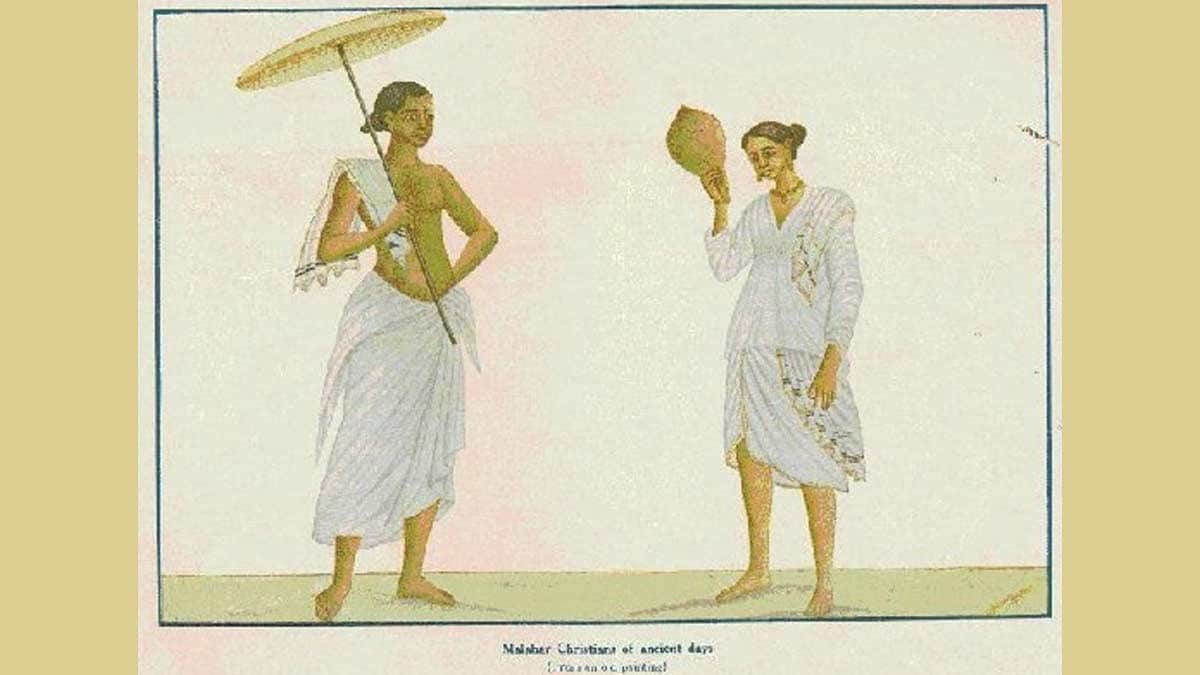
In India, Christmas does not arrive as a guest. It has been here long enough to know the house.
Long before Christmas trees, plum cakes, and mall décor entered the subcontinent, the story of Christ had already taken root along India's western coast. According to tradition widely held by Indian Christian communities, St Thomas the Apostle arrived in Kerala in 52 AD, establishing churches among local Jewish and trading communities in what was then part of the global spice route. This makes Indian Christianity one of the oldest continuous Christian traditions in the world, dating back to a time older than Christianity in much of Europe.
For centuries, Indian Christians have celebrated the birth of Christ without snow, without fir trees, and without the Western calendar’s festive excess. Instead, Christmas evolved quietly, shaped by monsoon rhythms, local grains, regional art forms, and the social structures of Indian life. It was not a festival imposed from outside; it was absorbed, translated, and lived.
Even the idea of Christmas as a fixed date—December 25—was formalised in Rome only in the 4th century, when Emperor Constantine legalised Christianity. Indian Christians, meanwhile, were already marking Christ’s birth liturgically, often in alignment with Eastern Christian calendars and Syriac traditions. The Saint Thomas Christians of Kerala used Syriac (a dialect of Aramaic) in their prayers, linking them linguistically closer to the world of Jesus than to medieval Europe.
This matters because it unsettles the common assumption that Christmas in India is a colonial inheritance. When European missionaries arrived centuries later—Portuguese in the 16th century, followed by the Dutch and British—they encountered communities that were already Christian, already observing Christmas, and already Indian in practice.
As Christianity interacted with Indian society, it also entered Indian visual culture, not as a rigid icon, but as a flexible story. When Jesuit missionaries brought Christian art to the Mughal court in the late 16th century, Emperor Akbar encouraged dialogue between religions. Mughal painters began experimenting with biblical themes, rendering the Virgin Mary and infant Jesus using miniature painting techniques, Indo-Persian compositions, and local palettes.
This visual translation continued well into the modern period. In the 20th century, artists like Jamini Roy rejected European realism in favour of Indian folk forms, painting Christian subjects with flattened perspectives and bold lines inspired by Bengali pata painting. Angelo da Fonseca, working in Goa and Pune, went further, portraying Mary in a sari, Christ with brown skin, and biblical scenes set unmistakably in Indian landscapes.
These were not aesthetic experiments alone. They were cultural assertions: that Christ did not need to look European to be sacred, and that faith could belong fully to Indian bodies and spaces.
If art shows how India imagined Christ, food reveals how India lived Christmas.
Unlike the uniform Christmas meal of roast turkey and pudding popularised by the West, Indian Christmas cuisine is radically regional. It changes every few hundred kilometres, shaped by climate, agriculture, and local history.
Along the Konkan and Malabar coasts, Christmas food is built around rice, coconut, toddy fermentation, and meat. In Kerala, Christmas morning often begins with appam and stew, while lunch stretches into an elaborate spread of duck roast, beef fry, pork vindaloo, and vegetable thoran. Fruit cakes—dense with nuts, caramelised sugar, and alcohol—are prepared weeks, sometimes months, in advance, turning patience itself into part of the ritual.
In Mangaluru, Christmas is announced by kuswar: rose cookies, kulkuls, nevries, and coconut sweets exchanged between homes. Pork bafat and sannas follow. In Goa, Portuguese influence mingles with local technique in dishes like sorpotel, vindaloo, bebinca, and dodol, many of which require days of preparation.
Travel east and north, and the table shifts again. In Meghalaya, pork with black sesame and local herbs dominates. In Kolkata, Christmas blends Anglo-Indian traditions with Bengali winter produce, plum cake, roast meats, and bakery culture, taking centre stage. Across hill towns and border regions, Nepali, tribal, and regional flavours enter the feast.
What unites these meals is not a menu but a method: slow preparation, collective labour, and hospitality. Christmas food in India is rarely cooked for one household alone; it is meant to travel across neighbours, relatives, and memory.
Over time, Christmas in India also became porous. The participation of non-Christian communities—in schools, markets, bakeries, and neighbourhoods—transforms Christmas into a shared cultural moment rather than a closed religious event. By the late 19th and early 20th centuries, Christmas had entered Indian public life: in clubs, railway calendars, newspapers, and urban social calendars.
Yet it never became uniform. There is no single Indian Christmas—only many, coexisting. That plurality is its strength. Christmas in India does not demand sameness; it accommodates difference. It has survived centuries not by resisting Indian culture, but by allowing itself to be shaped by it.
To see Christmas in India as an import is to misunderstand both India and Christianity. The festival's endurance here lies in its ability to be local without losing meaning, ancient without becoming frozen.
Nearly two thousand years after St Thomas is said to have stepped onto the Malabar Coast, Christmas in India remains what it has always been: a living tradition, told through prayer and painting, through kitchens and community, through faith that learned early how to speak in many languages at once.
