



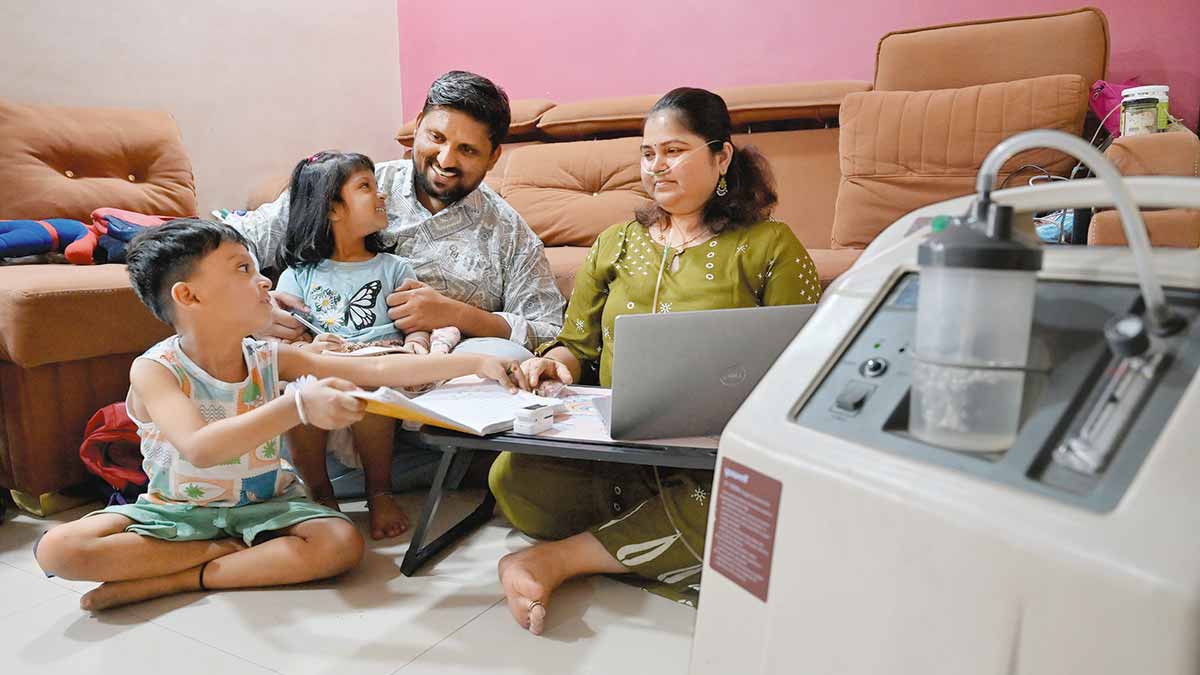
At her home in Navi Mumbai, Sunayana Ghadge, 39, lives tethered to an oxygen concentrator that runs 24x7, its steady hum marking the rhythm of her breath. Diagnosed with interstitial lung disease (ILD), her condition has worsened over time. Six months ago, she did not need continuous oxygen support; today, she depends on four litres of oxygen, and even that feels insufficient. “If I reduce it, my oxygen level drops to 60–65 per cent (normal range: 95-100 per cent),” she says, describing the breathlessness, nausea and coughing that follow minimal physical activity.
Her disease has progressed to the point where a lung transplant is her only option, but for now, she remains on the waiting list, registered six months ago, with no certainty of when a suitable organ will become available.
The wait is governed by factors beyond her control—blood group, body size, height and weight—and when a donor is found, she will have to reach Pune within four hours for the surgery. Until then, her body continues to weaken. The prolonged use of steroids has led to weight gain and water retention, causing swelling across her body and placing additional strain on her heart. Her immune system is fragile, reacting sharply even to minor changes in weather or exertion. A slight shift in temperature or fatigue can trigger coughing and further complications, making everyday life unpredictable.
Ghadge lives with her husband Sushant and their five-year-old twins, Mauli and Malhar, trying hard to care for them, match their levels of activity and simply be a normal mother amid constant medical vigilance. Her day is structured around medication—10 to 15 tablets daily, including steroids and immunosuppressants—and careful monitoring of symptoms that can escalate quickly.
As her condition deteriorates, the wait stretches on, and survival depends not just on medical care, but on whether a matching donor arrives in time. “Doctors told us this is just the beginning. There are patients who have been waiting for years for a transplant,” says Ghadge, tearing up as she looks fondly at her kids.

Likewise, Ajit Singh Randhawa, 54, a former railways employee from Bhusaval in Maharashtra, spent nearly one-and-a-half months in the transplant ICU at MGM Healthcare, Chennai, waiting for a donor heart as his condition grew increasingly critical. Diagnosed with advanced ischaemic cardiomyopathy, a severe weakening of the heart muscle caused by coronary artery disease, his illness had progressed to heart failure, leaving transplantation his only option. “But the hardest part was the wait,” says his daughter Rashmeet. His heart had weakened to the extent that doctors placed him on an intra-aortic balloon pump, used to help the failing heart pump blood and maintain oxygen supply to vital organs, until a transplant became possible. Over the years, Randhawa had undergone multiple cardiac procedures, including angioplasty in 2016, 2019 and 2020, followed by bypass surgery in 2024, but his condition continued to deteriorate despite repeated interventions. “The biggest challenge was that almost every day he would fall to some or the other infection and related complications. So many times, he could not get the transplant done because his body was not in the ideal state to accept the organ,” says Amrita Kaur, his wife.
For patients awaiting organ transplants, survival often depends not just on the availability of a donor, but on whether the body can remain medically stable long enough to receive one. Doctors describe the waiting period as a constant battle against physical deterioration. Patients must undergo repeated blood tests, hospital visits, nutritional monitoring and intensive medication regimens to stay ‘transplant-ready’. As disease progresses, the body weakens steadily leading to muscle wasting, infections become more frequent, immunity declines and vital organs begin to struggle under prolonged stress. In many cases, patients are caught in a narrow medical window, that is, sick enough to urgently need a transplant, yet required to remain stable enough to survive the surgery and the powerful immunosuppressive drugs that follow. For families, this prolonged phase becomes an exhausting cycle of medical vigilance, financial strain and uncertainty. This can itself become a fight for survival.
In intensive care units, doctors frequently see the harsh reality of what prolonged waiting for a transplant does to patients. According to Dr Shruti Tandon of Jaslok Hospital in Mumbai, deterioration while waiting for a transplant is a common occurrence. “Patients with liver failure come with acute decompensation,” she explains. “But because there is no donor, we lose them.” Tandon recalls a case involving a man in his mid-fifties, who had initially listed at one hospital and later registered in another state in the hope of finding a suitable liver donor. He and his family spent nearly a year moving between locations while waiting for the transplant opportunity. Eventually, when a donor did become available, his condition had deteriorated so severely that surgery could not be performed.
Take the case of Netaji Chavan, a 44-year-old businessman from Mumbai’s Sion, who spent five years waiting for a liver transplant. What began in February 2021 as a routine case of jaundice was later diagnosed as liver cirrhosis. Chavan had been battling decompensated cirrhosis, a severe stage of liver disease marked by complications such as abdominal fluid accumulation, jaundice and muscle wasting. From then on, his health became increasingly fragile. His wife, Shrutika Chavan, recalls a cycle of complications, falling sodium levels, low haemoglobin, dropping platelets, recurring infections and a stomach ulcer that required frequent hospitalisation. “He had to be admitted at least 15–20 times before the transplant,” she says.
Chavan had been on the deceased donor waiting list since April 2021. There were moments of hope when the family received calls about potential cadaver donors, sometimes multiple times in a week, but the surgery never materialised. In some cases, the process went as far as hospital admission and preparation for surgery, only to be halted at the last minute. “He was even taken into the operation theatre once, and then brought out because the liver was found unsuitable,” says Shrutika. Over time, his condition worsened, with increasing fatigue, abdominal pain, panic episodes and repeated need for blood and platelet support. After multiple failed attempts, the transplant was finally successful. While some issues like blood and platelet levels still require monitoring, Shrutika says his condition has improved, marking the end of a long and uncertain wait.
In case of liver transplants, during prolonged waiting periods, patients’ bodies undergo noticeable physical decline. One of the earliest and most visible signs is severe nutritional deficiency. Patients become increasingly weak and lethargic as their disease progresses and there is a lot of muscle wasting, Tandon explains. “At the same time, the body begins to swell because of low levels of albumin, a protein produced by the liver that helps regulate fluid balance,” she says. “As a result, patients may appear swollen in the abdomen and feet, masking the significant loss of muscle mass underneath. Reduced appetite further worsens the condition. Many patients consume less food because of dietary restrictions, including limits on salt intake. Their bodies begin breaking down muscle to compensate for protein deficiencies. Over time, patients become severely nutritionally depleted and physically frail. Slowly, the patient withers away.”
As liver failure progresses, other visible symptoms appear. Patients may develop a slate-grey skin tone, brittle nails, and yellowing of the eyes during advanced stages of disease. Even routine activities become exhausting. Breathlessness is common, although it is often caused by fatigue rather than a direct lack of oxygen. Patients may also experience internal bleeding, leading to vomiting blood or passing blood in their stools.
“Almost every day we receive calls from family members whose loved one is battling organ failure as they await transplants, and you can feel the desperation in their voice,” says Jaya Jairam, programme director at MOHAN Foundation, an NGO dedicated towards organ donation and transplants. “Waiting for an organ transplant is not just emotionally exhausting, it is medically challenging as well. That is why timely organ donation is so critical. Even slight delays can significantly impact survival and quality of life.”
While kidney patients at least have dialysis as a temporary lifeline, says Jairam, patients requiring organs such as the heart or lungs have no such support systems. “For kidney failure, dialysis can prolong life. For liver transplants, there is still the possibility of a living donor stepping forward from the family. But for organs like the heart and lungs, patients are entirely dependent on deceased donors,” she says. “Many people do not survive long enough to receive a heart transplant. This is because of acute shortage of cadaveric donors in India.”
Recalling a particularly painful case, Jairam talks about a young man in his early thirties working at a multinational bank whose kidneys had failed. “He and his wife were constantly in touch with me. They had many questions about life after transplant, what to expect, how to prepare. We had several telephonic counselling sessions,” she said. The patient had registered himself on the transplant waiting list and was diligently undergoing dialysis. “He understood the importance of not missing dialysis sessions in order to keep his body in an ideal condition to be able to receive a donor kidney,” she explains. “Despite that, just three months later, his wife called to tell me he was no more.... It really brought home how uncertain life becomes for patients waiting for an organ.” She estimates “more than 4 lakh people suffer from end stage kidney failure, more than 50,000 suffer from end stage liver failure and an equal number suffer from end stage heart failure, all in the waiting game of seeking transplants”.
As per the National Organ and Tissue Transplant Organisation, the country faces a massive shortage of deceased donors, with nearly 90,000 patients currently on national waiting lists. In 2025, more than 20,000 organ transplants were performed in India, a fourfold increase from less than 5,000 in 2013. Yet, only 18 per cent of transplants currently being performed are with organs donated from deceased donors. That means patients waiting for especially a heart, which can only come from deceased donors, have very low chances of securing an organ soon after registering for it.
Even in the case of hand transplants, in which India leads globally as per government data, remaining transplant-ready for days comes at a high cost. Shriya Sathe (name changed) lost both her hands in an accident. The 23-year-old has to depend on others for day-to-day activities, which she finds “taxing”. “Every single minute I keep praying to God to please give me my new hands as soon as possible before anything else happens to my body and I am unable to receive them,” she says.
Whenever there is a loss of limb, depending upon whether it is a single hand or both hands, it affects the patient very badly, says Dr Subramania Iyer of Amrita Hospital, Kochi, making them psychologically very unstable and depressed. “Many of the patients who have come to us have said that they are on the verge of suicide because their life is meaningless as they have to depend upon other people,” he says. Patients coming in for a hand transplant are asked to wait for a year, he adds, to ensure that the scarring of the wounds is complete and to prepare them for lifelong care of their transplanted hand.
The most important thing to do when the patient is waiting for the transplant, say doctors, is to start physiotherapy and muscle strengthening exercises and keep the joints supple and mobile, which also help their functional recovery post transplant. If that’s not done, there will be wasting of the muscles, and joint contractures can occur. Neuromas (thickening of nerve tissues), too, can form and they can be painful and this scarring has to be excised while the transplant is done. Patients also tend to become obese because of lack of physical activity. Those with comorbidities become ineligible for transplants if they are not able to stabilise their condition. Lack of personal hygiene and nutrition also contribute to their deteriorating condition, as does age. The more they wait and the more they age, undergoing a rigorous surgery as well as taking immunosuppressants may become a problem, says Iyer.
But there are times when patients show remarkable determination and persistence while waiting for a transplant. Dr Haresh Dodeja, director of nephrology and transplant services at Fortis Hospital in Mumbai’s Mulund, recalls a recent case of a middle-aged woman who waited nine years for a cadaveric kidney transplant while continuing dialysis treatment. Poonam Das had been under his care for years before finally receiving a transplant last year. While such outcomes are not always possible, said Dodeja, her disciplined approach to treatment helped her survive the long wait. “She would do regular follow-ups and tests, and we were able to do everything by the book for her,” he says. As for Das, she tells THE WEEK that what pushed her to keep at it was her “determination to live and the knowledge that this was the only option” she had.
Dialysis, however, is not a complete substitute for kidney function. According to Dodeja, the treatment replaces only the excretory function of the kidney, removing waste products from the body. It cannot fully replicate the organ’s synthetic functions, which are necessary for producing certain hormones and maintaining metabolic balance. As a result, patients continue to require multiple medications even while undergoing dialysis. “The side effects of kidney damage still remain and continue,” he says. Over time, the limitations of dialysis become increasingly apparent. Standard haemodialysis removes many toxins from the body, but some molecules known as ‘middle molecules’ are not efficiently eliminated. Advanced forms of dialysis such as haemodiafiltration can remove them more effectively, but these treatments are more expensive and not widely available in many centres. As the years pass, patients gradually begin to deteriorate physically. The strain of chronic kidney disease and long-term dialysis often affects multiple organs, says Dodeja. “The heart takes a hit, infections become a possibility, and the fistulas used for dialysis may fail,” he says. When fistulas fail, patients sometimes require catheters inserted into the neck, known as permanent catheters or ‘perm caths’. These, too, carry risks such as infection or clotting. “There were times when the entire process of repeated dialysis day in and day out for nine years became too much to bear and the wait just seemed endless,” recalls Das. “I went through bouts of infections, acute fatigue, weariness and emotional drain, but somehow I persisted.” Repeated hospitalisations are also common. “After a couple of years, patients invariably get hospitalised once or twice for different problems related to kidney disease and dialysis,” says Dodeja.
Das says, and Dodeja concurs, that she managed to withstand these challenges largely because of strict adherence to medical advice. Diagnosed in her late forties, she continued working throughout much of her treatment and maintained a rigorous follow-up routine. “The right thing is to see the doctor every month so that every report is reviewed and guidelines are followed,” says Dodeja. Monitoring haemoglobin levels and maintaining proper calcium and phosphorus balance are critical to managing complications of kidney disease. However, many patients eventually become fatigued by the repetitive nature of dialysis and medical visits. Some begin skipping follow-ups and only return when complications arise.
Nutrition also plays a crucial role in long-term outcomes for those on long waiting lists. Dodeja notes that many dialysis patients mistakenly continue restricting protein intake because they were advised to do so earlier in the course of kidney disease. Once dialysis begins, however, the kidneys are already non-functional, and patients should actually consume normal amounts of protein to maintain strength and overall health.
Apart from the medical cost of declining health, prolonged waiting for an organ incurs huge financial strain on families. Rashmeet tried crowdfunding the expenses for her father, but for a bill of Rs85 lakh, only Rs29,000 could be raised until the day of the transplant. “Each day in the ICU cost us Rs1 lakh, while the overall cost of the transplant surgery, ICU care and recovery was estimated between Rs80 lakh and Rs1 crore,” she says.
At the same time, many patients from lower-income backgrounds struggle to afford even routine treatment for liver failure. The cost of a transplant in a corporate hospital typically ranges from Rs16 lakh to Rs20 lakh, excluding the cost of the donor surgery and the ongoing expenses of post-transplant care. Even when families manage to raise money through fundraising or community support, long-term treatment can remain financially overwhelming, says Tandon. She recounts the story of a patient whose son was both her donor and fundraiser. He travelled widely, requesting schools, organisations and community groups for financial support for his mother’s transplant. After months, he managed to arrange the necessary funds and donate a portion of his liver to her. Doctors operated during a narrow window when she was stable enough for surgery.
The transplant was initially successful, and the patient survived for a few years. But the financial consequences lingered. Even after the surgery, the son continued to struggle with debts incurred during the treatment. Follow-up consultations were provided without charge by the medical team, but medication costs and repeated hospital visits remained difficult to sustain. “There was a point when he had to give up,” says Tandon.
The financial cost of long-term dialysis, too, can be enormous. According to Dodeja, a kidney transplant at his hospital costs approximately Rs8 lakh, with an additional Rs1 lakh for investigations, bringing the initial cost to around Rs8 lakh–Rs10 lakh, including the first three months of follow-up care. After that, patients typically require medications costing roughly Rs1.5 lakh annually. Over a 10-year period, this means that a transplant patient might spend approximately Rs25 lakh in total. By contrast, dialysis performed three times a week in a hospital setting costs roughly Rs2,500 per session. Over 10 years, the dialysis procedure alone can cost around Rs38 lakh, without accounting for additional expenses such as medicines, investigations, consultations and hospital admissions. Altogether, the total cost of living on dialysis for a decade may reach Rs60–70 lakh.
For the Chavans, the financial burden compounded the strain. With no insurance coverage, the family spent over Rs23 lakh on the transplant surgery alone, and estimates that the total cost of treatment over the years reached Rs50 lakh.
Dodeja believes there is still widespread misunderstanding among patients about deceased donor transplants. Many people assume that registering for a cadaveric transplant means that they will receive an organ within months. In reality, he says, the waiting period could average five years or more, particularly in cities like Mumbai, where the demand far exceeds the number of available donor organs. But even in case of living donor transplants, the wait can be endless. Ghadge has been told that she can expect the transplant to happen within days or even years, and she must have her body prepared for it. “It is like we are battling with this unforgiving unsurety of what life will be like the next moment. It drives me crazy. I really feel if I don’t get a transplant soon I may go insane,” she says.
Jairam emphasises that conversations around organ donation need to happen much earlier within families. “Please pledge your organs and have this conversation at home,” she says. “When a family is grieving, organ donation is often the last thing on their mind. But if there has been a prior conversation, families remember the wishes of their loved ones. Many even reach out to hospitals, NGOs or the medical fraternity to ensure that those wishes are honoured.” She agrees that many people avoid discussing organ donation because they perceive it as a morbid topic. “But it is actually something beautiful and powerful,” she says. “We are not talking about donating organs while alive. We are talking about donating organs when we no longer need them, instead of burying or burning them away.” Calling organ donation “the highest form of giving,” Jairam adds: “An organ donor can save at least eight lives and impact entire families collectively. It is about leaving behind a legacy. You don’t need to be a doctor to save lives, you can simply be an organ donor.”
India’s organ transplant ecosystem has expanded significantly over the past decade, but the gap between demand and availability remains stark. According to NOTTO, India recorded 18,911 organ transplants in 2024; in 2013, it was 4,990. Much of this growth has been driven by living donations, which accounted for 15,505 transplants in 2024, underscoring the continued dependence on family members rather than deceased donors. Deceased organ donation, though slowly increasing, remains limited. India reported 1,128 deceased donors in 2024, up from 340 in 2013.
The rise reflects improvements in hospital networks, transplant coordination and awareness campaigns, but experts note that the numbers are still far below what is needed for a country of over 1.4 billion people.
Globally, India has emerged as one of the leading countries in organ transplantation by volume. With 18,911 transplants in 2024, India ranked third in the world, behind the United States (48,935) and China (24,684). Yet experts caution that the comparison masks a deeper reality: India’s transplant rate per million population remains far lower than many developed countries. While surgical capabilities have advanced rapidly, the availability of donors has not kept pace with the rising burden of organ failure. The result is a system where the operation itself may take only a few hours, but the waiting for a suitable organ can stretch indefinitely. And, that needs to change.
