



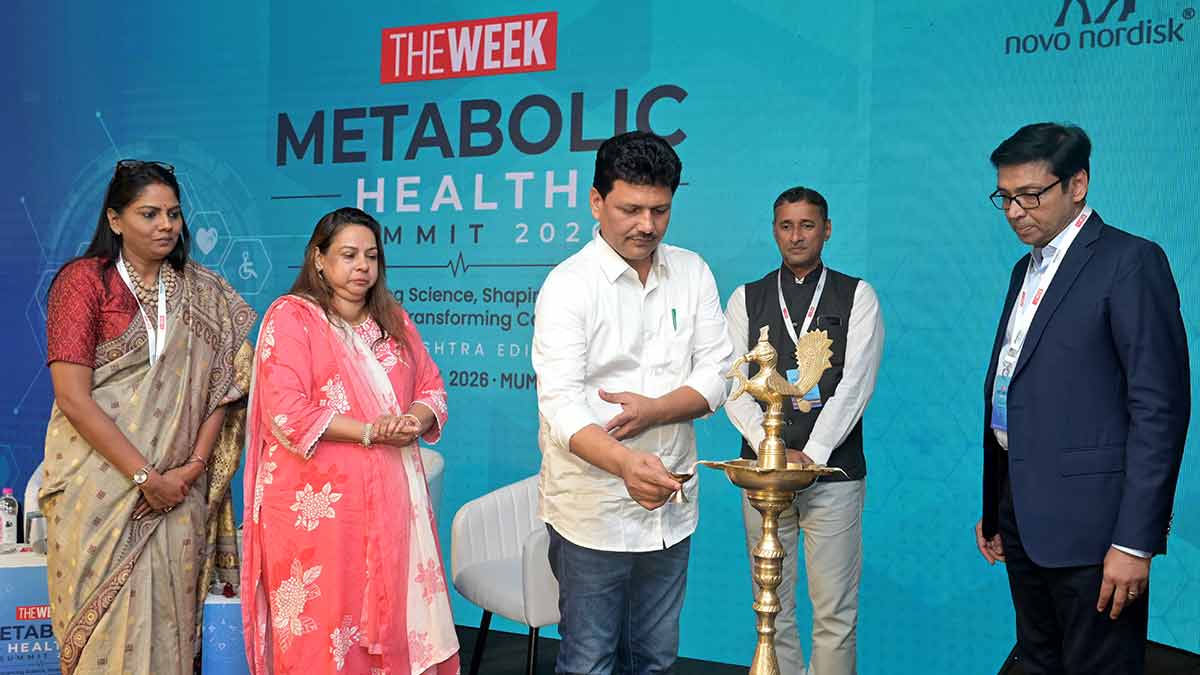
INDIA HAS SUCCEEDED in helping its people live longer. The next challenge is to ensure that those additional years are healthy. This theme was at the heart of the THE WEEK Metabolic Health Summit 2026, Maharashtra Edition, held at the Trident in Mumbai on August 6. It brought together policymakers, government officials, clinicians, public-health experts and leading doctors to discuss the future of cardiometabolic health.
The scale of the challenge was laid out by Dr Rajiv Kovil, senior diabetologist and medical director at Dr Kovil’s Diabetes and Obesity Management Centre, Mumbai. “In the next 10 to 15 years we are going to have a majority of deaths, maybe 80 to 90 per cent across the globe, based on these disorders (obesity, diabetes and related disorders),” said Kovil. India, he said, has 100 million people living with diabetes and 136 million with prediabetes—the highest globally. Around 65-70 per cent of deaths are attributed to non-communicable diseases. “Almost one per cent of our GDP goes to obesity-related disorders,” he said. “So this is not just a medical tsunami in India, but also an economic tsunami.”
The situation is particularly worrying because the disease burden is beginning early. Kovil cited data showing that, according to NFHS-6, one in four Indians is already overweight, while 5-10 per cent of school-going children have fatty liver disease, or metabolic dysfunction-associated steatotic liver disease. Nearly one in five people screened across the country, he said, has elevated blood sugar. For him, the answer cannot lie solely in medication. “Policy intervention has to make healthy food cheap and unhealthy food expensive,” he said.
The need to move from treatment to prevention was also central to the first panel discussion, ‘Designing Health Systems for Better Cardiometabolic Outcomes’. The panel brought together senior physicians from government and teaching hospitals across Maharashtra to examine how health systems could be structurally redesigned to deliver better outcomes.
Dr Atul Rajkondawar, the head of the Department of Medicine, Government Medical College, Nagpur, stressed the urgent need for effective prevention strategies to bring down the incidence of Type 2 diabetes. Dr Rosemarie D’Souza (head, Department of Medicine, Nair Hospital, Mumbai) said a person who appears thin can have visceral obesity—a risk factor for cardiovascular disease and mortality. The panellists were of the opinion that patients need to be active participants in care, with understanding of their condition.
An intervention which found broad support was catching them young. Panellists called for nutrition to be introduced as a subject in schools, arguing that children need to understand food, nutrition and healthy choices. If prevention is the goal, however, the recommendations have to translate into practice.
The second panel, ‘From Recommendations to Roadmaps’, brought together specialists from government medical colleges and hospitals across Maharashtra. Asked about the challenges, the panellists pointed to gaps: a lack of awareness, seamless continuity of care, stronger referral systems, digital health care and access to newer, affordable evidence-based pharmacological therapies.
Dr Sunil Bhaisare (head, Department of Medicine, Government Medical College, Chandrapur) pointed to the question of health-system investment. “All developed nations spend a significant amount of their budget on health and education but we are still lagging behind,” he said. “One cannot just open medical colleges; quality is also important.”
Dr Johann Varghese, a consultant endocrinologist in Mumbai, suggested three areas for policy attention: making nutrition a basic subject in schools, access to medicines important for the common population and education about preventive care.
Dr Pallavi Saple, director, Directorate of Medical Education and Research, Maharashtra, spoke about the need to make preventive medicine part of routine clinical practice rather than leaving it to community medicine. A paediatrician, Saple spoke about seeing 15- and 16-year-olds with hypertension linked to lifestyle factors.
She highlighted the NCD Corner initiative, supported by Maharashtra Health Minister Prakash Abitkar, under which people visiting medical colleges can be screened for non-communicable diseases and receive lifestyle advice. Saple called for a symbiotic relationship between government and industry to strengthen such efforts.
Health Minister Abitkar, who lit the ceremonial lamp at the summit, also emphasised on the need to prioritise prevention over cure. Last year, Abitkar had launched a statewide organ donation campaign by personally filling out a pledge form—the Angdaan Jeevandaan Sanjeevani Abhiyan. He used the summit to provide an update: “I am proud to share that more than one lakh people joined the campaign. Though the progress in organ donation has not been as expected, it is picking up.”
The summit also examined how newer pharmacological therapies could change the management of metabolic diseases.
Varghese discussed semaglutide and its potential role in diabetes management and reducing cardiometabolic complications. He argued that its benefits needed to be considered in the broader context of preventing non-communicable disease and cardiovascular complications, while also outlining situations in which clinicians would exercise caution, including a history of pancreatitis, family history of medullary thyroid cancer, symptomatic gallstones, previous allergic reactions to semaglutide and pregnancy planning.
The conversation around newer therapies brought the discussion back to a recurring theme of the summit, that innovation has meaning only when patients can actually access it. The summit was supported by Novo Nordisk, whose more than century-long history has been closely associated with innovation in diabetes and obesity care.
For a country facing a rapidly expanding metabolic burden, the challenge is bigger than any drug. It is about changing how India thinks about metabolic health: from disorders treated after diagnosis to something prevented across homes, schools, communities and health systems.
