




It was a regular workday in February 2016, but not so for Rajiv Mehrishi. The Union home secretary was at his office in North Block, going through and replying to queries from Pakistan on the 26/11 Mumbai terror attacks. Pak authorities were carrying out their own investigations into the attacks, and they wanted India to provide them information.
The feeling in New Delhi was that it had waited long enough for Islamabad to bring the Pakistan-based culprits to book. India had replied promptly to the first list of 30 questions Pakistan had sent in 2009. In 2013, it twice allowed teams comprising members of the judicial commission of Pakistan to meet and cross-examine key witnesses. Despite all this, Islamabad continued to drag its feet.
When Narendra Modi came to power in 2014, India set about the task of driving Pakistan into a corner in the terror issue with renewed vigour. With Ajit Doval as national security adviser, New Delhi decided that it would not allow Islamabad to continue its delaying tactics. So Mehrishi, who had taken charge only a few months earlier, dealt with the queries quickly, providing additional evidence against the accused in Pakistan.
“It has been more than a year since all the information sought by Pakistan were provided,” said a senior home ministry official. “But we have not heard from them since.”
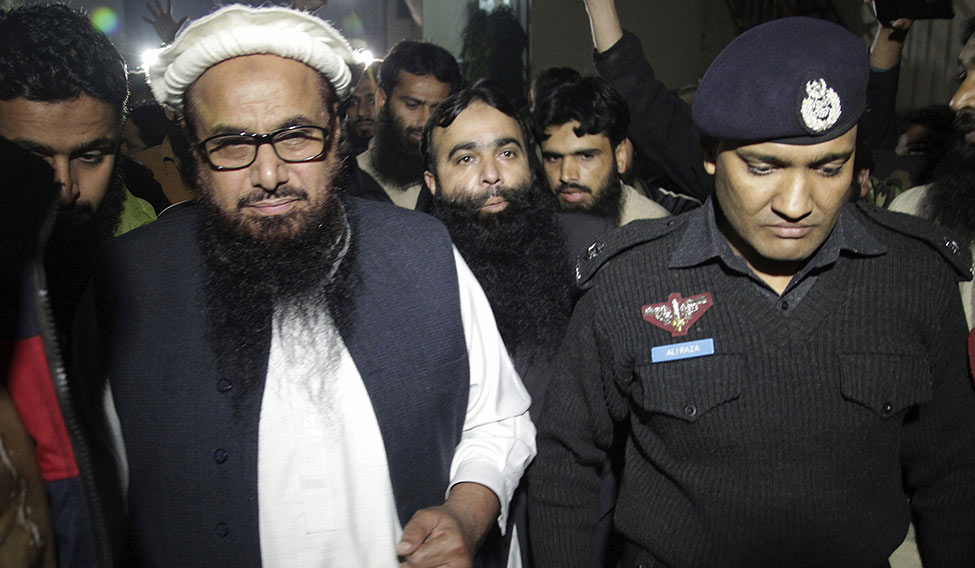
What is now being heard, though, are the fresh noises Islamabad is making about seeking the deposition of 24 Indian witnesses. India, on its part, has been insistent that Pakistan put Jamaat-ud-Dawa chief and Lashkar-e-Taiba cofounder Hafiz Saeed and LeT operational commander Zaki-ur-Rehman Lakhvi on trial in the light of the evidence it has already provided.
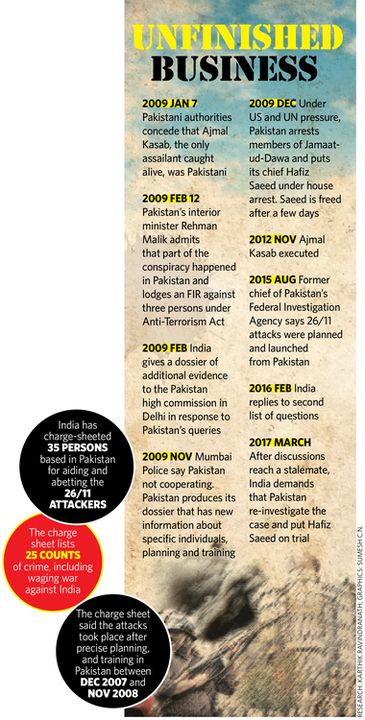
The result is a stalemate, with war of words replacing action. “We have not received any written request from Pakistan seeking deposition of Indian witnesses,” said the home ministry official. “There has been no action from their side for all these months.”
For its part, Pakistan does not seem to be interested in proceeding with the case. “Just because India wants us to take action against certain people, it does not mean that we should act against our own people,” retired lieutenant colonel Bashir Wali Mohmand, former director-general of the Pak intelligence bureau, told THE WEEK from Islamabad. “On the other hand, it is a fact that we never blamed India openly. It was only when we caught a serving Navy official spying in Balochistan that we approached the United Nations. India’s interference in KPK (Khyber Pakhtunkhwa) and Balochistan is a major issue for us. I am also sure that India is using Afghans [against Pakistan]. I am a son of that soil and I know it. But, is India investigating all these issues?”
According to Wali Mohmand, India was lucky “that we have a mild government which allowed the Indian prime minister to lash out against Pakistan during his visit to Kabul and then land in Islamabad without visa and passport”. He was referring to Modi’s sudden stopover in Islamabad, where he was welcomed by Prime Minister Nawaz Sharif in December 2015.
For Wali Mohmand and others who are part of the Pakistani establishment, the Mumbai attacks trial is not a priority. He said Saeed and the JuD were engaged in social work in Pakistan, helping people affected by earthquakes and other calamities. “Let there be an FIR against him first,” he said. “Why should we arrest him? Let’s stop playing games first, and start by being honest and truthful.”
M.L. Kumawat, who was special secretary (internal security) in the home ministry at the time of the 26/11 attacks, said he was sceptical about the trial in Pakistan moving forward. “The fresh noise from Pakistan is a giveaway of the fact that it does not want to act,” he said. “The culprits may never be brought to book. The tactics being employed by that country in allowing Saeed to roam freely and change the name of his organisation show the intricate relationship between state and non-state actors in Pakistan. When Pakistan is using these non-state actors against India, how will it act against them?”
 Bashir Wali Mohmand
Kumawat was in North Block when terrorists began laying siege to Mumbai. Madhukar Gupta, then home secretary, was away in Murree in Pakistan holding talks with his Pak counterpart. In Gupta’s absence, it was Kumawat who coordinated the initial response of commandos of the National Security Guard as they rushed to Mumbai.
That is all water under the bridge now. But Mehrishi continues to bear the burden of an unaccomplished task: punishing those who were behind the attacks. At North Block, the morale is down as New Delhi seems to have exhausted all diplomatic and legal options. “There is no extradition treaty with Pakistan,” said Kumawat. “There are 35 wanted in the case and they are in Pakistan. Anyone who knows how Pakistan and the ISI [Inter-Services Intelligence] work would understand that the case has got a silent burial.” Unless, of course, he said, there was a political decision to the contrary.
But those who are part of the Pak establishment give no indication of any such political decision. “I would say there is a trust problem,” said Wali Mohmand. “Whether it is Mumbai or Pathankot, whatever happens in India is blamed on Pakistan and the ISI. Every time, Pakistan has agreed to carry out an inquiry. It is time India came forth on its own activities against Pakistan.”
According to him, it was “silly” on the part of the Pak government to put Saeed under house arrest in January. “If this government is strong, it should not take pressure from the US or India. I believe it [putting Saeed under house arrest] was done in the larger interest and not to demonstrate any intent related to the Mumbai case. If he has done anything wrong, let the law take its own course,” said Wali Mohmand.
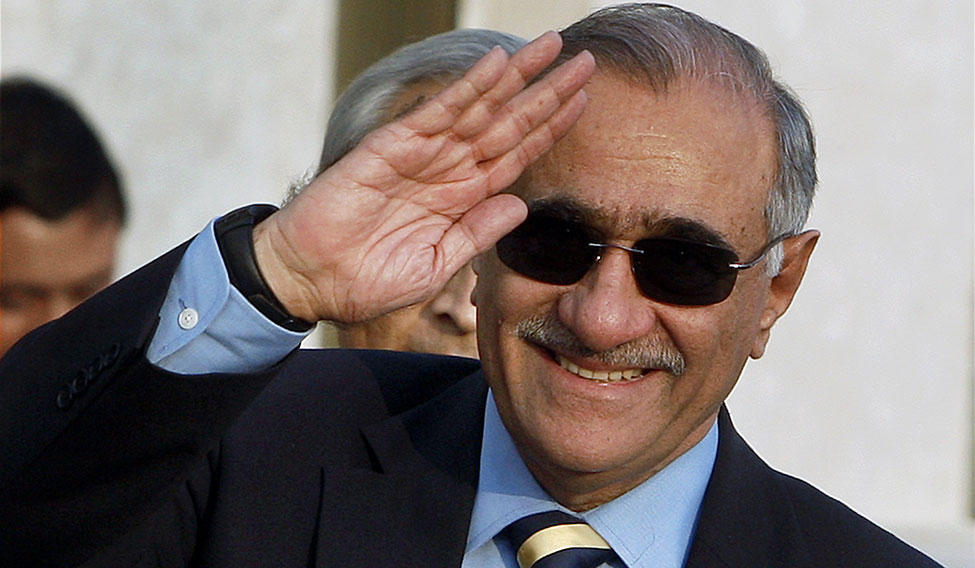 Mahmud Ali Durrani, former Pak national security adviser
But Mahmud Ali Durrani, former Pak national security adviser, said Saeed had lost his utility and must be punished. “Pakistan should take action against him. The 26/11 terror attacks in Mumbai were carried out by a group based in Pakistan,” he said. Durrani, however, insisted that the Pakistani government and the ISI had no knowledge about the group’s plans.
Security experts in Delhi said Durrani’s admission had little value, as it was becoming clear that the trial had come to a standstill. With Pakistan freeing Saeed, and its interior ministry keeping mum on the case, North Block seems to be struggling to break the deadlock.