



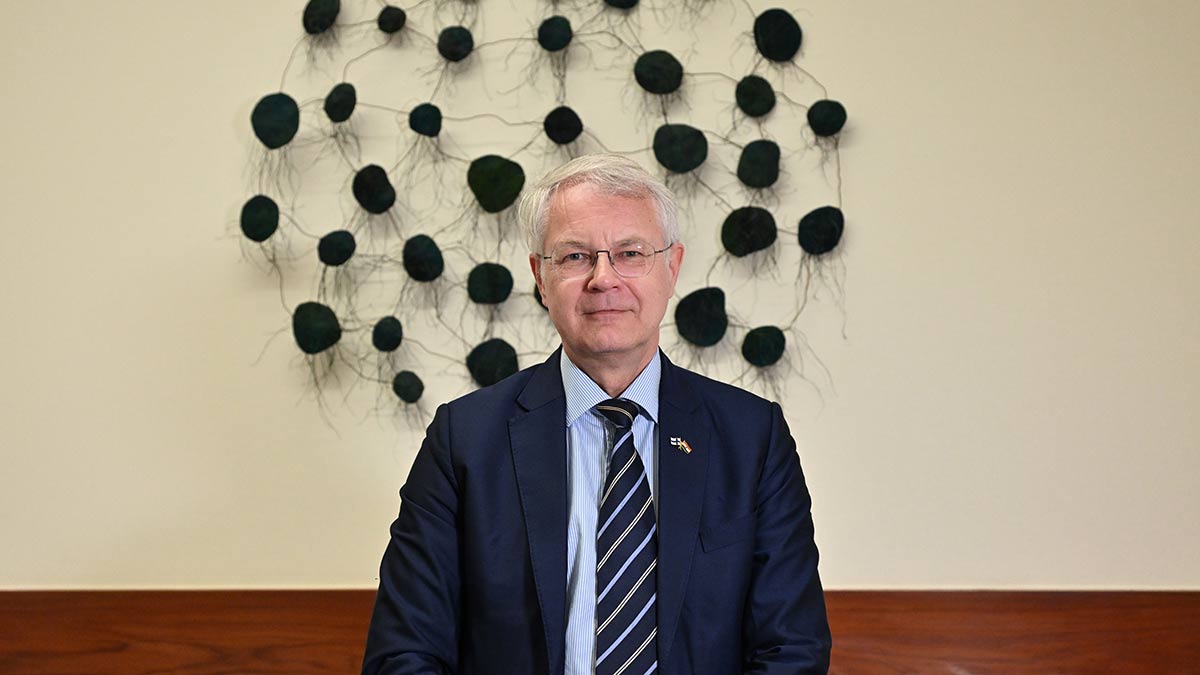
Interview/ Kimmo Lähdevirta, ambassador of Finland to India
DAYS AFTER THE European Union and India concluded the largest free trade agreement either has ever negotiated, Finland finds itself at the crossroads of multiple opportunities with India. As Prime Minister Petteri Orpo prepares to visit New Delhi for the AI Impact Summit, and India gears up to host the World Circular Economy Forum in partnership with Finland’s Innovation Fund Sitra, Helsinki is positioning itself as a key bridge between Europe and India. In an exclusive interview with THE WEEK, Ambassador Kimmo Lähdevirta outlines how the new FTA will reshape economic ties, how Finnish clean-tech and circular economy solutions can help Indian cities and the opportunities for Indian students and professionals in Finland. Edited excerpts:
Q/ How do you see the free trade agreement reshaping economic ties between India and Europe, particularly Finland?
It is the largest trade deal that either side has made so far. We strongly believe that the agreement will increase trade and investment in both directions and deepen political ties between India and the EU. What is also important in the present-day world is that it increases stability and predictability. At the moment, trade in goods and services between India and Finland is about 3 billion euros altogether, counting both imports and exports. Considering the benefits the FTA will bring, I think we should aim to double trade by 2032, as has been estimated could happen.
Q/ Which sectors stand to gain the most from this deal?
Finland mostly exports industrial goods to India. We have strong areas such as machinery, including energy production, and telecoms manufacturers like Nokia. Everything related to those sectors will be important, but there are also many other sectors that we see as benefiting.
Q/ How would you describe India–Finland ties today, and what are Finland’s top priorities for the next five years?
The relations are strong and growing. We already have 75 years of diplomatic ties behind us, and trade, as I said, is now about 3 billion euros annually. We have over 100 Finnish companies doing business in India and about 20 Indian companies in Finland. There are direct flights between our capitals, and tourism and business ties are expanding.
Over the next five years, we will continue to promote our DESI+M approach, increasing cooperation especially in these areas. Another important priority is to fully utilise the potential provided by the free trade agreement. Doubling bilateral trade would be a good goal. This year, we also have a very important goal, as India will host the World Circular Economy Forum towards the end of the year in cooperation with Finland and the Finnish Innovation Fund Sitra.
Q/ You have travelled across India. Which states matter most for Finland, particularly in manufacturing?
Most Finnish companies are present in Maharashtra, West Bengal, Gujarat and, of course, the Delhi region. These are the main hubs. This is also reflected in where we have our diplomatic missions or honorary consulates. The most recent addition was in Ahmedabad in June, where we appointed Kulin Lalbhai as our honorary consul. Finnish companies also operate in other states, in a variety of sectors.
Q/ Where can Finnish clean-tech and circular economy solutions most realistically help Indian cities?
First, it is important to identify sources of pollution. We have advanced monitoring technologies and clean-tech sensors that can locate pollution sources in real time.
We also offer solutions in waste management, renewable energy and decarbonisation, including reducing emissions in construction. Finnish companies are partnering with Indian firms to convert agricultural waste into bioenergy and plastic waste into new packaging. These solutions work best when paired with local urban planning and circular economy principles.
Q/ Finland is now a member of NATO, which you joined after Russia invaded Ukraine. What has changed in practical terms for Finland’s security?
We see NATO as a source of security. A regular poll conducted last year showed that about 75 per cent of Finns feel NATO membership strengthens their sense of security. Since accession, we have increased personnel in NATO structures, strengthened coordination mechanisms and conducted joint military exercises in Finland and abroad. We have also approved eight NATO treaties within one year, including the Status of Forces Agreement and the Paris Protocol.
Q/ Given India’s ties with Moscow, what role does Finland expect India to play?
We see India as an important global player, with the ability to be heard across the West, the east and the Global South. We hope India continues to use its contacts with Russia to help bring the war to an end.
Q/ Are high-level visits between India and Finland expected in the near future?
We are looking forward to Prime Minister Petteri Orpo’s visit to India this month to attend the AI Impact Summit in New Delhi, accompanied by a business delegation. This will highlight Finland’s expertise in AI and give Finnish companies direct access to Indian decision-makers. President Alexander Stubb and Prime Minister Narendra Modi have remained in contact, and both sides have expressed interest in deepening political and economic ties. Prime Minister Modi has invited President Stubb to visit India, although no timeline has been finalised.
Q/ As more Indian students and professionals look to Finland, what steps are being taken to ease mobility and long-term integration?
We actively seek Indian talent through the Talent Boost programme. The number of Indian students in Finland is rising, with around 2,000 currently enrolled. We aim to make mobility simpler and mutually beneficial. Finland offers over 600 bachelor’s and master’s programmes in English, along with competitive tuition fees and scholarships. For long-term integration, learning local languages alongside English is helpful.
