



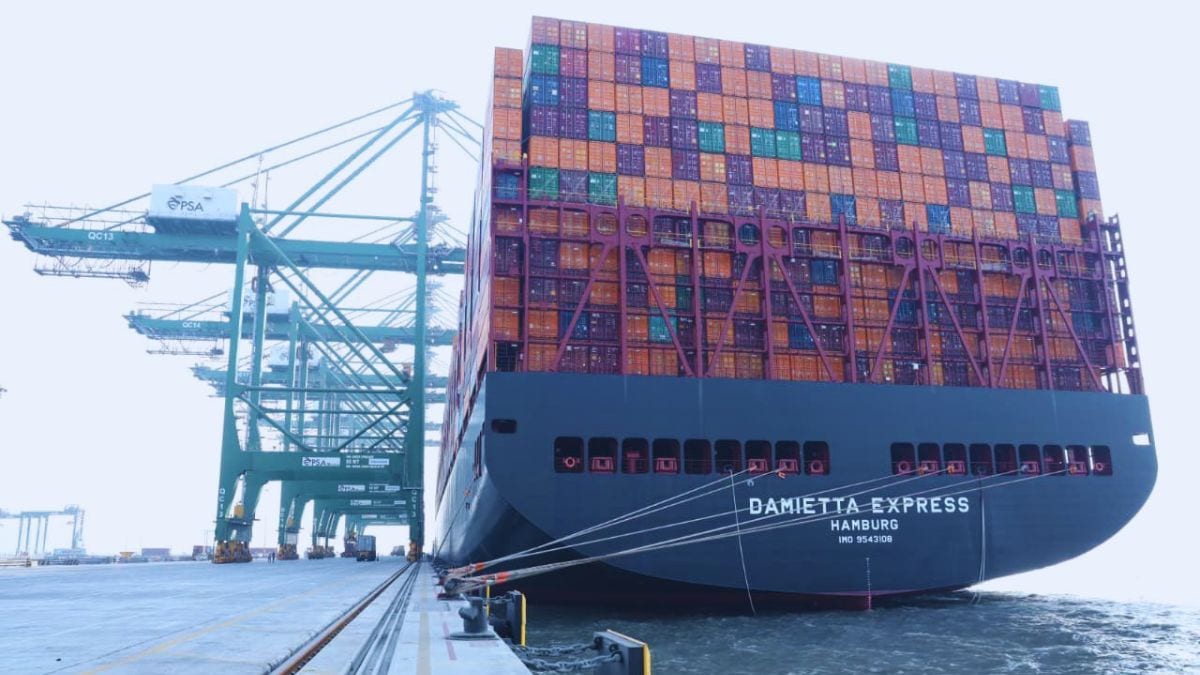
The Jawaharlal Nehru Port (Nhava Sheva) is all set to benefit from a major revamp in Red Sea-linked services.
The Emirates Shipping Line’s (ESL) on November 1 modified its South Red Sea (SRS) service, making it a dedicated shuttle between the Maharashtra-based port and the Jeddah Islamic Port in Saudi Arabia, as per a Dynaliners report. This marks a major boost for cargo handling at one of the busiest container ports on India’s western coast.
The new SRS rotation will be:
Nhava Sheva → Jeddah → Nhava Sheva
Two vessels ranging from 1,800 TEUs to 2,600 TEUs will operate the service every nine days.
Notably, THE WEEK had reported in early June that the Jeddah port had joined the SRS service, alongside the Mundra and Djibouti ports.
The November 1 report noted that the Jawaharlal Nehru Port will also be a part of ESL’s North Red Sea (NRS) rotation—a wider one connecting it with the Port of Djibouti, the Aqaba Port in Jordan, the Ain Sokhna Port in Egypt, and the Sohar Port in Oman—as follows:
Nhava Sheva → Djibouti → Aqaba → Sokhna → Sohar → Nhava Sheva
Two vessels ranging from 1,700 TEUs to 2,500 TEUs will operate the service approximately every fortnight.
However, THE WEEK could not independently verify if the Mundra Port in Gujarat will be assigned to a separate service, or if it was removed from ESL’s Red Sea services altogether.
This comes as other shipping lines are also attempting a cautious return to Red Sea transits, with Maersk and Hapag-Lloyd announcing on November 2 that ships under their ME1 Gemini service would soon sail on the trans-Suez route again, instead of going around the Cape of Good Hope, thus reducing transit times and saving fuel.
The ME1 is a shipping service under the Gemini Cooperation—a hub-and-spoke maritime partnership between Maersk and the German carrier Hapag-Lloyd, that services the East-West trade routes.
Notably, the Jawaharlal Nehru Port has also been retained under the revamped ME1 rotation, which also includes the Mundra Port as follows:
Mundra → Nhava Sheva → Salalah → SUEZ CANAL → Tangier → Rotterdam → Wilhelmshaven → Hamburg → London → Algeciras → Tangier → SUEZ CANAL → Salalah → Mundra
“Maersk and Hapag-Lloyd will continue to monitor the security situation in the Middle East region very closely, and any alteration to services within the Gemini Cooperation will remain dependent on the ongoing stability in the Red Sea area,” the Danish carrier said in a statement.
The first westbound ME1 transit will be done by the Liberia-flagged Atlanta Express (IMO: 9667162) from the Port of Salalah on November 4, while the first eastbound one will be done by the Savannah Express (IMO: 9665607) from the Tangier Port on November 13.
Why Nhava Sheva?
The Maharashtra-based gateway port climbed to the 22nd spot globally in the Container Port Performance Index (CPPI) 2025, also retaining its position as India's best-performing container port.
In September alone, it had handled more than 8.35 lakh TEUs of container cargo, registering a 28.63 per cent year-on-year boost. Overall throughput also grew by more than 18 per cent to reach 9.90 million metric tonnes (MMT).
This pushed its April to September container cargo handling this fiscal to 46.61 lakh TEUs, which reflects more than 17 per cent growth. Overall cargo throughput also grew by 13.36 per cent to reach 56.26 MMT.
Nhava Sheva also serves as a gateway to the Western Dedicated Freight Corridor (WDFC) rail network of high-speed cargo trains. In fact, it was the first port to be connected to India’s first double-stack long-haul container train under this network.
In any case, what this means is that cargo arriving under the Red Sea services gets fast, direct access into the National Capital Region (NCR) and other industrial regions in the vicinity.
