



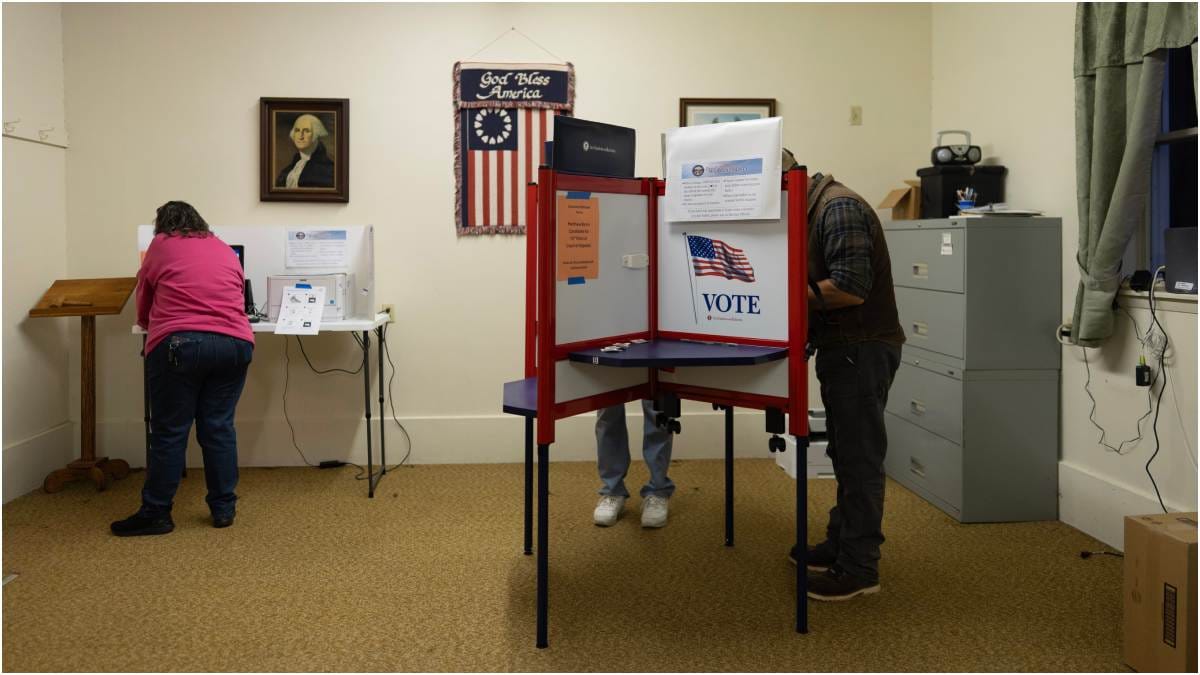
Voting is underway in the US for the crucial midterm elections that will decide which party controls the House of Representatives and the Senate.
The elections come at a time when voters are struggling with the price of fuel, groceries, housing and healthcare, while inflation remains above the level targeted by the US Federal Reserve.
President Donald Trump's Republican Party currently controls both chambers, but Democrats need to win four additional Senate seats and three House seats to take control.
Democrats are betting that discontent over Trump's failure to deliver on his promise to tackle rising costs, and perceptions that he has focused more on gilding the nation's capital than addressing the concerns of people, could depress Republican turnout and drive their own voters to the polls.
Republicans, meanwhile, are hoping their money advantage will help stem the tide as they fight to retain control of Congress.
More than 57 million people had already cast ballots as of Monday, with turnout surpassing the early vote four years ago in many closely watched states.
The results will shape the final two years of Trump's second term after the Republican-controlled Congress supported much of his agenda.
If they control Congress, Democrats would be better placed to block Trump's plans and could also launch investigations into the president and his team. Control of even one chamber would open the possibility of investigations and impeachment proceedings.
Still, margins are tight in both chambers, and one or two seats could tip the balance. Democrats need a net gain of four seats in the 100-member Senate, an uphill climb because many of the most competitive races are in historically Republican states. In the 435-member House, they need only three.
Republicans have tried to buck historical precedent, under which a president's party almost always loses seats during the midterms, with an aggressive redistricting effort aimed at creating a more favourable congressional map.
However, new districts drawn in Florida and other states to be safely Republican may not vote that way.
Only 35 per cent of US adults approve of Trump's performance as president, according to the most recent polling from AP-NORC Center for Public Affairs Research. Most blame him for high prices as they struggle to afford gas and groceries.
What was once his strongest issue is no longer: 25 per cent of US adults now say they approve of Trump's handling of the economy. Overall, about seven in ten say the country is heading in the wrong direction.
"The American people are angry. They want change," said Rep. Suzan DelBene, chair of the Democratic Congressional Campaign Committee, who said momentum was on her party's side.
In the Senate, Democrats have been most confident about picking up North Carolina and holding Georgia, where Senator Jon Ossoff faces Republican Mike Collins. Other key battlegrounds include Ohio and Alaska, while Republicans hope to hold seats in Iowa, Kansas and Maine and pick up Michigan.
In the House, Republicans are trying to hang on to their narrow majority as Democrats attempt to flip seats in states Trump has repeatedly carried, from Florida to Texas to Iowa.
An especially strong showing for Democrats would also boost potential presidential candidates, including Gavin Newsom, JB Pritzker and Pete Buttigieg, while the outcome could affect the political ambitions of Vice President J.D. Vance and other Republicans.
