



Our battlegrounds have shifted south of the Vindhyas. The Vijayanagar kingdom is already history, and Islamic rule is dominant across the peninsula. The Deccan sultanates are reigning and a young, ambitious military leader is itching to make his mark in history. Twenty-nine-year-old Shivaji, who has been dreaming of reviving Hindu swarajya, has been breaking chunks off Adil Shah’s territories. He needs to be contained.
The sultan sent his experienced general Afzal Khan with a 12,000-strong force to tackle the young Maratha. Khan, en route, destroyed temples that were patronised by Shivaji’s family. Given that there were enough Marathas in his army, this act was perhaps not to hurt Hindu sentiments, but to draw out Shivaji into the open, where Khan would be at an advantage. Shivaji, instead, headed for the fort of Pratapgarh, up in the Western Ghats.
The Adil Shahi troops moved into the very valley they wanted to avoid. “En route, Khan’s army was split. One faction remained in Wai, and the other camped at Paar, at the base of the Pratapgarh fort,” says Kedar Phalke, postdoctoral researcher on Shivaji at Pune’s Deccan College. “The two forces, however, lost their communication links with each other.” Then began the waiting; who would blink first.
According to Phalke, Khan made the first move, sending an emissary to Shivaji seeking total submission. Shivaji pretended he was too scared to move out of his fortress. He then sent his own emissary, with sleuths, to Khan’s camp, agreeing to meet in the valley, at a place of Shivaji’s choosing. The sleuths assessed that Khan had no intention of any peaceful settlement.
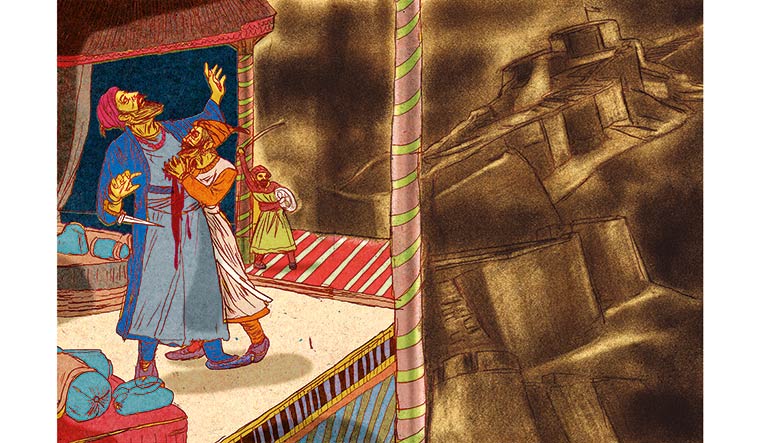
Shivaji and Khan agreed to meet unarmed, with ten bodyguards, each standing an arrow’s length away from the other. Peace, it turned out, was not the option either was seeking. On November 10, 1659, in the shamiana set up for the rendezvous, the two approached each other for a wary embrace. Khan had a dagger in the folds of his clothes, with which he made a stab at Shivaji. This was classic Khan strategy; he had eliminated a previous foe similarly. The Maratha was prepared; he was wearing a vest of mail. He had also worn a set of brass knuckles in one hand, which had metallic claws sticking out. In the other was a metal pincer. So while Khan’s dagger clunked dully on the armour, Shivaji’s claws dug deep into his enemy’s belly, pulling out the entrails.
Khan, the 6.7ft-tall giant, made a dash for the open, clutching his innards, but was decapitated by one of Shivaji’s men. (Some accounts, including the Sanskrit tome Shivaji himself endorsed, Shree Shivbharat, however, say Shivaji was armed with a toothed, flexible sword with which he killed Khan.)
The Adil Shahi army had lost their general even before the battle began. So, the Marathas made swift work of it. Shivaji fired a cannon, a signal to his men to attack. The rival force thought it was just a blast to celebrate the parleys and was caught unprepared, says Phalke.
In the true tradition of the valorous victor, Shivaji organised a proper burial for Khan in the valley where he died. Within a fortnight of the Battle of Pratapgarh, Shivaji’s forces had taken over most of the Adil Shahi assets. The age of the Marathas had begun.
“The Battle of Pratapgarh is a textbook example of planning, intelligence gathering and assessing the foe,” says Phalke. Khan’s battle plan had many errors. But, the fatal one was his assumption that the enemy had not studied his past strategies. Shivaji was prepared for the dagger attack, and had his own attack planned. Had Khan used a fresh ploy, would he have killed Shivaji? “If Shivaji had died that day, there would have been no Maratha empire,” says Phalke.
