



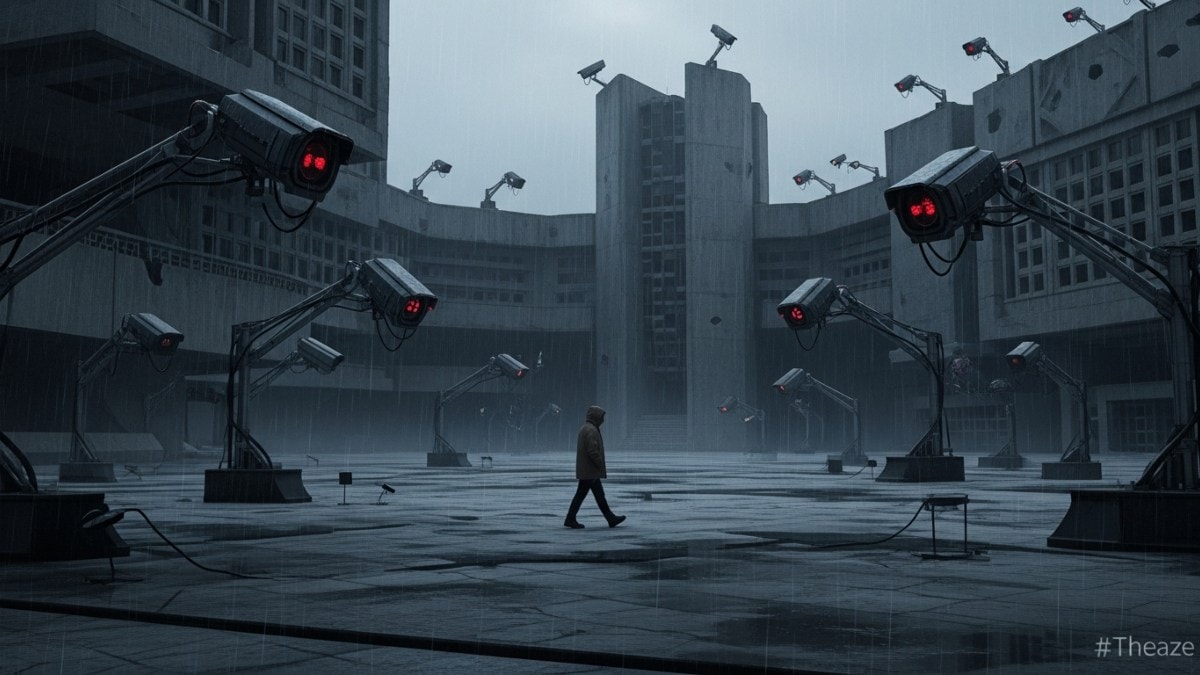
Most people know George Orwell’s 1949 novel Nineteen Eighty-Four to be a futuristic look at life under a totalitarian regime. Those in Myanmar, however—where Orwell spent five years as an officer of the Imperial Police Force in the 1920s—consider it to be a prophecy about their country. That is why, when Emma Larkin (a pseudonym for the author of Finding George Orwell in Burma) asked an old Burmese man about Orwell, the man slapped his forehead gleefully and said, “You mean the prophet!” Larkin spent many months in the country in the early 2000s tracing Orwell’s path, and she was amazed by the parallels between Nineteen Eighty-Four and Myanmar, which had been ruled by the military junta since the coup of 1962.
In Nineteen Eighty-Four, for example, every person’s house in the imaginary country of ‘Oceania’ has a ‘telescreen’—a surveillance instrument used by the thought police. The telescreen, writes Orwell, received and transmitted simultaneously. Any sound you made above the level of a low whisper would be picked up by it. There was no way of knowing for certain when or how often you were being watched. “You had to live—did live, from habit that became instinct—in the assumption that every sound you made was overheard, and, except in darkness, every movement scrutinised,” he writes. And it was not just the telescreen. Books, periodicals, posters, films, soundtracks and cartoons were regularly censored to glorify the supreme leader or ‘Big Brother’ of Oceania.
Under its military government, this kind of surveillance was not uncommon in Myanmar. A vast network of Military Intelligence spies ensured that no one could say or do anything that could threaten the regime, writes Larkin. The Burmese media—books, magazines, movies and music—was controlled by a strict censorship board and government propaganda churned out, not only through newspapers and television, but also in schools and universities. In short, it was “a place where Orwell’s nightmare visions are being played out with a gruelling certainty”.
Predictably, Nineteen Eighty-Four was banned in Myanmar because it could be read as criticism of how the generals were running the country. As a Burmese man told Larkin, why did they need to read it? They were already living inside it.
Things have changed, but not much. The country has been caught in a civil war since the coup of 2021. Today, the power of the military junta has decreased. It is estimated that it controls only about 30-40 per cent of the country, with the border regions under the control of various ethnic groups who have set up parallel governance systems. The elections of early 2026 were mostly a sham, won by the military-supported Union Solidarity and Development Party. The conflict in Myanmar has displaced an estimated 3.6 million people, with 12.4 million facing acute food insecurity.
According to ACLED (Armed Conflict Location & Event Data)—a global conflict monitor—the Myanmar military accounted for nearly a third of all violence committed by state forces against its own citizens in 2025. Israel and Russia were collectively responsible for 88 per cent of all violent incidents that targeted civilians outside their borders.
ACLED posits that this is part of a larger trend of states contributing to an ever-increasing share of global conflict. “Government forces were directly involved in 74 per cent of violent events worldwide in 2025, the highest recorded share since ACLED reached global coverage six years ago,” it says. “Likewise, civilians around the world do not just face more violence; they face more state violence. State-led violence that targets civilians has increased threefold since 2020: State forces are now responsible for 35 per cent of global violence directed at civilians, compared to 20 per cent in 2020.”
This violence is often in indirect ways. In Palestine, for example, it takes the form of severe curtailing of freedoms by Israel. Writer Nathan Thrall’s Pulitzer-winning book ‘A Day in the Life of Abed Salama’ gives a chilling picture of how things have changed in Palestine since the Israeli occupation even before the Gaza war. During the youth of Abed Salama, a Palestinian living in Anata, the quiet, rural village was dotted with olive and fig trees and open fields of wheat and lentils, writes Thrall. Homes had outhouses, and women carried water from a nearby spring in large jars balanced on their heads. Children bathed in giant buckets brought into their living rooms once a week, on Fridays, afterwards lining up with wet hair to thank their fathers with a kiss on the hand, receiving in turn a kiss on the forehead and a blessing of comfort and bliss, known as na’eeman.
Anata began to change after Israel conquered it and the rest of the West Bank in the 1967 war. “In Anata, the government seized the land piece by piece, issued hundreds of demolition orders, annexed part of the town to Jerusalem, erected a separation wall to encircle its urban centre, and confiscated the rest to create four [Jewish] settlements, several settler outposts, a military base and a segregated highway split down the middle by another wall…,” writes Thrall.
“The town’s natural pool and spring was turned into an Israeli nature reserve, which was free to the settlers of Anatot but charged admission to the people of Anata. The road to the spring went through the settlement, which Palestinians could not enter without a permit, so they had to use a different route, taking a long detour on a dangerous dirt road.”
‘A Day in the Life of Abed Salama’ is about the death of Abed’s five-year-old son Milad in a bus crash 14 years ago, and about Abed’s harrowing search for his son after the accident. The accident itself, Thrall claims, was a result of the systemic oppression of the Palestinians by the Israelis. The children were in the bus in the first place because they could not play in the nearby Jewish settlement, and instead had to take a detour to a playground along a “death road”. Emergency services in the Israeli-controlled area did not take the situation seriously, and the bus burned for more than half an hour before official help arrived. Although the hospitals in Jerusalem were far better, most of the children had to be taken on the flooded road (it was raining heavily that day) to the hospital in Ramallah, because only drivers with blue IDs could enter Jerusalem.
“This is a very segregated place,” Thrall told THE WEEK earlier. “You have Jewish-only communities right next to Palestinian-only communities with almost zero interaction between them. And so, I thought I needed something like a car accident, some sort of event that would bring these segregated lives into contact with one another, if I wanted to tell the bigger story of Israel-Palestine.”
The case for a totalitarian state goes as far back as Aristotle, for whom the state was to be an entity with sweeping powers to produce good and virtuous citizens. The individual existed for the state and not the other way around. ‘The good life’ is something the state defines and enforces through law and education, thus leaving very little space for dissent, or for people who disagree with the state’s definition of ‘virtue’. A state with sweeping powers will, therefore, be a state that produces moral absolutism, constricting instead of expanding people’s freedoms.
This kind of mind control and moral ‘bending’ by the state was predicted by Orwell decades ago. In Nineteen Eighty-Four, everyone is supposed to take part in a daily ceremony called Two Minutes Hate, where the face of the main rebel leader of Oceania is broadcast on the telescreen, and everyone spews hate at him. People leap up and down, shouting at the top of their voices. “The horrible thing about the Two Minutes Hate was not that one was obliged to act a part, but that it was impossible to avoid joining in,” writes Orwell. “Within 30 seconds any pretence was always unnecessary. A hideous ecstasy of fear and vindictiveness, a desire to kill, to torture, to smash faces in with a sledgehammer, seemed to flow through the whole group of people like an electric current, turning one even against one’s will into a grimacing, screaming lunatic.”
