



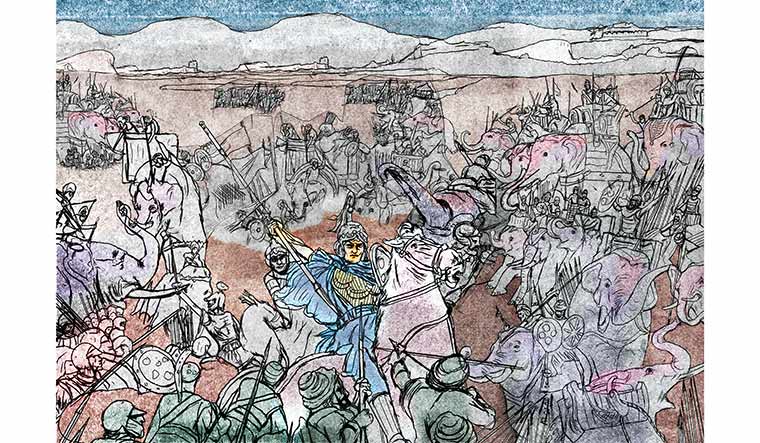
If is perhaps the oldest recorded historical military invasion on ‘Indian’ soil. Two thousand three hundred and forty-four years ago, Alexander, after nearly a decade of conquests moving eastwards, eyed lands beyond the massive river system of the Sindhu. This name, as it travelled west, had become Hindu, and then, Indus. For the Macedonian conqueror, the land east of this river was India.
It was to be Alexander’s last major battle. It was to be the first of the many invasions of India. And, this battle, known as the Battle of the Hydaspes, set a pattern that would repeat through millennia.
There is no written record of the battle in Indian texts, or if there is, it remains undiscovered and uninterpreted, in a language and script no longer understood by us. The story, therefore, is Greek. Though history is written by the victors, it says a lot about what an impression Porus, the king of Paurava, must have made on Alexander; he has been referred to in glowing terms even in the victor’s version.
Euphoric after his conquest of Persia, Alexander headed beyond the Hindu Kush to a land reputed for riches, the legendary “golden bird”. He won a few small battles and allied with Ambhi, the king of Taxila, before he took on Porus, who ruled the lands which are now known as Punjab.
Porus had the military might—an infantry of 20,000 to 50,000, a 2,000- strong cavalry, 200 war elephants and over 300 war chariots. The latter two were novelties for the Greek invaders, who fought on foot, or on horse. Porus also had the home advantage; he knew the lay of the land better. Or did he? As he lined up in war formation on the eastern bank of the Jhelum (Hydaspes) in a place believed to be present-day Jalalpur Sharif (now in Pakistan), he must have seemed formidable to the Greek army on the other bank. This was his homeland, the river was his. “It was a battle he should have won,” says retired Major General Ian Cardozo, veteran of three wars and author of several books on the military history of India.
Porus was a child of the monsoon. Every year he had seen its pattern. He had seen the Jhelum swelling as the months passed, rain and melting snow feeding it. He was confident it was unfordable while the rains lasted. Alexander, though new to the terrain, leveraged it in a manner Porus did not anticipate. He lulled the Indian king into believing that he would camp out the rainy season, setting up elaborate camp fires and, some say, even a decoy. All the while, he looked for a ford on the river. He found the spot and crossed over; a formidable task, as the river was in spate. Porus had his spies out, too, and though they missed the fording, they reported that a detachment had crossed over. Porus sent his son (some accounts say brother) to tackle them. The Indian six-seater chariots, however, got bogged in the squelchy mud and were easy meat for the Greek cavalry. Should the local army not have known better?
Alexander, sensibly waited for the rest of his army to catch up, before tackling Porus. The Greeks faced a traditional war formation, the infantry lined up between elephants—what the Greeks called the “human wall with towers”. Alexander had a few elephants himself, too, from Ambhi. But, the Greeks were apprehensive of elephants; they scared the horses.
Initially, the Indians deployed the elephants effectively, but Alexander’s sharpshooting Central Asian archers managed to create confusion in the ranks. They first eliminated the Indian cavalry, after which the battle came down to hand-to-hand fighting. Through the rain and the blood, Alexander marvelled at the bravery of his rival, and the valour with which he was fighting a losing battle. When the chained Porus was brought to him, he did something he had never done before. He asked Porus how he would like to be treated. As a king, said Porus, according to Greek accounts. So, Alexander handed him back his lands, letting him rule as his vassal.
Would history have turned its course had Porus been the victor? Not really, since Alexander returned soon after, deciding not to face the Magadhan might. There already existed trade and cultural exchange between the two lands. Though his conquest shaped the Gandhara school of art, this might have happened even otherwise.
So, what makes the Battle of the Hydaspes important from the Indian perspective? “This battle established a pattern that we would see repeated through millennia,” says retired Squadron Leader Rana T.S. Chhina, a military researcher. “Conqueror after conqueror would hear of the richness of India, and come invading. Infighting among the local chieftains would work for him; the invader would easily get a local ally. The locals would fight with a valour that would impress the enemy, yet, they would lose the battle, thus changing the course of history, time and again.”
We will see this pattern play out in several other battles over the next pages.
