



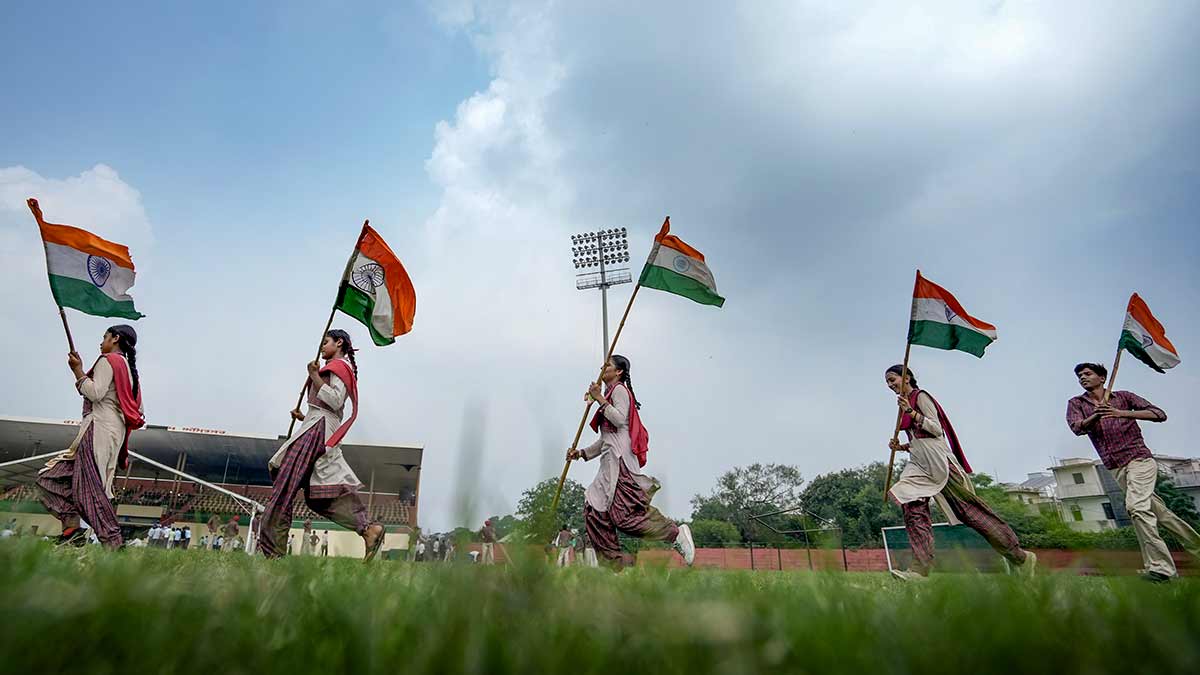
All good things must come to an end, and so my final column, after a decade in this space, comes near our 80th Independence Day: a fitting occasion to restate my own beliefs about our beloved India.
I have often stated that my approach to India lies in a simple insight—the singular thing about India is that you can only speak of it in the plural. There are many Indias; everything exists in countless variants. There is no single standard, no fixed stereotype, no ‘one way’. Our pluralism is acknowledged in our constitutional and political arrangements, which encourage a bewildering variety of social groups, religious communities and ideologies to contend. Even though India was partitioned to create a Muslim homeland, India embraced the Muslims who remained, sustaining them through an official policy of secularism that is now bitterly challenged by its current ruling party. In an era when most developing countries chose authoritarian models of government, claiming it necessary to promote nation-building and steer economic development, India chose to be a multi-party democracy. And despite many ups and downs, and moments of greater or lesser stress on its democratic institutions, India has remained a democracy—flawed and corrupt, perhaps, but flourishing.
Many observers abroad have been astonished by India’s survival as a pluralist state. But India could hardly have survived as anything else. Pluralism is a reality that emerges from the very nature of the country; it is a choice made inevitable by India’s geography and reaffirmed by its history.
Pluralism and inclusiveness have long marked the essence of India. India’s is a civilisation that, over millennia, has offered refuge and, more important, religious and cultural freedom to Jews, Parsis, several denominations of Christians, and, of course, Muslims. Jews came to Kerala centuries before Christ, with the destruction by the Babylonians of their First Temple, and they knew no persecution on Indian soil until the Portuguese arrived in the 16th century to inflict it. Christianity arrived on Indian soil with St Thomas the Apostle (the Doubting Thomas of biblical lore), who came to the Kerala coast some time before 52 CE and was welcomed on shore, if legend is to be believed, by a flute-playing Jewish girl. He converted many to his faith, so there are Indians today whose ancestors were Christian well before Europeans discovered Christianity.
Islam is portrayed by some in the north as a religion of invaders who pillaged and conquered, but in Kerala, where Islam came through traders, travellers and preachers rather than by the sword, a local king, Cheraman Perumal, was so impressed by the message of the Prophet that he travelled to Arabia to meet the great teacher himself. He never returned, but the Kerala coconuts he took with him have sprouted trees that flourish to this day south of Salalah on the Oman coast. Indeed, the Zamorin of Calicut was so impressed by the seafaring skills of the Muslim community (epitomised by the famed and fearless Kunjali Marakkars) that he issued a decree obliging each fisherman’s family to bring up one son as a Muslim, to man his all-Muslim navy!
India’s heritage of diversity means that in the Kolkata neighbourhood where I lived during my high school years, the wail of the muezzin calling the Islamic faithful to prayer routinely blended with the chant of mantras and the tinkling of bells at the local Shiva temple, accompanied by the Sikh gurdwara’s reading of verses from the Guru Granth Sahib, with St. Paul’s Cathedral just around the corner.
Today, I represent in Parliament the constituency of Thiruvananthapuram, the capital of Kerala, where the gleaming white dome of the Palayam Juma Masjid stands diagonally across from the lofty spires of St. Joseph’s Cathedral, and just around the corner from both, abutting the mosque, is one of the city’s oldest temples, consecrated to Lord Ganesha and recently renovated. My experiences and encounters in my constituency remind me daily that India is home to more Christians than Australia and nearly as many Muslims as Pakistan.
That is the India whose freedom we celebrate this month. And that’s my last “Last Word”. Jai Hind!
editor@theweek.in
