



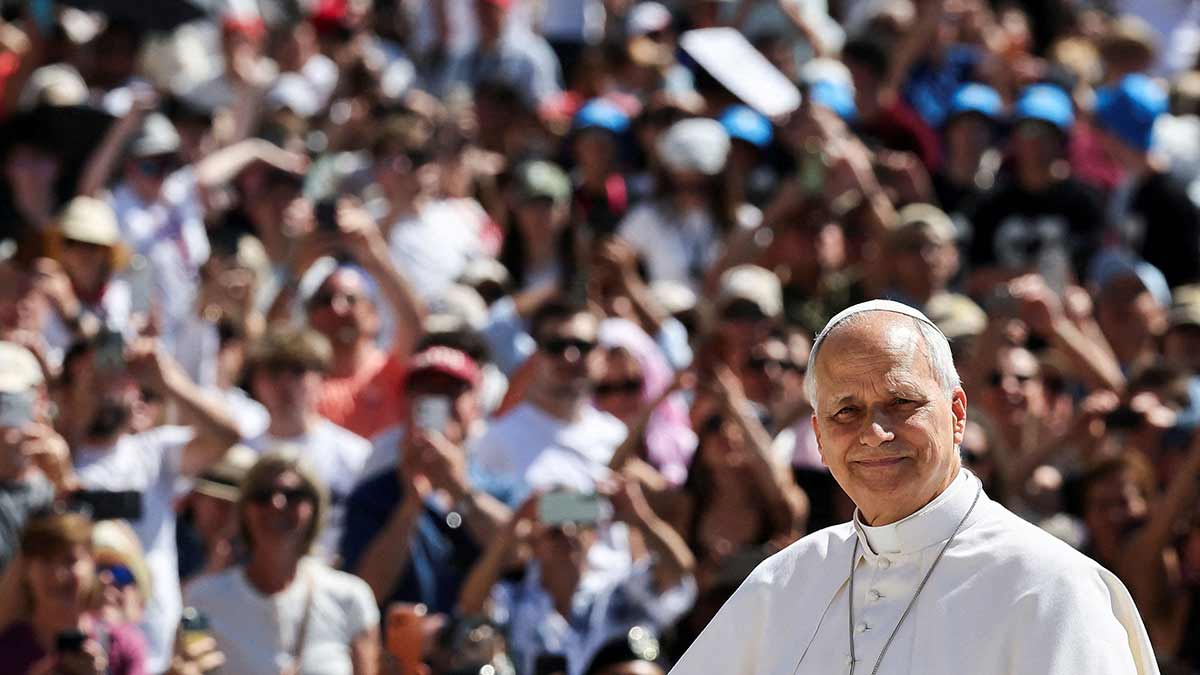
In our deeply polarised world, there are still rare moments of unity. Last year, Norwegians were united in their conviction that President Donald Trump should not get the Nobel Peace Prize. This year, there is rare unity about who should get the Nobel Peace Prize: Pope Leo.
The tale of the two Americans symbolises polar opposites in ideology, character and worldview. The Pope’s criticism of warmongering “tyrants”, nuclear weapons and anti-immigrant violence sparked admiration for the pontiff around the globe. Trump disgraced himself when he retaliated with characteristic abuse. Pope Leo travelled to Africa, abstaining from being drawn into Trump’s mudslinging. If words won the Pope admiration, his silence earned him appreciation—even in Lutheran Norway, where Catholic Jesuits were banned from entering the country until 1956.
But this is not the reason why the Norwegians want Pope Leo to win the Nobel Prize. It is for his timely encyclical (letter) urging a moral response to AI, a technology that can accelerate war, joblessness, injustice and indignity. Pope Leo is an eminently deserving Nobel Prize candidate. But the Norwegian Nobel committee that chooses the laureate is not guided by public wishes.
As the AI race among companies, states and countries intensifies, it is suicide to allow competitors to get ahead. Pope Leo’s red line is that lethal decisions should not be outsourced to AI autonomous weapons’ systems. But within days, NATO defence ministers were reexamining whether lethal weapons must necessarily require humans to choose targets. Making humans “optional” helps them compete with their adversaries’ fully autonomous weapons.
Still, the pontiff’s encyclical to the bishops enables his clergy and like-minded people to propagate a clear message to the world: transformative technology is welcome but must be introduced with responsibility, care and vigilance. The Pope’s encyclical is not a Letter of Lament. It is a call to action to create a womb of ethics that births AI, to “prevent innovation from becoming an accelerator of injustice”. He urges all, “Let us not be afraid to get our hands dirty on the ‘construction site’ of our time.”
While the spiritual leader dealt with AI, the temporal Trump ducked. He dust-binned his own executive order requiring safety-testing before releasing frontline AI models into the market. Trump’s transactional, pro-corporate, self-pelf-over-public-good priorities triumphed again. Even his failures fail to stop Trump. King Midas turned everything he touched to gold. The idiomatic opposite is Sadim—Midas spelt backwards.
Sadim’s touch turns everything to toxic lead, to ruin. The Strait of Hormuz was a busy smooth-flowing artery of global trade. Trump’s war turned it into a blood clot, threatening to give the world a heart attack. Americans are paying the price for his tariffs and Iran war. The European Central Bank warned Trump’s actions risk triggering a global financial crisis. Judges halted several of Trump’s shocking decisions, including his $1.8bn “slush fund” to reimburse his cronies’ legal costs. Another judge ordered him to remove his name from the prestigious John F. Kennedy Center for the Performing Arts. Trump solicited $1billion membership fee from world leaders for his “most consequential” Board of Peace. Not a dime has been deposited so far.
Unlike the Pope’s healing touch, Trump’s decisions have caused pain, destruction, disruption, inflation, uncertainty and fear. Simultaneously, people worry that AI will reduce humans to slaves, victims and losers. Against this dismal backdrop comes the Pope’s encyclical titled Magnifica Humanitas (Latin for ‘Magnificent Humanity’)—a tribute to humanity’s grandeur, a call to disarm, a noble trophy and a shield to safeguard humankind’s dignity.
Pratap is an author and journalist.
