



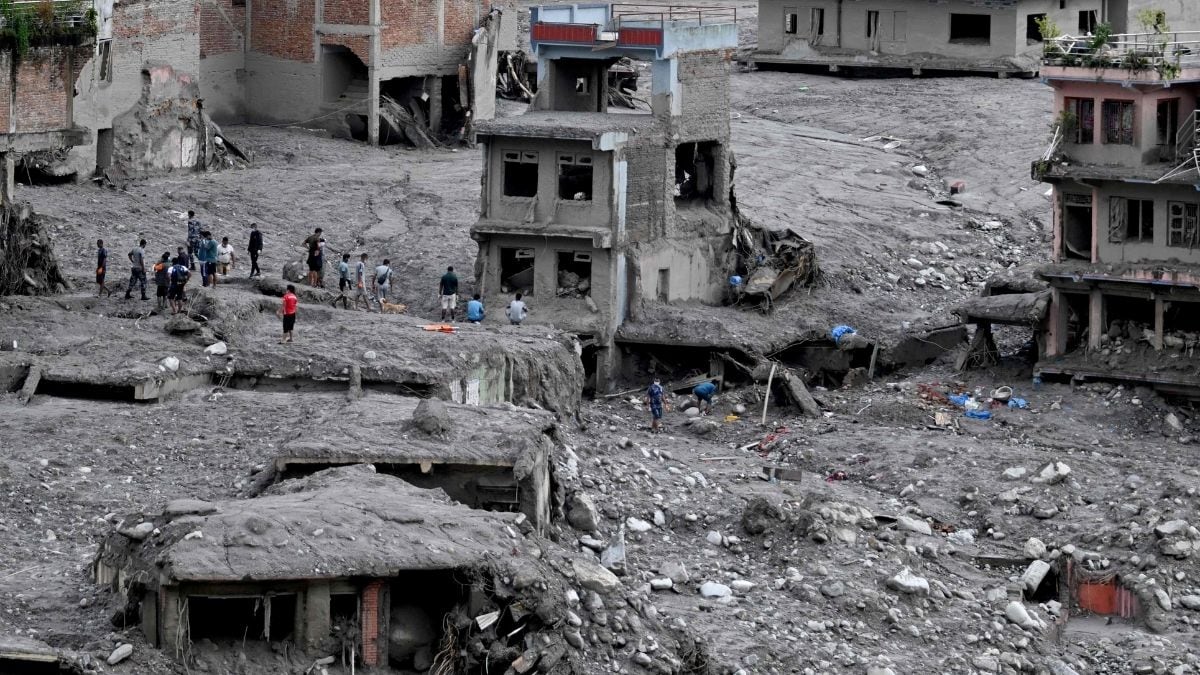
Nepal’s Ministry of Finance has dispatched a formal climate compensation claim letter to its international partners after a catastrophic flood on August 26 killed about 900 people along its northern border with Tibet.
The Nepal government has also sent an urgent request to the Fund for Responding to Loss and Damage, a global climate finance mechanism, seeking financial assistance.
In an interview with the Kantipur TV, Nepal’s Foreign Minister Shisir Khanal said that Nepal’s greenhouse gas emissions are “virtually negligible” and the country was “paying the ultimate price for a global crisis the country did not create”.
“The rapid melting of glaciers and these catastrophic mountain tsunamis are direct consequences of global climate change,” he said.
He said that the world’s top emitters, China, the USA and India, had a historical responsibility to compensate vulnerable nations like Nepal.
“We are shifting our diplomatic framework from “aid” to “justice and compensation”. This is not a matter of charity; it is a matter of legal and moral liability,” he said.
Khanal said that they would raise the matter with “absolute firmness and clarity at every upcoming international forum.”
“This is a matter of civilisational survival. If our Himalayan glaciers disappear, the water security of over two billion people in South Asia—dependent on rivers like the Ganges and the Trishuli—will be permanently compromised. We are advocating not just for Nepal, but for the survival of South Asian civilisation.”
Khanal also said that the flood was not a “standard flood”. He said that the vocabulary to describe the floods was limited.
Its heights reached 20-30 meters, and speeds reached 180 kilometres per hour.
“This was a disaster of tornado-like velocity—what many are rightly calling a “Himalayan Tsunami”. It is a scale of disaster that is entirely outside the living memory of Nepal,” he stated.
“The damage is immense. Early assessments indicate that ten municipalities across Nuwakot, Rasuwa, and Dhading, spanning 30 to 32 wards, have been heavily impacted, with additional damage downstream in Gorkha and Chitwan. We are looking at tens of thousands of damaged private homes, alongside heavily hit schools and multi-billion-rupee hydropower projects,” he said.
Climate scientists say that the Himalayan region is warming faster than any other part in the world and that it is at risk for increasing global warming as a result of human-caused climate change.
Reports from the Kathmandu-based climate research group International Centre for Integrated Mountain Development say that the glaciers in the Hindu Kush Himalayan region are losing ice at an accel accelerating rate, while permafrost degradation, unstable slopes, glacial lakes and increasingly erratic rainfall are raising the risks of floods, landslides and debris flows, AP reported.
For Nepal, the stakes are high as the country relies on hydropower as a foundation of its electricity grid and as an important source of economic growth.
Both India and China have offered assistance to Nepal following the massive Bhotekoshi-Trishuli floods in Nepal. The neighbouring countries sent teams to help them search for the people trapped in its hydropower tunnels.
India sent 13 military personnel and 19 forensic experts with emergency supplies, including 57.5 tonnes of relief supplies. China deployed four tunnel rescue teams with specialised equipment.
The US meanwhile pledged $500,000, and Australia committed $1 million for rehabilitation efforts.
