



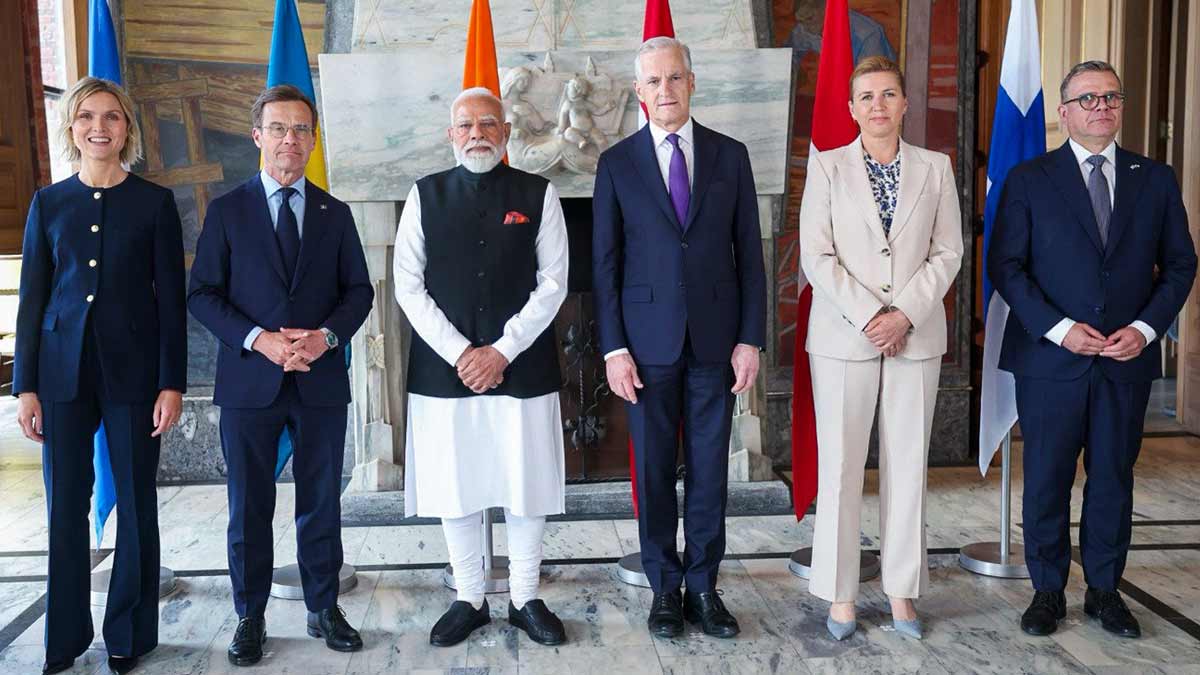
The Third India-Nordic Summit, concluded in Oslo on May 19, 2026, produced a set of agreements that, taken together with the India-EU Free Trade Agreement (FTA) signed in January, represent the most significant reconfiguration of India’s European economic relationships in a generation. The EFTA India TEPA commits to a $100 billion investment target. The EU FTA opens 144 services subsectors and establishes a mobility framework for Indian professionals across the bloc. A Security and Defence Partnership was signed in January. On paper, the architecture is in place for India to become structurally embedded in European supply chains at scale.
The more useful analytical exercise, however, is not to catalogue what was signed but to examine where the architecture is weakest, where comparable frameworks have failed before, and what India would need to do differently this time to convert legal text into commercial reality. India has a long record of concluding agreements that underperform their stated ambitions. The question is whether the current external environment has changed the underlying conditions enough to produce a different outcome.
The China displacement hypothesis: Tested, not assumed
Much of the strategic rationale for deepening India-Europe ties rests on the premise that European firms are actively diversifying away from Chinese supply chain dependency and that India is the natural beneficiary. This is partially true and significantly overstated. European industrial diversification is real, but it is proceeding unevenly and is constrained by factors that India has limited ability to address quickly. Nordic and European firms moving out of Chinese supply chains are not simply redirecting procurement to Indian manufacturers; they are, in the first instance, re-shoring to Central and Eastern Europe, building capacity in Vietnam and Mexico, and, in several critical industrial categories, accepting higher costs to maintain domestic production. India competes in this environment, but not without friction.
The sectors where India’s case is strongest—IT services, pharmaceuticals, certain categories of engineering goods—are also the sectors where existing relationships are deepest and where the incremental gain from a formal FTA is smallest. The sectors where the FTA could make a structural difference—advanced manufacturing, green energy components, maritime equipment—are precisely those where India’s industrial base has the largest capability gap relative to what European buyers require. Closing that gap requires time, consistent policy, and investment in industrial infrastructure that moves faster than political cycles. None of these conditions can be assumed.
The FTA implementation problem
India's FTA history shows a consistent pattern: ambitious agreements on paper, low utilisation by exporters in practice. Regulatory barriers, compliance costs, and institutional gaps make preferential tariffs worthless. The EU FTA will likely replicate this. Political success masks commercial underperformance. Success requires more than tariff administration: regulatory alignment, standards harmonisation, mutual recognition of qualifications, and functioning dispute resolution. The political will exists on both sides, and strategic incentives are strong. But the commercial outcome will likely follow the pattern: ratified, celebrated, underutilised. The risk is not political failure. It is operational mediocrity disguised as strategic success. How do we address this?
The American variable: Durable shift or contingent opening
Europe's India partnership is contingent on American disengagement. If the US returns to multilateralism, even partially, by 2026-2028, Europe's strategic urgency for India evaporates. India has intrinsic value (market, services, demographics), but European policymakers are conflating this with circumstantial value (US absence). Europe is not choosing India because it prefers India. Europe is choosing India because it cannot rely on America and trust China. The moment that calculation shifts, so does Europe's strategy. India must factor in this risk as it builds long-term commitments around a short-term European necessity.
The Russia exposure: Tolerance has a horizon
Europe has accepted India's Russia energy relationship, including the lucrative refinery arbitrage that converts discounted crude into refined products for European and Asian markets, as the price of maintaining strategic leverage on Ukraine and securing India's commitment to the FTA.
This is not tolerance born of principle but of calculation: Europe judges that confronting India costs more than accommodating her, and India's back-channel relevance to any Ukraine settlement provides offsetting diplomatic value. But the arrangement is conditionally tolerated, not settled. It depends on a specific configuration of European political priorities that could shift: if the Ukraine conflict trajectory changes, if US secondary sanctions tighten, if European public opinion hardens on Russian energy laundering through India, the entire structure fractures. India's current account position has become materially dependent on European indulgence of an arrangement Europe views as problematic. The partnership appears to be deepening. The foundation is contingent. The exposure is asymmetric, and the fragility is real.
The mobility paradox: Where the partnership becomes real
Trade agreements work through people. The India-Europe partnership expands its macro architecture at the exact moment member states are narrowing labour mobility. Sweden raised work permit thresholds to 90 per cent of the median wage. The Netherlands tightened skilled worker criteria. Germany liberalised but under reversible coalition politics.
Contradiction: agreements on paper, barriers in practice. The FTA text ignores this because fixing it would require EU member states to make domestic political commitments they won't make. This is not a secondary detail. This prickly issue can significantly impact the work of this partnership.
What the analysis actually requires
TEPA, the EU FTA, the defence FDI corridor, and the Green Technology Partnership signal a genuine structural shift: India as an industrial partner, not a peripheral market. But every iteration stalls at the gap between signed architecture and realised outcomes. Three things change that: (1) India establishes manufacturing standards bodies and enforceable regulatory timelines; success is European procurement to Indian producers increasing 30 per cent+ in 24 months. (2) Europe uses India as a test case for an EU-wide skilled worker framework, targeting 5,000+ annual India-EU talent flows by 2027. (3) India builds capabilities valuable regardless of US policy. By 2027, the partnership must survive US normalisation, or it was never real. Signed architecture is easy. These three require political will and measurement on actual outcomes. Do them, or the FTA joins the history of underutilised Indian trade agreements.
Rajesh Mehta is a leading international affairs expert and adviser to the Nordic Council of Indian Diaspora. Manu Uniyal is general secretary of the Nordic Council of Indian Diaspora and a writer based in Sweden.
The opinions expressed in this article are those of the author and do not purport to reflect the opinions or views of THE WEEK.
