



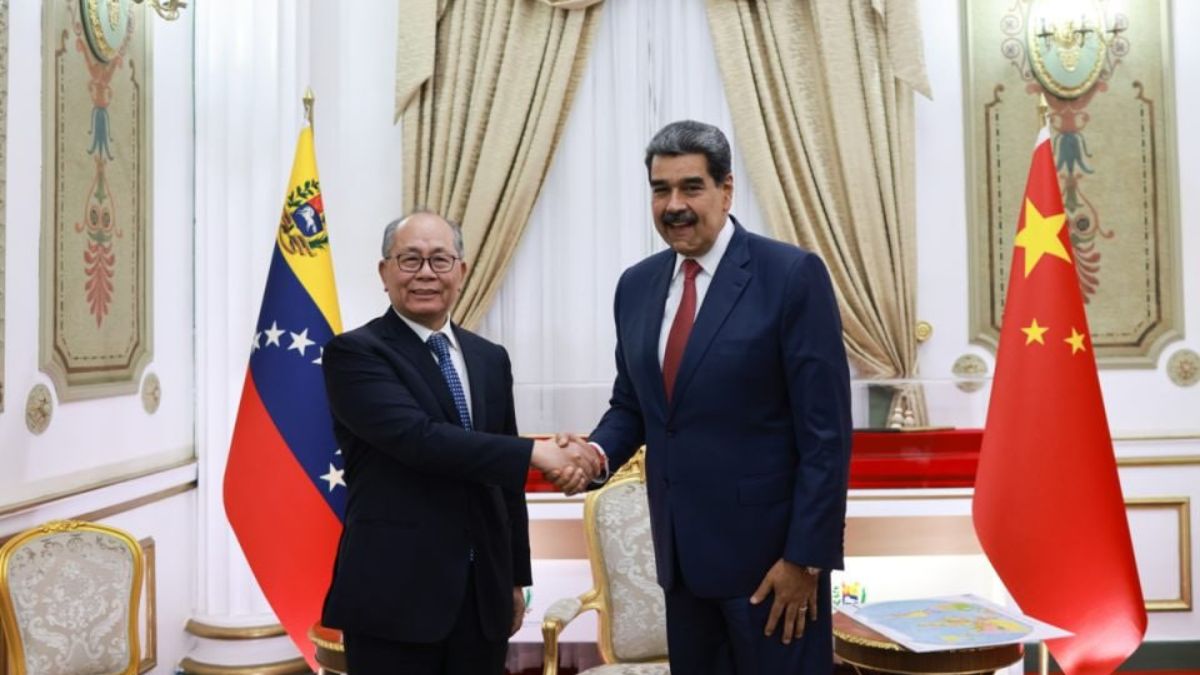
The last act of Venezuelan President Nicolas Maduro, before he was captured by the United States forces on Donald Trump's orders, seems to have been a meeting with the Chinese delegation. Reportedly, shortly after the meeting with the Chinese envoy, Maduro and his wife, Cilia Flores, were taken into custody by the US forces. Maduro appeared with Qiu Xiaoqi, a special representative on Latin American Affairs of the Xi Jinping-led Chinese government, on state television.
The meeting took place at the Miraflores Palace in Caracas. Maduro shook hands with the Chinese diplomat and welcomed him with a New Year's wish. "We met 20 years ago when President Hu Jintao was in power...It’s impressive that you’ve become a director-general now...Time truly flies,” said Maduro. It is known that bilateral cooperation was discussed by both nations.
"We reaffirmed our commitment to the strategic relationship that is progressing and strengthening in various areas for building a multipolar world of development and peace," Maduro was quoted as saying after the meeting.
There are some reports that amid the turmoil, the Chinese delegation is still stuck in Venezuela.
Meanwhile, on Sunday, China urged the US to release Maduro and settle the issue through dialogue and negotiation. "Such hegemonic acts of the US seriously violate international law and Venezuela’s sovereignty, and threaten peace and security in Latin America and the Caribbean region. China firmly opposes it," a spokesperson for China's Ministry of Foreign Affairs said.
The operation is likely to affect the US-China relations. It should also be noted that the economic rivalry between China and the US has taken a new dimension recently, with both countries striving to be the leader in the race on the development of Artificial Intelligence (AI).
The delegation also included Lan Hu, Venezuela’s Chinese ambassador, Liu Bo, Director-General of the Ministry of Foreign Affairs for Latin America and the Caribbean, Wang Hao, Deputy Director-General of the same department, and Liu Zhen, a regional official.
After the capture, Trump has indicated that he has his eye on the South American country's oil reserves. Trump said that the US will be strongly involved in Venezuela's oil industry. "We’re going to have our very large United States oil companies, the biggest anywhere in the world, go in, spend billions of dollars, fix the badly broken infrastructure and start making money for the country," he said.
Maduro's capture also came just a day after he said that Venezuela is ready to discuss a drug-trafficking deal and oil investments with the US.
