



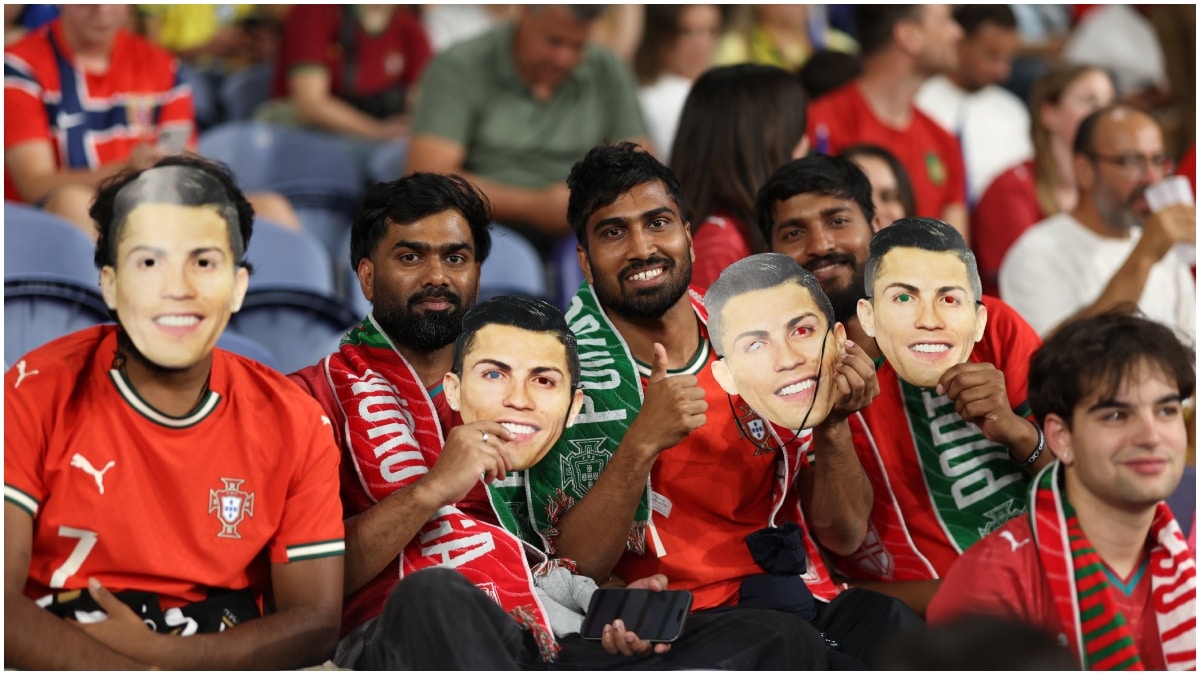
Cristiano Ronaldo on Wednesday clarified that he is not following Lionel Messi into international retirement just yet. The Portugal superstar said he will remain available to play for his national team, despite having walked out on the squad during the current international window.
“CR7” had earlier left the Portugal national team camp in the middle of an international window, making many wonder if it was the end of an illustrious international career of 234 appearances and 146 goals—more of each than any man has ever managed.
He left a day before the team played against Denmark in Copenhagen. Portugal beat Denmark 4-2. The scoreline suggests the story is over; the statistics suggest otherwise.
"After the press conference of the national team, and following a conversation with the President of the Portuguese Football Federation, I have decided to leave the national team training camp," Ronaldo wrote. "In due time, I will tell all the Portuguese people the truth about the reasons that led to my departure from the national team, to which I always devoted myself."

Notably absent from that statement was the word retirement. The federation's own announcement confirmed only that Ronaldo had left the camp in Copenhagen and that preparations for Thursday's Nations League match against Denmark, and Sunday's match against Norway at the Estádio do Dragão, "will continue as planned with the remaining 24 players." Portuguese daily O Jogo reported that the decision is irreversible and that his appearance against Wales last week was his final game, though neither the player nor the federation has confirmed that.
On Sunday, in a 2-1 Nations League win over Norway in Oslo, Ronaldo warmed up in the second half and was benched. It was the first time in more than 18 years (since Euro 2008) that he had passed a match without stepping onto the pitch. At full-time, he walked straight down the tunnel instead of joining his teammates to applaud the travelling supporters.
"It wasn't to protect him physically, because he was fit to play for as long as I wanted," head coach Jorge Jesus said. "It wasn't the right moment to bring him into the game; it was a tactical choice." On Wednesday morning, Jesus went further, confirming Ronaldo would not start against Denmark. "I can promise whatever I want. I'm the coach," he said. "If I need him for 30 minutes he will play, and if I don't need him, he won't play. There is no player who will make me change my mind. Not him nor anyone else in football, not even any president. Never, no one."
Ronaldo had warned a week earlier where his limit lay. "I will finish when I feel like I'm not doing anything here," he said. "For me, the basic point is to be able on the pitch to score the goals and to help the team win games."
In a long statement posted Tuesday, just hours before Messi's much-anticipated farewell game with Argentina, Ronaldo said recently hired coach Jorge Jesus hadn't been true to his word about when he would play the striker in the latest round of Nations League matches.
Still, the 41-year-old Ronaldo said he owed fans and his teammates an apology and expects to receive a punishment.
"I can promise all my fans, and naturally especially all Portuguese people, that we will have one or more farewell matches. There will be time for that," Ronaldo said.
He added: "Therefore, if I am physically fit, playing for my club, hopefully scoring goals, then after serving whatever suspension is imposed on September or October, I will be available, as I have always been until today, to compete and win for our national team."
If Ronaldo's exit was abrupt, the argument over his place was not new. Over the past two years, the Portugal captain has increasingly been framed as the obstacle in his own team's path.
The precedent dates to Qatar 2022, when Fernando Santos dropped him for the last 16 against Switzerland. Gonçalo Ramos scored a hat-trick; Santos lost the quarter-final to Morocco, then his job, and Ronaldo's cold treatment of him afterwards became the cautionary tale every successor filed away.
Roberto Martínez inherited the daunting task but failed to escape a similar fate. Ronaldo started all five of Portugal's matches at this summer's World Cup and was substituted in only one. According to figures compiled by BBC Sport, 366 players at the tournament touched the ball more often than Ronaldo despite him playing all but ninety minutes across five games. He created one chance for a teammate and took 18 shots, the same as Erling Haaland, who scored seven goals.
Portugal lost 1-0 to Spain in the last 16 on July 6 in Dallas, with Mikel Merino scoring in stoppage time. Ronaldo touched the ball 19 times in 96 minutes, the fewest of any starter, and was in tears at the final whistle. Thierry Henry isolated a moment on Fox Sports in which Ronaldo, chasing a goal of his own, ran into Bruno Fernandes' path and killed a tap-in. "The team needs to score," Henry said. "Not you need to score." Martínez resigned after the match.
The counter-case is not frivolous. Portugal's attacking failure was systemic: a midfield of Fernandes, Vitinha, and João Neves circulated possession rather than threatening, while full-backs supplied all the width. Quaresma called the attackers cowardly; Rooney said the midfield never serviced Ronaldo. On that reading, he was not the problem but its most visible symptom and the easiest target, because his name sold newspapers.
He scored three goals at that World Cup and became the first man to score at six of them. He was also called a “41-year-old in a system built for someone younger”. Fixing that was precisely the task Jesus was given.
Legacy
Portugal had never won a major trophy before him. As captain, he won Euro 2016 in Paris, the tournament he finished on a stretcher and then directed from the touchline, and the Nations League in 2019 and again in 2025. He is the only player to have scored at six World Cups, and Portugal's leading scorer at them.
Ronaldo scored 146 of the approximately 1,220 goals Portugal have scored in 105 years of international football: roughly one in eight, or 13 per cent of goals. He has played 234 of their matches over 23 years. No other Portuguese player has reached 50 international goals. Even Pauleta, second on the list, finished on 47.
That is no small feat, and it is worth stating plainly before anything else in this story. A man accounted for, across six World Cups and five European Championships, leading them to the first major trophy in their history at Euro 2016, then the Nations League in 2019 and 2025.
The team without Ronaldo
Following his walkout, Portugal were a goal up against a side ranked below them, away from home, without their captain. Then Rasmus Højlund made it 2-2 in the 53rd minute, finishing a Denmark counter-attack after Portugal's high press failed. But soon Vitinha headed in Bruno Fernandes' free kick in the 67th minute, and João Félix, on as a substitute, added a fourth in the 87th minute.
The statistics say Portugal were never really in trouble: 19 shots to Denmark's 12, 10 on target to three, seven corners to four, and six saves forced from the Danish goalkeeper against one from Diogo Costa. Denmark had 53.7 per cent of possession and did nothing with it. The honest reading is that Portugal were comfortable but careless.
The No. 7
UEFA published Portugal's matchday squad on Thursday morning and Leão, who wore 17 in the opening two games, was listed against the number Ronaldo has owned since he took it from Luís Figo in 2007. Leão played 62 minutes before being replaced by Trincão.
It was deeply dishonouring to see that the number was handed over without hesitation. Nations League rules require matchday squads to be numbered consecutively from one to 23, so the shirt could not be left empty. But Portugal still chose which number to fill, and they filled his within 24 hours while his future with the team was officially unresolved.
In Buenos Aires, the same question produced the opposite answer. Argentina's coach Lionel Scaloni has left the number 10 vacant for this entire window. "We aren't obligated to assign it for these matches, so we won't give it to anyone until Leo's farewell game," he told ESPN. The shirt stays unworn against Bolivia and Burkina Faso, then goes on Messi's back one last time against Benin on October 6. AFA president Claudio Tapia has said since 2023 that the number will be "retired for life in his honour". FIFA still requires numbers one to 23 at major tournaments, which is why Argentina's attempt to retire it for Maradona in 2002 was refused.
Read together, the contrast is hard to avoid. One federation is building a ceremony around its departing legend. The other put his number on a newcomer the next morning. Leão isn’t a bad player, but the legacy of that shirt is too big for him. An important moment in the match occurred when Højlund equalised and celebrated with Ronaldo's iconic "Siuuu." The team ignored him, but the world still remembers.
The fate of Ronaldo is yet to be sealed; the number on the back was never the achievement. A celebration so iconic that it has been copied on basketball courts, on cricket fields, and even in schoolyards on every continent. He is 41 and still built like a tank, and a generation grew up believing that was possible for them. A kid from Madeira outlasted everyone by simply refusing to give up. Portugal can give away the jersey, but No. 7 will always be remembered for one man—Cristiano Ronaldo dos Santos Aveiro.
