



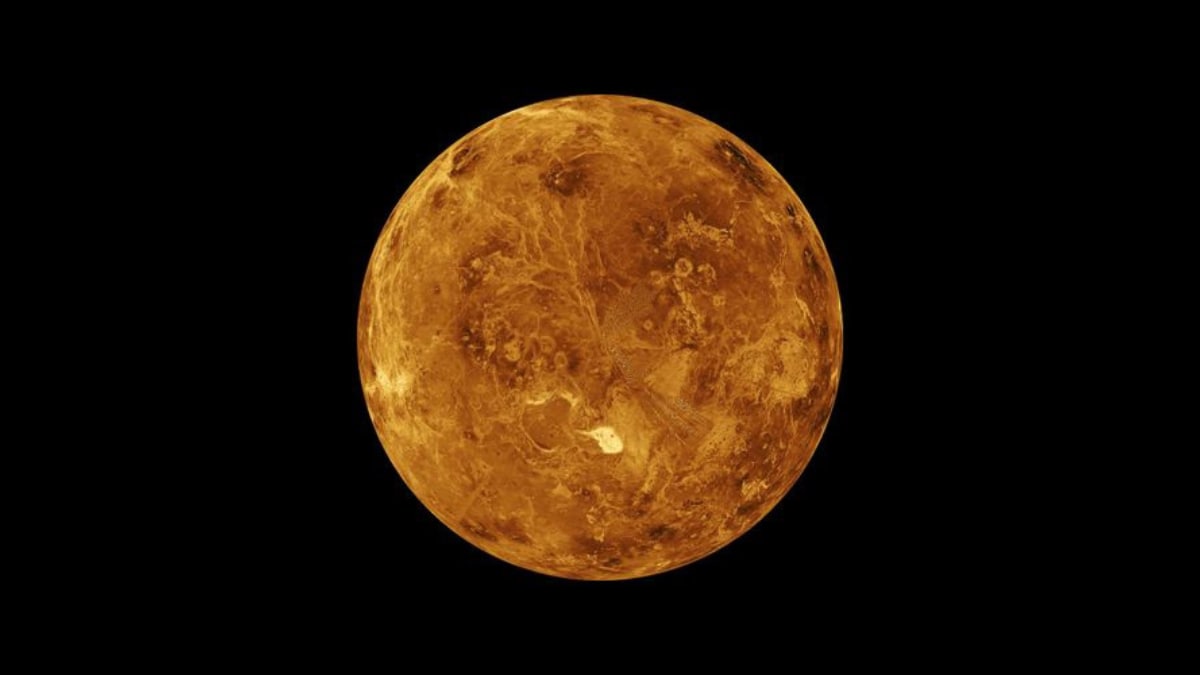
Venus is termed the least hospitable of all the planets in our solar system. It’s less hospitable than the closest-to-the-sun Mercury, as well as Jupiter and Saturn, which lack a solid surface altogether.
Venus is the hottest planet. Its temperature can melt lead. The surface pressure, meanwhile, can crush a human instantly. Coming to water, there’s none. On top of that, a thick cloud of highly corrosive sulphuric acid surrounds it. Its concentration reaches a staggering 98 per cent.
A nightmare for any trace of life!
The conditions, however, change a few kilometres above the surface. Temperature and pressure become moderate. For years, researchers have pondered whether this narrow cloud layer could support some form of life.
New research from scientists at the Massachusetts Institute of Technology (MIT) might now give some clues.
The findings
The research, published in Proceedings of the National Academy of Sciences, found that peptides could remain stable and even folded into well-defined three-dimensional structures in highly-concentrated sulphuric acid.
Peptides are small chains of amino acids that, in turn, are the building blocks of proteins.
The study challenges the general assumption that Venus’ highly acidic clouds destroys all molecules required for biology.
“What hadn’t been known is that peptides can survive so well and have specific three-dimensional shapes in an acidic environment,” noted Mei Hong, MIT professor and one of the authors of the study.
While surviving the extremely acidic environment is itself unexpected, the molecules also folded into distinct three-dimensional structures called omega loops.
Does that mean there’s life on Venus? Not exactly!
Firstly, the study was a lab experiment. And more importantly, further research is required to clearly ascertain the existence of any life on the planet.
What the research does, however, is challenge the notion of how life exists on other planets.
For instance, much of life is known to depend on water. Venus lacks it. Not only that, the lack of water was seen as the exact reason why peptides survived in the harsh environment created by sulphuric acid. This is because several chemical reactions that break peptide bonds rely on water.
“Without water, an acid that you would consider a harsh solvent suddenly is not as menacing as one might think,” Hong added.
Hence, what this piece of research shows is that environments that might look harsh and inhabitable from an Earth-perspective might not be as such.
