



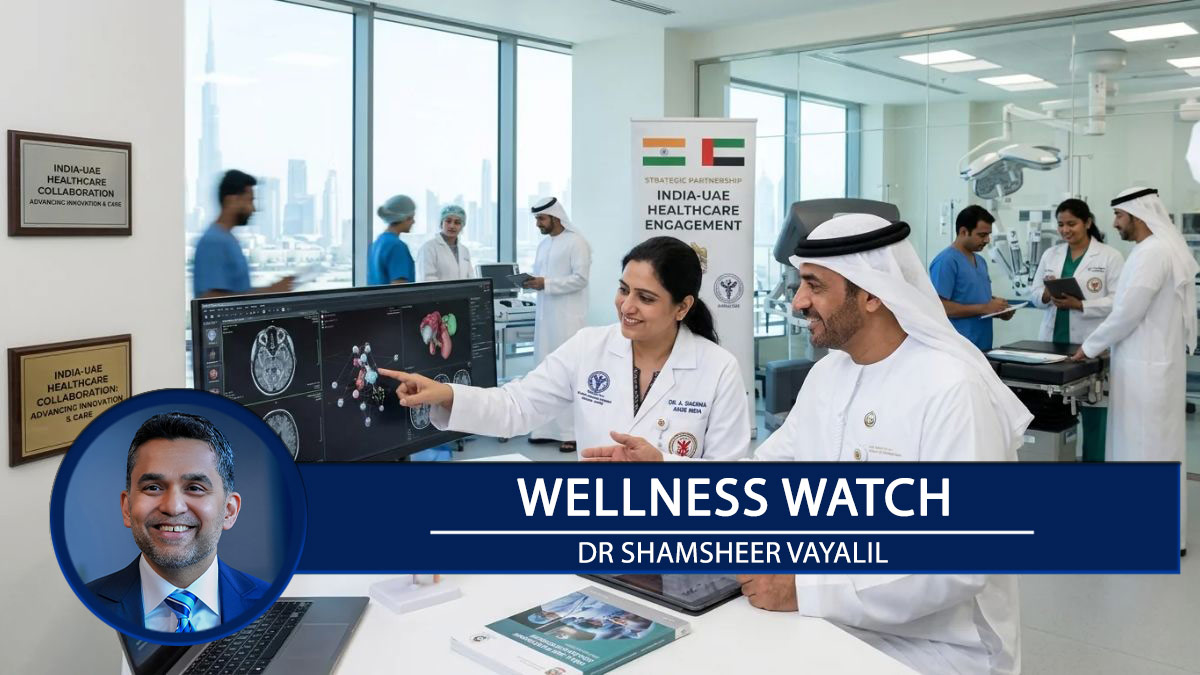
What will the relationship between India and the UAE mean a 100 years from now? When I think about 2126, I see a partnership extending far beyond trade agreements, investments and diplomacy. I see two countries combining their strengths to advance science, improve healthcare, nurture innovation and create opportunities for the wider world.
For centuries, the Arabian Sea connected India and the Gulf through trade, culture and human relationships. Sheikh Zayed bin Sultan Al Nahyan’s historic visit to India in 1975 helped strengthen a modern partnership that has continued to evolve across generations. Today, millions of Indians call the UAE their home. They have contributed to its development across healthcare, aviation, business, education and technology. What makes this relationship special is not simply the opportunities the UAE has provided, but how it has embraced and recognized those who have contributed to its progress.
Consider Dr. George Matthew, who arrived in Al Ain in 1967 and became one of the UAE's pioneering physicians. His decades of service were recognized with UAE citizenship and the naming of a street in Abu Dhabi in his honour. More recently, Indian pilot Captain Smit Machchhar was honoured by the UAE leadership following his courageous actions during an aviation emergency involving a flight from Dubai to Tel Aviv amid regional hostilities.
These stories, separated by generations, reflect the profound reality that the UAE recognizes contribution, commitment and courage, regardless of where a person was born.
My own journey reflects this relationship. India gave me my education and foundations in medicine. The UAE gave me the opportunity to dream bigger, become an entrepreneur and build healthcare institutions. I have never viewed these two identities as competing. To me, they represent complementary strengths.
From a diaspora to a connected community
For generations, Indians have travelled to the UAE seeking opportunities, building careers and contributing to the country’s development. The next phase should go beyond the traditional idea of an expatriate community. It should allow Indians living abroad to remain connected to India while participating fully in the economic and social life of the UAE.
Technology can make this possible. Today, eligible overseas Indian citizens generally need to return to their registered constituencies in India to exercise their voting rights. In the future, secure and transparent mechanisms could enable them to vote from abroad, subject to appropriate legal and electoral safeguards.
Similar opportunities exist in education, professional mobility, entrepreneurship and healthcare.
The next generation should not experience the India–UAE relationship as a choice between two countries, but as an opportunity to benefit from the strengths of both.
UAE as a gateway for Indian innovation
For decades, India has been one of the world’s greatest sources of professional talent. I believe the next century could be defined by an important transition from exporting talent to exporting innovation, with the UAE serving as a gateway to the world.
India has remarkable capabilities in pharmaceuticals, biotechnology, artificial intelligence, engineering and entrepreneurship. Yet turning a discovery into a globally successful product requires more than an idea. It requires capital, intellectual property protection, research infrastructure, regulatory pathways and access to international markets. The UAE can help bridge that gap. Imagine an Indian biotechnology company developing a breakthrough therapy, validating it through clinical research in the UAE and bringing it to patients across the Middle East, Africa and beyond. Or an Indian technology start-up developing an AI-powered diagnostic solution, testing it in UAE hospitals and taking it internationally.
The opportunity is not just to distribute Indian products through the UAE, but to jointly develop intellectual property, commercialize discoveries and build globally competitive enterprises. The UAE can become an international platform for Indian innovation, while India can help accelerate the UAE’s development as a knowledge-driven economy.
From sharing doctors to discovering cures
Healthcare offers perhaps the most compelling example of what this partnership could achieve.
Indian doctors, nurses and medical professionals have contributed to the UAE’s healthcare system for generations. During COVID-19, the two countries demonstrated the strength of their relationship through mutual support in medical professionals, equipment and essential supplies.
But, the future should go beyond the movement of healthcare talent and patients. It should be about creating medical knowledge together.
Imagine joint medical schools, research institutions, clinical trials, pharmaceutical manufacturing and innovation platforms connecting India and the UAE. India’s scientific talent, pharmaceutical capabilities and experience in affordable healthcare, combined with UAE investment, clinical infrastructure and international connectivity, could accelerate discoveries in oncology, genomics, rare diseases and regenerative medicine.
Artificial intelligence could connect specialists across borders, support earlier diagnosis and make advanced medical expertise available to communities that currently lack access. More than building hospitals, the next frontier is about developing integrated healthcare ecosystems that connect education, research, technology, manufacturing and patient care. India and the UAE could jointly develop affordable medicines, new therapies, and scalable healthcare models for Africa, the Middle East, and South Asia. This is how a bilateral relationship can become a platform for global human progress.
Building institutions that outlast us
One of the most important lessons I have learned from the UAE is the value of thinking beyond immediate horizons. India has demonstrated the extraordinary potential of human capital, entrepreneurship and scientific capability. The UAE has shown how long-term vision, infrastructure and investment can transform ambition into reality. Combining these strengths can create institutions whose impact lasts for generations.
A medical school established today could educate thousands of future physicians. A research institution could make discoveries decades after its founding. An Indian entrepreneur supported by the UAE could build a global company that improves millions of lives. The future of this relationship should therefore be measured not only by trade volumes or investment flows, but also by the scientific discoveries we enable, the intellectual property we create, the institutions we establish and the human lives we improve.
By 2126, I hope that, beyond being successful economic partners, India and the UAE will be recognised as two nations that helped transform the future of healthcare, technology and innovation for the wider world. The greatest legacy of the India–UAE relationship may not be what the two nations build for themselves, but what they make possible for generations they will never meet.
(Dr. Shamsheer Vayalil is a healthcare and education leader, physician-entrepreneur, and strategic investor. He is also the founder and chairman of VPS Health.)
