



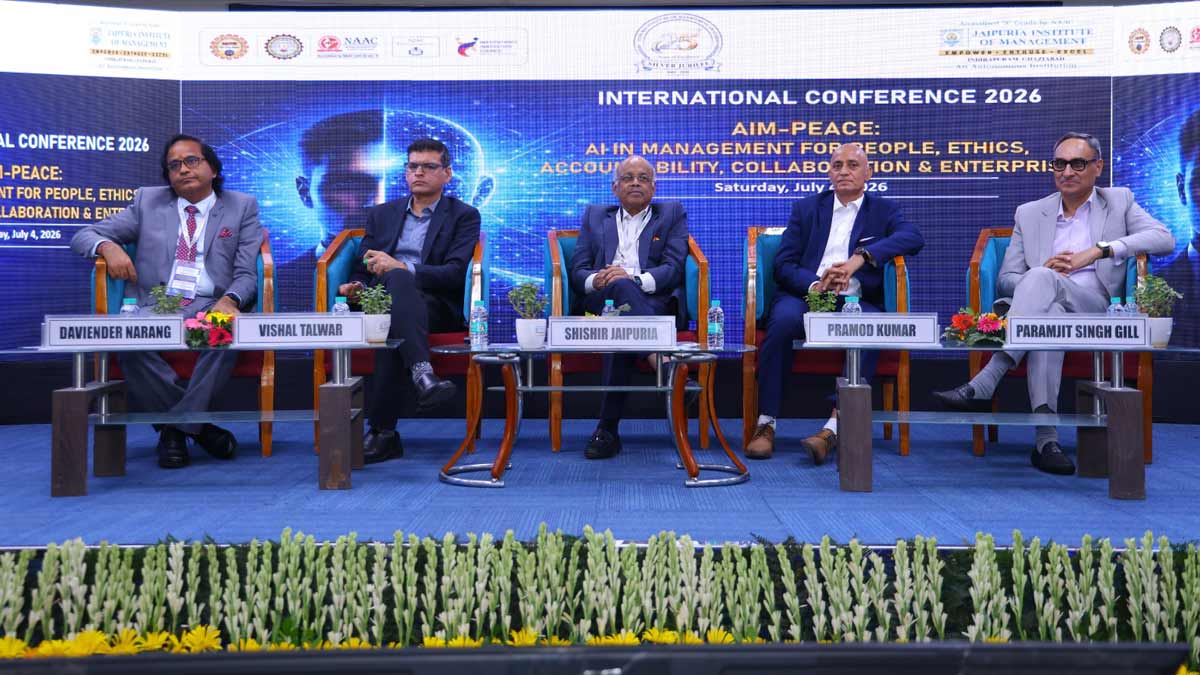
Artificial Intelligence is no longer a futuristic concept waiting in the wings. It is already reshaping workplaces, eliminating some jobs, creating new ones, and forcing businesses, policymakers and educational institutions to rethink what leadership should look like in an age when machines are becoming increasingly capable.
That was the central message at the eighth International Conference of the Jaipuria Institute of Management, Ghaziabad, held on Saturday, where academics, industry leaders and technology experts discussed the opportunities and dilemmas posed by AI.
Addressing the gathering, Shishir Jaipuria, chairman of the Seth Anandram Jaipuria Education Society, urged participants to move beyond viewing AI merely as another technological innovation.
"AI is no technology waiting for tomorrow," he said. "It is already recognising patterns, revealing trends, solving complex problems and optimising human efficiency."
But he argued that technological adoption alone would not define successful organisations.
"The real challenge is responsible leadership," he said, stressing that qualities such as empathy, trust, compassion and accountability remain uniquely human.
Responding to a question from THE WEEK on how society would cope with the increasing "humanisation" of AI, Jaipuria said resilience and accountability would become the defining traits of future leaders.
The conference repeatedly returned to one fundamental question: What happens to leadership when machines begin performing tasks that were once considered uniquely human?
Professor Vishal Talwar, chief operating officer at the University of Southampton, painted perhaps the starkest picture of the changing employment landscape.
He drew parallels with earlier technological revolutions that gradually rendered entire professions obsolete, from telephone exchange operators to video cassette sellers, but argued that AI represents a more profound transformation.
"During the Industrial Revolution, machines were helping us do a better job," he said.
"Now AI doesn't need humans anymore."
According to Talwar, the first casualties are likely to be middle-skill and entry-level jobs that involve repetitive cognitive work. Rather than resisting this change, educational institutions must prepare students for it by making AI literacy an essential part of higher education.
He also called for stronger ethical review mechanisms and continuous policy updates to keep pace with technological advances.
Speaking to THE WEEK, Talwar referred to the famous "Hole in the Wall" experiment while explaining how AI would spread beyond India's metropolitan centres.
"The access and the low cost are the hole in the wall," he said, suggesting that affordable digital technologies would enable AI adoption even in Tier-3 and Tier-4 cities.
While concerns about employment dominated much of the discussion, the conference also highlighted AI's potential to drive innovation.
Technology expert Dr Pramod Kumar pointed to the government's efforts to build an innovation ecosystem through initiatives such as the BHASKAR (Bharat Startup Knowledge Access Registry) platform and programmes under the Department for Promotion of Industry and Internal Trade (DPIIT).
Innovation and experimentation in research and development, he argued, would determine India's ability to compete globally in the AI era.
Encouraging young entrepreneurs to embrace uncertainty, Kumar remarked: "Celebrate failure; it is the proof of trying."
His comments reflected a broader consensus that India's AI ambitions would depend not only on technological capability but also on fostering a culture that encourages experimentation and accepts setbacks as part of innovation.
If innovation was one pillar of the discussion, ethics was the other.
Paramjit Singh Gill, CEO of Globus Spirit, cautioned against placing blind faith in data-driven systems.
"If we keep massaging data, then we will believe what it makes us believe," he said, warning of algorithmic bias and the dangers of relying on flawed datasets.
While acknowledging that AI-driven innovation would inevitably reshape governance and policymaking, Gill argued that sustainability, empathy and trust must remain central to organisational decision-making.
"Innovation is like an amoeba; it will keep changing, but sustainability is the pillar," he observed.
The conference also turned the spotlight on educational institutions and their responsibility to prepare students not just for new careers but also for the psychological uncertainty accompanying rapid technological change.
Professor (Dr) Daviender Narang, Director of Jaipuria Institute of Management, Ghaziabad, said the institute has introduced student development initiatives focused on time management, stress management and overall well-being.
As graduates enter an increasingly unpredictable job market, institutions, he suggested, have a responsibility to equip them with resilience alongside technical competence.
Dr Ruby Bhatia, Professor and Dean (Academics), said counselling sessions and workshops form an integral part of the institute's support system, recognising that employability today extends beyond technical knowledge to emotional preparedness and adaptability.
