



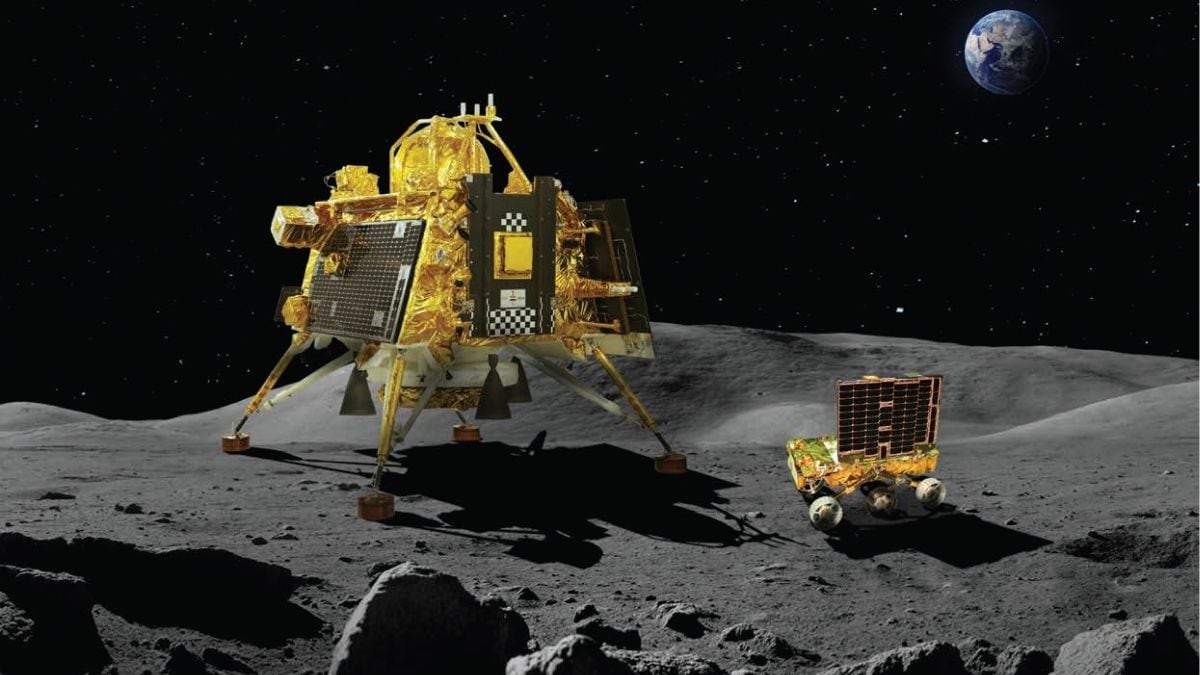
India is taking a big and exciting step in its Moon journey. ISRO, together with the Department of Atomic Energy (DAE), is working on a special artificial heating systems for future Moon landers.
This move is significant because currently, a lander can work on the Moon for only about 14 days. But with this new heating technology, a lander could survive and work for 100 to 200 days.
ISRO Chairman V. Narayanan recently shared this news. Experts say that it could change the way India explores the Moon.
Why heaters matter
On the Moon, one day lasts about 14 Earth days, and one night also lasts about 14 Earth days. “During the day, sunlight falls on solar panels, and the lander easily gets power to work. But when night comes, there is no sunlight at all. The temperature drops to a harsh -180°C or even lower, especially near the poles. In such terrible cold, the batteries, electronics, and scientific instruments can get damaged and stop working forever,” explained space analyst Girish Linganna.
During the mission Chandrayaan-3, its Vikram lander made history on August 23, 2023, when India became the first country to land softly near the Moon's South Pole. During the lunar day, Vikram worked wonderfully and did its job beautifully. But when the cold night came, it went silent, because it did not have enough heating to survive that freezing darkness. This is the exact problem the new heaters want to solve.
Narayanan had said that the new artificial heaters would keep the important parts of the lander warm during the dark, freezing night. He said that if this technology works, future landers could stay active on the Moon for 100 to 200 days instead of just 14. This is a joint effort: DAE brings its deep knowledge of nuclear and thermal technology, while ISRO brings its space engineering skills. If they succeed, India can do long scientific studies and collect data for months instead of only a few weeks.
India is not the only country trying to win this battle against the Moon's cold night. Many nations have faced this same problem. Most of them used devices called radioisotope heater units (RHUs) or radioisotope thermoelectric generators (RTGs).
These clever machines make heat from the natural decay of radioactive materials like plutonium-238. They give steady warmth, and sometimes electricity too, even when there is no sunlight.
“The Soviet Union's Lunokhod rovers in the 1970s used polonium-210 heaters and survived for several months. China has done very well too. Its Chang'e-3 mission with the Yutu rover and the far-side Chang'e-4 with Yutu-2 used RHUs along with solar power, special insulation, and phase-change materials. Because of this, they survived many lunar nights, and Yutu-2 kept working for years. During the cold nights, the systems went into a low-power sleep mode while the heaters kept them warm. But Chang'e-5 had no RHU, so it could not survive the second night,” added Linganna.
The United States has a long history, too. NASA used RTGs to power its Apollo experiment packages, which worked for years across many lunar cycles. For its modern Artemis missions and rovers like VIPER, NASA is now building clever "warm box" designs. These are insulated boxes for electronics connected through heat pipes and thermal switches, which manage heat without depending too much on nuclear sources.
NASA is also testing ideas like storing heat in lunar soil and using advanced batteries. Japan's SLIM lander gave a pleasant surprise in 2024 by surviving multiple lunar nights even though it was not designed for it, thanks to smart power management and a bit of good luck. As experts point out, all these efforts show one truth: there are many ways to fight the cold, from active heaters to passive insulation.
This heater technology comes at the right time, because India is preparing Chandrayaan-4, our first mission to bring Moon samples back to Earth. It has been approved with a budget of over Rs 2,100 crore and is expected around 2028. It is a complex mission with many parts launched on two LVM3 rockets.
A lander will collect 2-3 kg of samples using a robotic arm and drill, an ascender will lift off, the parts will join together in orbit, and finally return to Earth. For such long work near the South Pole, surviving the night is a must.
Challenges still remain, like making the heaters safe and reliable and managing power carefully. As Narayanan said, surviving many lunar nights would be a real game-changer. With heaters conquering the Moon's long, dark night, India's future missions can unlock deeper secrets of the Moon.
