



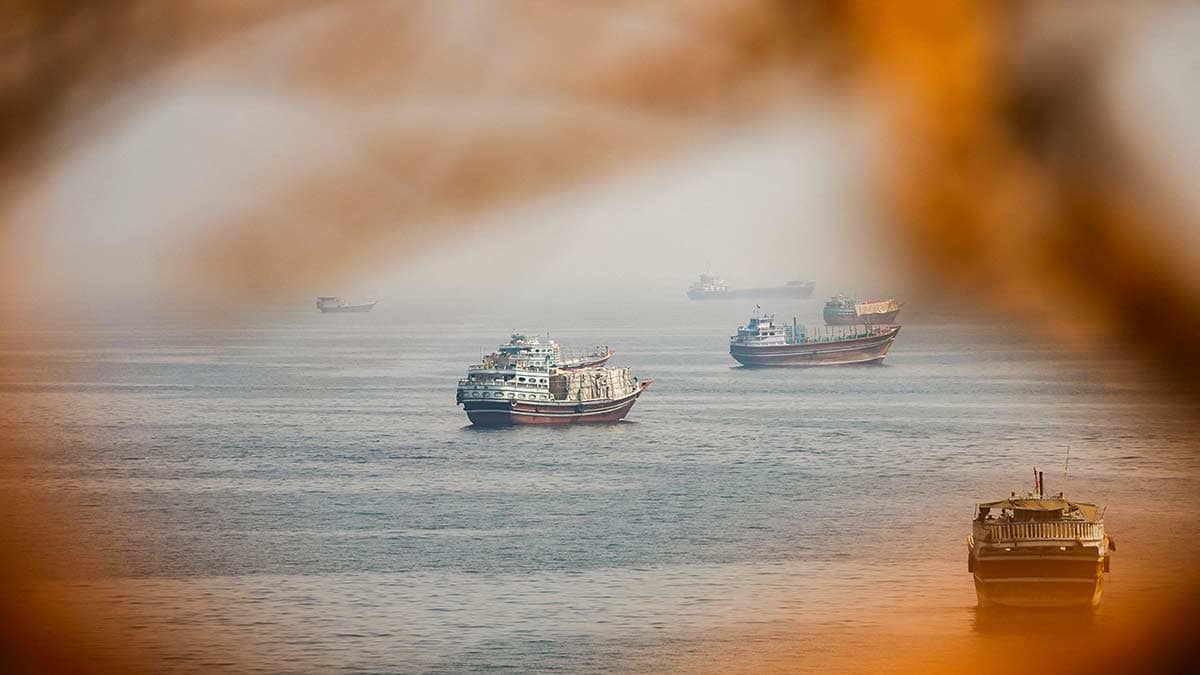
As the transit of crude oil through the Strait of Hormuz inches back up to normal levels, Iran seems to be reworking its strategy to stem the flow. Much of this flow is managed by an elaborate shuttle system operated by the Gulf states, especially the UAE, in close coordination with the US Navy. Smaller feeder vessels carry Gulf crude through a southern corridor near Oman and transfer it, ship to ship, onto Very Large Crude Carriers (VLCCs) in the Gulf of Oman. Overland pipelines supplement the route. Together they have lifted exports from Arab producers to about 92 per cent of pre-war levels, even as the US naval blockade pushed Iran's own crude exports to zero in September.
Figures from the global trade intelligence firm Kpler show that 16.5m barrels per day left the Gulf last month compared with 6.5m bpd in March. Dozens of Iranian tankers remain stranded abroad.
In response, Iran seems to be shifting its focus to the network that has allowed Gulf oil to bypass its grip. The Islamic Revolutionary Guard Corps (IRGC) claims to be hitting five to six ships a night, many of them outbound tankers operating with their transponders switched off. Mohsen Rezaei, the hawkish secretary of the Iranian Supreme National Security Council, has described the transfer system as a smuggling operation run by US Central Command and the UAE military.
Tehran's response has been to widen the arc of its attacks. Drones and precision projectiles have reached southern transit corridors and anchorages off Oman, such as Sohar. By showing that vessels remain exposed even under Western naval cover, Iran hopes to persuade shipowners and insurers that the shuttle cannot guarantee safe passage.
The IRGC Navy has cited mine threats, attributing recent tanker explosions to vessels transiting corridors without its clearance. Iran says the waterway is managed by a body it calls the Persian Gulf Strait Authority, and that commercial traffic must follow its directives. Iranian naval forces have also issued VHF radio instructions to vessels anchored off Ras al Khaimah in the UAE, asking them to leave immediately. The combination of physical hazard and administrative oversight is designed to present Iran as the sole gatekeeper of the passage.
The economic effect may prove more telling than the strikes themselves. Recurrent attacks have left a shortage of tankers willing to transit the Gulf, and the shuttle is estimated to tie up 15 to 20 per cent of global VLCC capacity. Freight costs, which accounted for 1 to 3 per cent of crude prices before the war, have risen to 25 to 30 per cent. Gulf national oil companies have reportedly offered discounts of up to $35 a barrel below official selling prices to move cargo. Meanwhile, ship captains who are ready to make the trip are offered $100,000 a month, plus a $50,000 bonus for each trip.
Iranian officials have said that if the blockade prevents Tehran from exporting, no other country in the region will be allowed to do so. Iran has also extended its warnings beyond shipping. Rezaei has cautioned that more than $2 trillion in US-linked technology assets in neighbouring states, including the UAE, could face retaliation if the blockade continues or foreign military action escalates. Data centres, artificial intelligence facilities, and undersea communications cables have been named. Digital infrastructure has already become a target in other theatres, with Ukraine repeatedly striking a Yandex data centre in Vladimir. For Gulf governments, the threat raises the cost of hosting American naval logistics.
Washington remains the principal audience. Brent crude for December delivery stood at $103.33 a barrel yesterday, and prices above $100 present a political difficulty for any American administration ahead of midterm elections. Shortages of US air defence interceptors may add to the pressure, since escorting and protecting the shuttle depends on sustained supplies. Tehran has said it will not step back until Washington meets seven conditions, including the lifting of the naval blockade and the restoration of what it calls full maritime sovereignty. Proposals relayed through intermediaries are under review, but there is little sign of an early agreement.
The strategy carries risks for Iran, but the alternatives are equally unappealing. Attacks on tankers could invite a stronger American response, and strikes near Omani anchorages may cost Tehran the goodwill of a state that has often served as a channel for dialogue. Gulf producers have already adapted once and could do so again, through added pipeline capacity, closer escorts, or transfer points beyond Iran's reach.
