



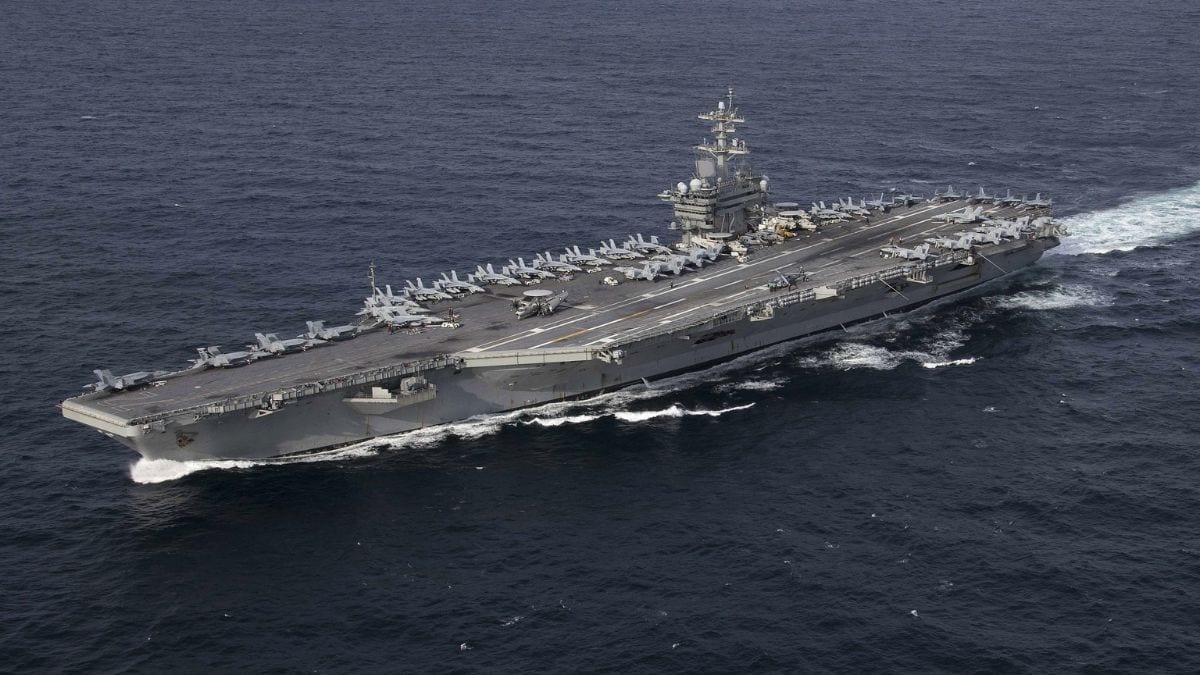
President Donald Trump has brushed aside growing alarm over the punishing, record-breaking deployment of the USS Abraham Lincoln in the Middle East. Asked by reporters yesterday whether nearly nine months at sea was too much for the aircraft carrier's crew to bear, Trump replied, "No, no, no, not nearly long enough." He went further, insisting that the families of the sailors were "not" worried about the situation, a claim that goes totally against the accounts emerging from the ship. Defence Secretary Pete Hegseth has taken a similarly dismissive line, calling reports of poor conditions aboard the Lincoln "completely misrepresented" and branding accounts of dwindling food supplies "FAKE NEWS."
The 5,000 personnel serving aboard the Lincoln are, according to multiple accounts from families and crew, facing a major crisis. Reports describe burnout, suicidal tendencies, and several instances of sailors attempting to jump overboard. One sailor did go over the side and was recovered by helicopter and treated. Conditions on board have deteriorated badly: broken toilets, mould in the showers, weeks without hot water or clean laundry. Even basic essentials have been rationed, with meals at times reduced to half a cup of rice and two tortillas, and strict limits placed on something as ordinary as soap. The ship's mail system collapsed entirely, leaving parcels from home stuck for months. One relative said a sailor aboard had lost 30kg.
The Lincoln crisis is the result of an extraordinarily long deployment, compounded by logistics that simply could not keep up. The carrier has now logged more than 240 uninterrupted days at sea, without a single stop at a liberty port for its crew to recover. A peacetime deployment usually runs to around six months. But the Navy's main logistics hub in Bahrain was badly damaged early in the conflict by Iranian missiles and drones, forcing the fleet to rely instead on a far more distant base at Diego Garcia. That bottleneck, combined with a ship in constant combat posture, left the Lincoln struggling to resupply and unable to dock at any friendly port.
The deployment is bound up entirely with the war against Iran. The strike group has flown roughly 10,000 sorties, both for strike missions and to enforce a tight blockade of Iranian ports through the Strait of Hormuz, a tempo that demands round-the-clock presence. Lawmakers argue the strain has been made worse by the administration's lack of a clear endpoint for the campaign. Hegseth has said the blockade will continue "indefinitely," tying the mounting pressure on the carrier force directly to a Middle East conflict with no clear exit strategy.
The Navy's public response has largely been one of defence rather than acknowledgement. Acting Secretary Hung Cao accused the media of trying to cast sailors as victims, insisting the crew currently has clean water, working air conditioning and proper meals. Behind the scenes, the Navy says it has had to prioritise "mission-critical supplies: first food, then hygiene items, then mail." Onboard, commanders have tried to hold the strain together with chaplains, medics and mental health staff, group therapy sessions, and small gestures such as ice cream socials. A tense town hall was recently held in San Diego, the Lincoln's home port, to allay the fears of families.
The reports have already drawn demands for scrutiny from Democratic lawmakers. Senator Richard Blumenthal, of the Senate Armed Services Committee, has written to Hegseth and Cao seeking answers on the supply shortages, the mental health toll and whether this operational tempo can be sustained at all. Senator Mark Kelly has questioned the wisdom of pushing a crew this hard on a mission with no defined strategy. Representative Ruben Gallego has called for a bipartisan congressional delegation to inspect conditions firsthand, arguing Congress cannot be kept at arm's length from what he called a dangerous situation. Representative Mike Levin has pressed for clarity on the mission's broader purpose, on behalf of constituents who are, in his words, deeply worried.
Relief, at least, is on its way. The Japan-based USS George Washington is en route to take over from the Lincoln, and was recently seen crossing the Singapore Strait. Even so, the Lincoln looks set to break the 326-day deployment record set by the USS Gerald R. Ford before it finally turns for California. The Navy's own top enlisted sailor, Master Chief Petty Officer John, has admitted that the current model cannot hold. The service, he said, must abandon its old peacetime mindset and build a new approach to generating forces, because the present demands are wearing out both the ageing carriers and the sailors who man them.
