



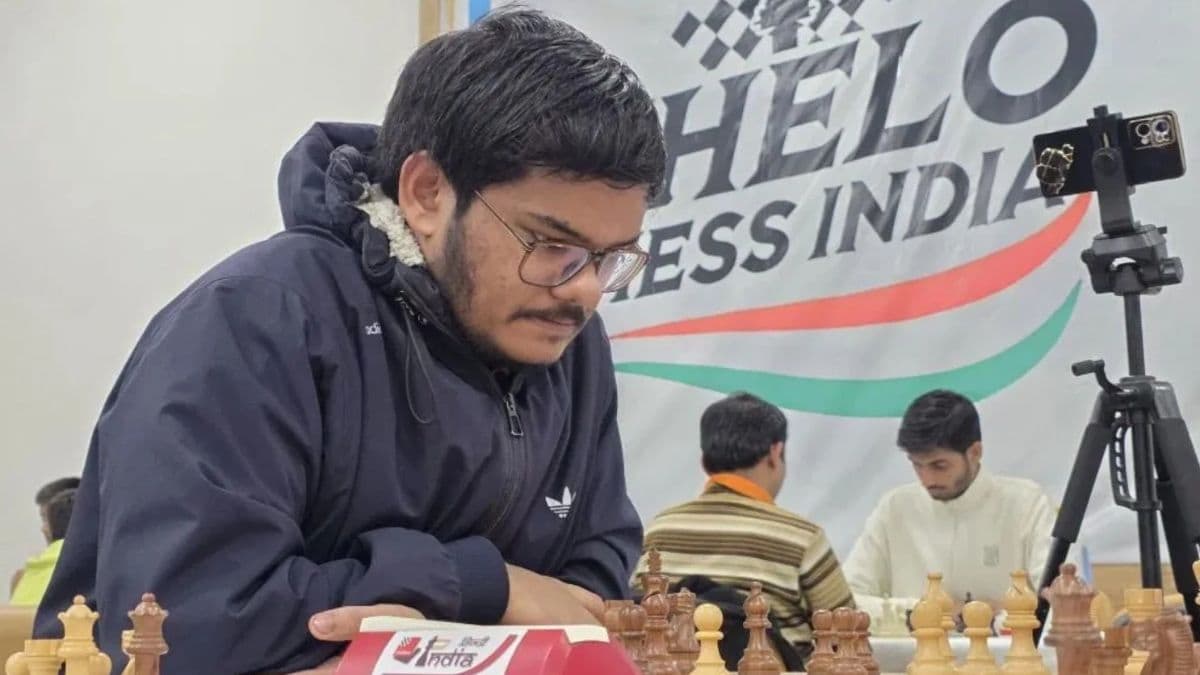
Chess player Anuj Shrivatri on Sunday became India's 100th chess Grandmaster after completing the title requirements by winning the 7th ASEAN Plus Individual Open Chess Championship, held in Ozamiz City in the Philippines.
The 22-year-old International Master is also the first from Madhya Pradesh to bag the prestigious chesss title awarded by the International Chess Federation (FIDE). The win has now pushed his FIDE rating to 2450.
This Diwali milestone comes despite his loss in the first match of the ASEAN chess championship, after which the International Master (IM) turned things around with a stunning recovery of seven points from nine rounds.
This put him just half a point above Vietnam's Nguyen Duc Hoa, who is a Grandmaster, and Nouri Alekhine from the Philippines, a FIDE Master (FM) who finished the tournament third with six points.
"Congratulations, Anuj! A proud moment for Indian chess. Onwards to 200 Grandmasters!" wrote All India Chess Federation (AICF) president Nitin Narang in an X post celebrating the victory.
Other Indian IMs in the fray included Viani Antonio Dcunha, who finished fourth with six points, Audi Ameya, who came in sixth place with a score of six points, and Ritviz Parab, who ended the tournament in the eighth spot with the same score.
Just half a point away from him were Dhulipalla Bala and Chandra Prasad, who tied for the ninth spot with 5.5 points each.
The International Chess Federation currently awards the title of GM to a player who achieves a 2500 FIDE classical (or 'standard') rating and fulfills three GM conditions.
This comes nearly a decade after the youth from Madhya Pradesh's Katni region became the youngest International Master from his state on August 22, 2019, aged 15 years and 31 days.
In an interview with Chessbase, Shrivatri explained that he began playing the game at the age of seven, after which his career progressed under a series of coaches such as the late V.K. Tiwari, Yashpal Arora, Rajesh Bahadur, and Niklesh Jain.
However, he also pointed out a significant part of his chess career also included "mostly working on (his) own", due to various constraints.
"Most (coaches contacted in 2018) were busy coaching others, while others had high fees for coaching and you can't take classes regularly. Also if you go somewhere especially for coaching, staying there and taking coaching would be simply too expensive. So I decided to completely focus on my own self-practice and I am happy that I managed to become an IM without a coach, but I wouldn't recommend that path for everyone, a good coach will certainly help you to achieve your goal faster," he had said in the 2020 interview.
