



Social media platforms such as TikTok, Telegram, Facebook, and WhatsApp are often used to spread misinformation, driven by engagement-driven algorithms that reward viral emotional content and enable rapid peer-to-peer sharing with little oversight. Although they are used to circulate information widely during a time of crisis, they can also be used to alter the original information to achieve greater reach, creating an environment in which false claims spread faster than verified facts. Applying the lessons from misinformation campaigns to the recent humanitarian crisis in Ceuta offers valuable insights into how social media posts can trigger a major humanitarian catastrophe in the 21st century.
The geopolitics of migration at Mediterranean borders has long been defined by an asymmetry of wealth and demographics between Europe and Africa, the European Union’s border controls, and the sea’s evolution into a zone of deterrence and humanitarian crisis. The case of Ceuta is unique because it is one of only two land borders between Europe and Africa (the other is Melilla). Viral social media misinformation and a misunderstanding of Spanish Supreme Court rulings in the last week of July triggered a migrant crisis in which tens of thousands of people rushed into the Spanish enclave from Morocco.

Ceuta is a tiny Spanish territory located next to the urban municipality of Fnideq in northern Morocco, with a population of approximately 83,000 to 85,000 residents. A false claim on platforms like TikTok, Instagram, and Telegram that Spain’s border was open and that migrants who swam across would not be sent back created a humanitarian catastrophe. Instead, it was a social media fabrication of a ruling that ‘hot returns’ could not be applied to migrants intercepted at sea under specific conditions, thereby requiring ordinary immigration procedures.
Encouraged by these rumours, an estimated 60,000 to 72,000 individuals swam around breakwaters or rushed the border fences in search of permanent asylum in Europe. This demonstrates that the digital space is increasingly shaping reality more than traditional media. In recent years, the convergence of socioeconomic vulnerabilities and algorithm-driven social media has fundamentally reshaped border dynamics. False social media narratives have not merely reflected the migration crisis in Ceuta; they have actively transformed latent regional difficulties into life-threatening humanitarian emergencies.
The primary mechanism by which false social media narratives worsen humanitarian conditions in Ceuta is the deliberate fabrication and viral dissemination of ‘pull factors.’ Digital platforms such as TikTok, Telegram, Facebook, and WhatsApp serve as primary vectors for both human trafficking networks and the spread of rumours. These channels frequently circulate misleading interpretations of legal developments.
For instance, judicial decisions on due process requirements for migrants intercepted at sea are routinely stripped of nuance and repurposed in viral posts claiming that border guards have stood down or that physical entry guarantees automatic asylum and legal work rights. These digital campaigns have generated over 11 million views within a week, spreading dangerous claims that the border is fully open. For economically disenfranchised youths across North and Sub-Saharan Africa (Harraga), this digital information offers an illusory window of opportunity.
The consequence of these viral posts is the rapid mobilisation of thousands of individuals within a short span. Traditional migration flows historically fluctuated with seasonal weather conditions, agricultural employment cycles, or political developments. In contrast, the new social media engagement models prioritise high-arousal content, allowing false information about ‘open borders’ to generate income through views.
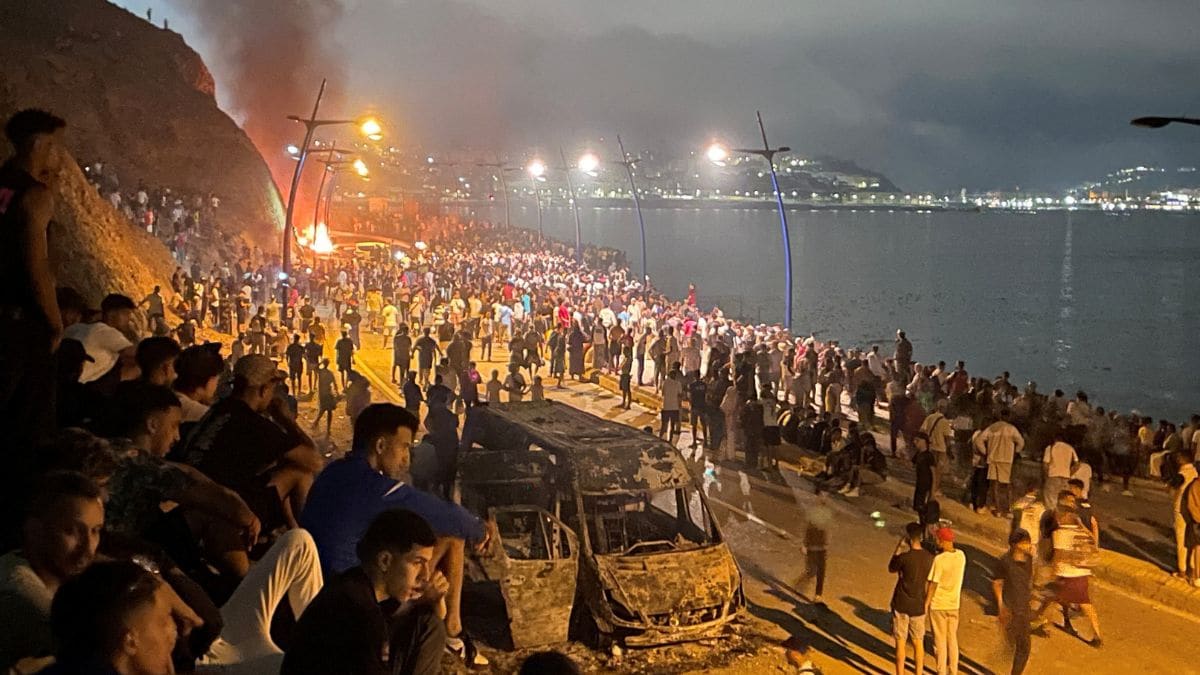
This false narrative triggered an unprecedented wave of people at the borders over 10 days. When thousands of hopeful migrants simultaneously arrived in the coastal town of Fnideq, the rapid influx outpaced both local warning systems and formal state responses. Amid the migrant surge, Fnideq faced severe civil unrest, violent clashes with security forces using water cannons, dangerous human stampedes near border fences, property damage, including burned vehicles, and casualties among the thousands gathered. Additionally, these migrants lacked adequate food, water, temporary shelter, or emergency medical support, resulting in an immediate operational collapse on the ground.
This escalated into a physical crisis when desperate migrants, misled by misinformation, attempted to breach the border infrastructure. Believing that security forces would not intervene, or that swimming around the breakwaters of El Tarajal or Benzú would face no legal or physical enforcement, thousands of people, including minors, young adults, and families, entered the ocean. The physical realities of the border are defined by coastal currents, breakwaters, fortified fences, and heavily armed security deployments, which contradict the seamless passage promised on digital media. Individuals’ crossing attempts, driven by these rumours, resulted in an official death toll exceeding 70 from drowning and over 1,000 recorded injuries from sharp physical barriers. The humanitarian crisis is thus manufactured not solely by poverty or conflict, but by digital misinformation.
In the wake of the disaster, EU tech chief Henna Virkkunen held urgent talks with tech companies, resulting in commitments from Meta and TikTok to rigorously fact-check and monitor content related to border crossings to prevent criminal networks from enticing people into deadly crossings. Similarly, the sudden influx sparked significant political friction, prompting Italy to suspend Schengen travel with Spain temporarily and to require passports for travellers between the two countries due to Spain’s migration management concerns.
Furthermore, the sudden, digitally induced influx of migrants created enormous pressure on Ceuta’s local institutions, drastically degrading the standard of care and basic human rights protections for arriving migrants. Ceuta is small, with modest municipal resources and constrained healthcare services. The sudden influx of migrants has increased the population by over 80 per cent in a matter of days, and the processing centres, temporary holding facilities, and local hospitals are overwhelmed. Under such conditions, public authorities struggle to maintain basic sanitary standards or properly identify and safeguard vulnerable populations, such as victims of human trafficking and unaccompanied children. The collapse of administrative capacity leads to mass return measures, with up to 70,000 individuals processed for immediate return within 48 to 96 hours.
The role of false social media narratives in Ceuta underscores a fundamental shift in international migration and border security. Border management can no longer be conceptualised solely in terms of physical fencing, naval patrols, and bilateral diplomatic arrangements. Information architecture has become a primary determinant of human behaviour, shaping perception and driving migration flows. False social media narratives drive the movement of people by exposing vulnerable populations to severe physical dangers, provoking militarised state reactions that further degrade human rights. Mitigating the humanitarian crisis in enclaves like Ceuta ultimately requires states, civil society, and technology platforms to safeguard the digital communication ecosystem against misinformation.
The author is a doctoral candidate at the Centre for West Asian Studies, Jawaharlal Nehru University, New Delhi.
