



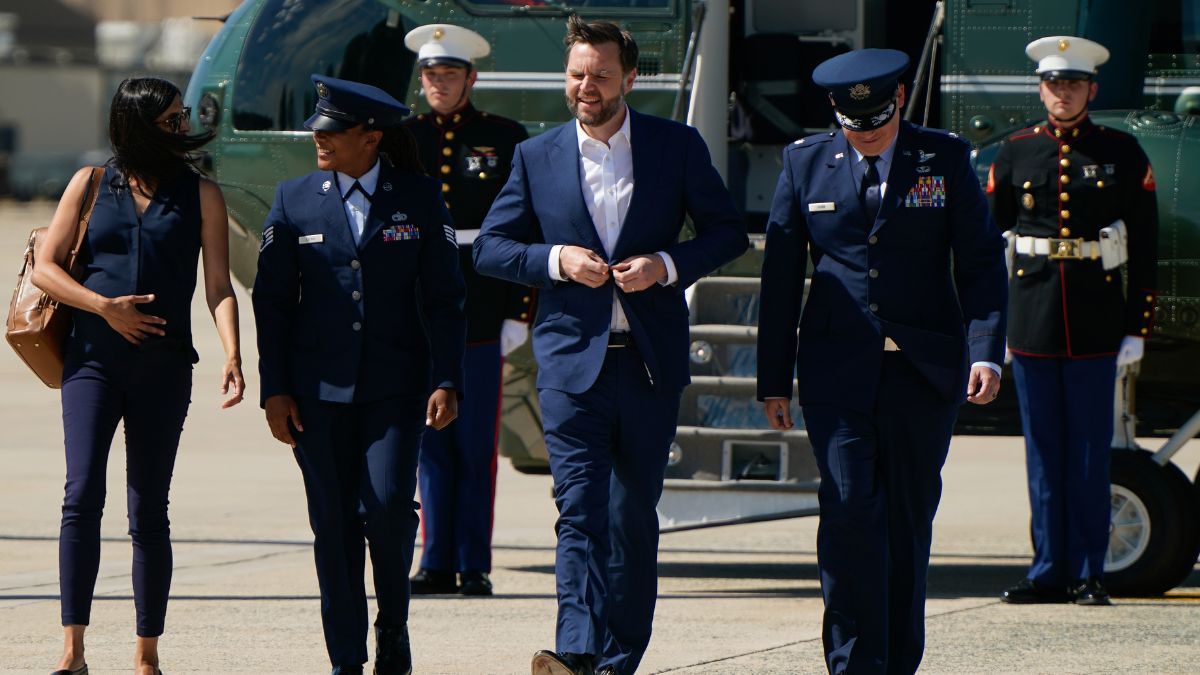
As he travels to Switzerland for crucial talks with Iran beginning on Sunday, US Vice President JD Vance says his focus will be on two key issues: Iran's nuclear programme and peace in Lebanon. Mediated by Pakistan and Qatar, the summit brings together senior figures, including Pakistani Prime Minister Shehbaz Sharif and Army Chief Asim Munir, to consolidate a fragile preliminary peace agreement between Washington and Tehran. Yet the negotiations are already under threat from renewed fighting between Israel and Hezbollah in Lebanon and an escalating dispute over the Strait of Hormuz.
The structure of the talks reflects Washington's two-track approach to diplomacy. Before departing Joint Base Andrews, Vance said he would remain in Switzerland for only "a day or two" to provide political leadership, then leave technical teams to continue detailed negotiations. The American delegation also includes President Donald Trump's envoys Steve Witkoff and Jared Kushner.
A significant gap, however, exists between American and Iranian expectations. While Washington hopes to launch a 60-day final phase of technical peace negotiations, Iranian officials have made it clear that they are not attending the summit for that purpose. The Iranian delegation is led by Parliament Speaker and chief negotiator Gen. Mohammad Bagher Ghalibaf, Foreign Minister Abbas Araghchi and Foreign Ministry spokesman Esmail Baghaei. Tehran has arrived with a firm set of conditions. Iranian officials insist that no final agreement can move forward unless the United States guarantees Israeli compliance with their 14-point memorandum of understanding.
At the centre of Iran's demands is the first article of the MoU, which calls for an immediate and permanent end to military operations across all fronts, particularly in Lebanon. Tehran argues that the peace process remains frozen in its initial phase until these commitments are honoured. Other unresolved issues include the status of the Strait of Hormuz, the lifting of US sanctions and the release of frozen Iranian assets abroad.
The Lebanese conflict risks undermining the delicate understanding reached between Washington and Tehran. There has been heavy exchange of fire between Israel and Lebanon over the past few days. Hezbollah launched more than 50 projectiles at Israeli forces and ambushed an Israeli infantry unit advancing towards a strategic ridge near Nabatieh. Israel responded with extensive air strikes across southern Lebanon, targeting dozens of Hezbollah positions and killing scores of fighters.
The humanitarian toll has been severe. Lebanon's health ministry reports that 47 people were killed in Saturday's strikes alone, taking the overall death toll since hostilities resumed on 2 March past 4,000. Complicating matters further, neither Israel nor Hezbollah is a signatory to the US-Iran agreement.
Israeli Prime Minister Benjamin Netanyahu has repeatedly maintained that Israel is not bound by the pact, insisting that its campaign against Hezbollah remains distinct from the wider conflict involving Iran. He has also rejected calls to pull his troops back from southern Lebanon. This has angered the White House, and Vance himself acknowledged the volatility of the situation, describing Lebanon as a crisis that Washington would need to manage continuously in order to preserve regional stability.
In response to ongoing Israeli military operations, which Tehran regards as a violation of the MoU, Iran announced the closure of the Strait of Hormuz. The naval arm of the Islamic Revolutionary Guards Corps warned that commercial vessels entering the waterway would do so at their own risk and vowed to maintain restrictions until the agreement is fully implemented. The prospect of renewed restrictions has already raised fears of another energy shock similar to that seen after earlier confrontations involving Iran, the United States and Israel.
Despite Tehran's assertions, American military officials dispute claims that the strait has been fully closed. Capt. Tim Hawkins, a spokesman for US Central Command, said Iran did not control the waterway and confirmed that commercial traffic continued under US surveillance. According to Centcom, 55 commercial vessels carrying more than 17 million barrels of oil successfully transited the strait on Saturday.
Nevertheless, tensions are once again affecting shipping patterns. Vance, therefore, faces an exceptionally tough task in Switzerland. He must press ahead with long-term nuclear diplomacy even as he tries to contain multiple regional crises.
