



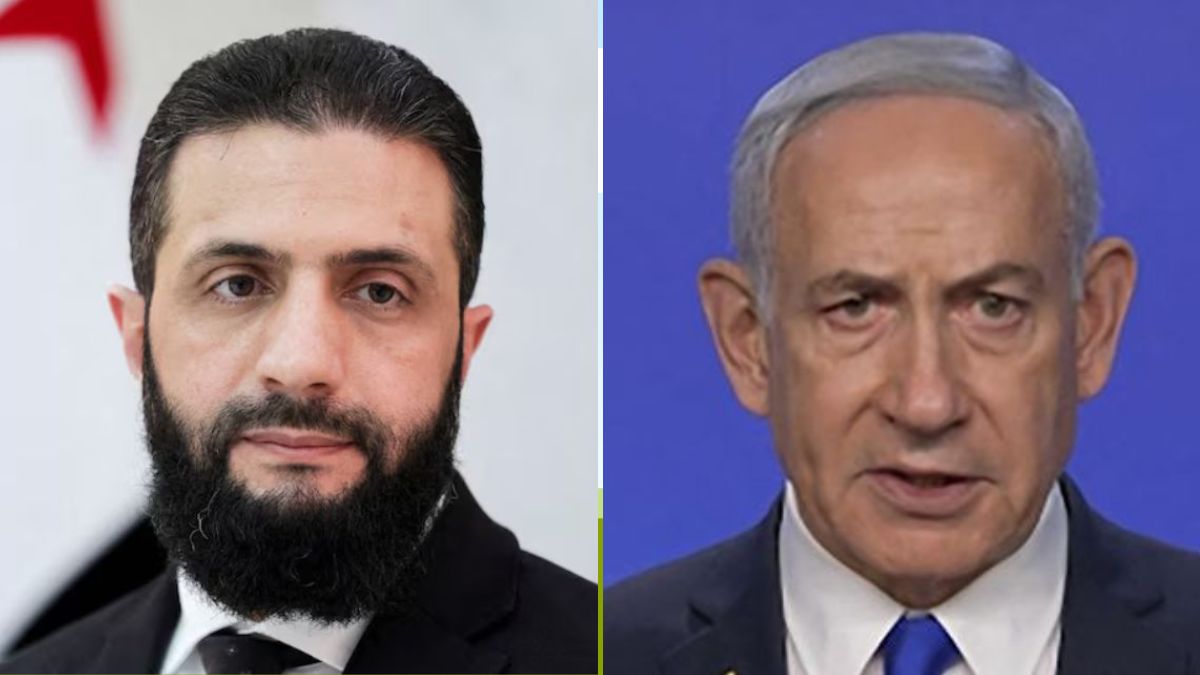
Syria and Israel may soon reach a security agreement to calm tensions along their volatile border. Syrian President Ahmed Al Sharaa, who assumed office after the fall of Bashar Al Assad last December, has expressed optimism that talks mediated by the United States could yield results “within days”. Speaking in Damascus earlier this week, he said Syria was “tired of conflict” after more than 13 years of civil war and was eager to secure peace with its neighbours.
ALSO READ | Syria's silent war: How a devastating drought threatens post-conflict recovery
The negotiations—with Jordan also participating—mark the most serious attempt in years to establish a security framework in southern Syria. They follow months of clashes and repeated Israeli strikes, which Damascus claims have numbered more than a thousand since Assad’s fall.
Al Sharaa insists that while an accord is possible, the central question is whether Israel will respect any deal it signs.
Israel's three-zone proposal
Israel has tabled a detailed plan modelled partly on its 1979 peace treaty with Egypt. It calls for the creation of three security zones stretching from the Israeli frontier towards Damascus.
The zone closest to Israel would be demilitarised, excluding Syrian troops and heavy weaponry but permitting police and internal security units. A middle zone would host limited Syrian forces under joint monitoring arrangements. Further out, a regular Syrian military presence would be allowed, potentially overseen by Jordanian observers.
Israel also demands a no-fly zone for Syrian aircraft over the frontier and an extension of the existing buffer by roughly 2km into Syrian territory. In exchange, it offers a phased withdrawal from areas captured after Assad’s ousting, with one exception: an outpost on Mount Hermon; a peak it regards as vital for surveillance. Israeli officials have described this as non-negotiable.
The proposal also envisages retaining flexibility for Israeli aerial operations over Syria: a point that has raised alarm in Damascus. Critics of the plan have labelled Israel’s terms “maximalist” and question whether they amount to a sustainable compromise.
Syria's red lines
President Al Sharaa and his foreign minister Asaad Al Shaibani have welcomed negotiations, but outlined firm red lines. Damascus insists that any accord must be anchored in the 1974 disengagement agreement, which established a UN-supervised buffer after the 1973 war. Syrian officials want international monitoring restored, and view the UN’s involvement as essential to guarantee compliance.
Syria demands the complete withdrawal of Israeli forces from areas entered after last December and rejects any arrangement seen as undermining its sovereignty. Al Sharaa has ruled out recognising Israeli control over the Golan Heights and dismissed suggestions that broader normalisation is on the agenda.
“This is not a peace treaty,” he told reporters, stressing that the focus is border security.
Negotiations on the clock
On Mount Hermon, Syria has said the issue is separate from current talks but maintains that its sovereignty over the peak is non-negotiable. Officials are reviewing Israel’s proposal and preparing amendments to protect national unity and authority.
Talks have accelerated in recent weeks. In London, Syrian and Israeli ministers met alongside US envoy Tom Barrack for a five-hour session. Sources said some progress was made, but that a final deal remains elusive. Washington is keen for tangible results before Al Sharaa speaks at the United Nations General Assembly on September 21.
Yet, obstacles remain. There is a wide gap between Israel’s insistence on retaining Mount Hermon and Syria’s demand for full withdrawal. Israel says the 1974 agreement is void after the collapse of the Assad regime, justifying its reoccupation of parts of the buffer zone. Syria, meanwhile, feels that Israeli strikes and incursions show the fragility of any prospective deal.
Fragile ground in the South
Even more alarming is the situation in South Syria. The July clashes in the Sweida province which caused hundreds of deaths and displaced tens of thousands of people have fuelled fears of a wider regional spillover. The United States and Jordan, anxious to prevent chaos, have stepped up mediation efforts in response.
Narrow room for compromise
Despite doubts, the very fact that talks are advancing marks a shift. For the first time in decades, Damascus and Jerusalem are discussing formal security arrangements, even if not political recognition. Analysts believe a limited accord could ease hostilities, re-establish the UN’s monitoring role, and create space for further dialogue.
ALSO READ | The ripple effects of Israel's Doha operation on Gulf states
Al Sharaa has suggested that an agreement could come quickly, though he cautioned that it may only be partial.
Syrian officials say several security and military pacts could be signed by the end of this year. Much will depend on whether compromises can be reached on Mount Hermon, the buffer zone, and Israeli military operations.
For now, Syria seeks guarantees of sovereignty, Israel seeks guarantees of security, and both remain wary of the other’s intentions. The coming days may reveal whether this fragile opening leads to a formal deal or falters once more in the long history of their conflict.
