



On a windy English morning, Keira Knightley’s Elizabeth Bennet stands on a cliff, her skirt whipping in the wind as Dario Marianelli’s piano score swells behind her. She has just learnt that Mr Darcy—the man she both resents and is drawn to—engineered the collapse of her sister Jane’s relationship with Mr Bingley, Darcy’s best friend. That windswept pose captures Elizabeth’s inner turmoil, but also her quiet independence. She is alone, shaken and yet resolute after refusing the rich Mr Darcy’s marriage proposal, accepting which could have changed her life.
Nearly 20 years after Joe Wright’s 2005 film reframed Regency England—its romance, patriarchy, feudalism and the politics of marriage and money, not to mention gowns and bonnets—Jane Austen, whose 250th birth anniversary was on December 16, remains the quiet architect of our most enduring romantic fantasies, from Darcy’s iconic hand-flex (not in the original book, though) to Colonel Brandon’s contained devotion. Austen’s women, meanwhile, continue to stride, question, rebel and negotiate a world that feels both unchanged and unsettlingly familiar.
The many Austens
“Jane Austen was writing about extreme patriarchy and the role of women in such a world. And sadly, we still live in a patriarchal society where women are often judged the same way, especially if they remain unmarried. I think she was raging against that,” says British-Kenyan filmmaker Gurinder Chadha. She brought that critique to life in Bride & Prejudice (2004), a cross-cultural, east-meets-west adaptation of Austen’s most beloved novel Pride & Prejudice.
Starring Aishwarya Rai Bachchan as Lalita and Martin Henderson as Will Darcy, she transforms Austen’s 19th-century feudal England into a fairly contemporary millennial India, where arranged marriages continue to be determined by status and security. It is only startling how Austen’s opening line—“It is a truth universally acknowledged, that a single man in possession of a good fortune, must be in want of a wife”—perfectly fits across centuries and continents.
Author Mahesh Rao found a similar echo when he reimagined Emma in Polite Society (2018). Here, Ania Khurana becomes the “handsome, clever and rich” meddling matchmaker—snobbish, sheltered, but compellingly charismatic.
For Rao, too, the parallels feel natural—between Austen’s Georgian Highbury and contemporary Lutyens Delhi where he sets his story, which he describes as a tightly packed radius of influence with just a few streets holding a huge concentration of political and economic power. And much like Austen’s Highbury, “where everyone’s houses are close to one another, and everyone is going to the same balls, churches and parks,” Lutyens Delhi, too, resembles a cloistered village. Rao describes it as, “A small group of wealthy families knowing one another, marrying one another, and everyone is connected, while the rest of the world is excluded.”

Bringing Emma into a fashionable Delhi was Sonam Kapoor’s rom-com Aisha (2010)—another reminder of Austen’s enduring appeal, but also of her literary brilliance.
Among the most celebrated Austen adaptations is Emma Thompson’s Sense and Sensibility (1995), which won her the Oscar for best adapted screenplay. The film boasts a charismatic cast—Thompson as the steadfast Elinor, Kate Winslet as the impulsive Marianne, Hugh Grant as the awkwardly charming Edward Ferrars, and Alan Rickman as the quietly smouldering Colonel Brandon.

If Thompson’s version was definitive, filmmaker Rajiv Menon’s Kandukondain Kandukondain (2000) remains one of the most inventive. A modern Tamil retelling of Sense and Sensibility, it transports Austen’s world to millennial south India, in the middle of the IT boom, with remarkable ease. The film was powered by A.R. Rahman’s music and featured a stellar cast, including Tabu, Aishwarya Rai Bachchan, Ajith Kumar, and Mammootty. It reshaped the Dashwood sisters into working women whose choices drive the narrative. Their heartbreaks, losses and reinventions feel contemporary.
“Strip the story down to its bones and the parallels are unmistakable,” says Menon. “Women seeking love, women at the centre of their own romantic journeys. Austen was among the first to write these stories within the structure of comedy.” What keeps readers returning to her, he adds, is that she wrote about a world where women had almost no agency, and yet found ways to carve out space for themselves. “Her characters grow, intellectually, emotionally, romantically, and ultimately arrive at what is right for them,” he says.

Coming-of-age
Almost all Jane Austen novels centre around this growth of her heroines. Such as Catherine Morland in Northanger Abbey—an unassuming 17-year-old whose imagination has been shaped by the Gothic novels. Over the course of the book, she confronts the gap between fantasy and reality, and what emerges is a heroine who sheds her naïveté without losing her innate goodness.

If coming-of-age is about growth, so too is the power of second chances, a theme Austen explores in Persuasion. At 27 and still unmarried, Anne Elliot is Austen’s most mature heroine, having once ended her engagement to the dashing naval officer Frederick Wentworth. Seven years later, he re-enters her life, just as her family is forced to rent out their ancestral estate to ease their debts.
Of marriage and money
What further cements Austen’s literary genius is that she garnered an endearing global legacy. Interestingly, in each of her six novels, her fascination with money—its power, the social standing it confers, and the ways it leaves women at a disadvantage—is unmistakable. In Sense and Sensibility, for example, the Dashwood sisters are disinherited after their father’s death and left at the mercy of their half-brother.
Nowhere is the interplay of wealth and social hierarchy more pointed than in Austen’s often-underrated Mansfield Park. Poor Fanny Price, abandoned by circumstance, is sent to live with her affluent relatives at Mansfield Park, constantly reminded of her inferior status while her privileged cousins go through life with ease. Yet these constraints never dim her moral clarity, as she resists even the prospect of marrying the rich and charming, but manipulative Henry Crawford.
“For most of her writing life, Jane Austen was extremely worried about her finances,” says Rao. Ironically, for a writer so attuned to the power of money, Austen was celebrated on the £10 Bank of England note in 2017, marking the 200th anniversary of her death.
Alongside money, marriage is another recurring theme in Austen’s novels. “What is fascinating is that someone who never married herself wrote so many endearing love stories,” says Menon. Even more striking is that virtually all of her heroines end up married.
Who was Austen?
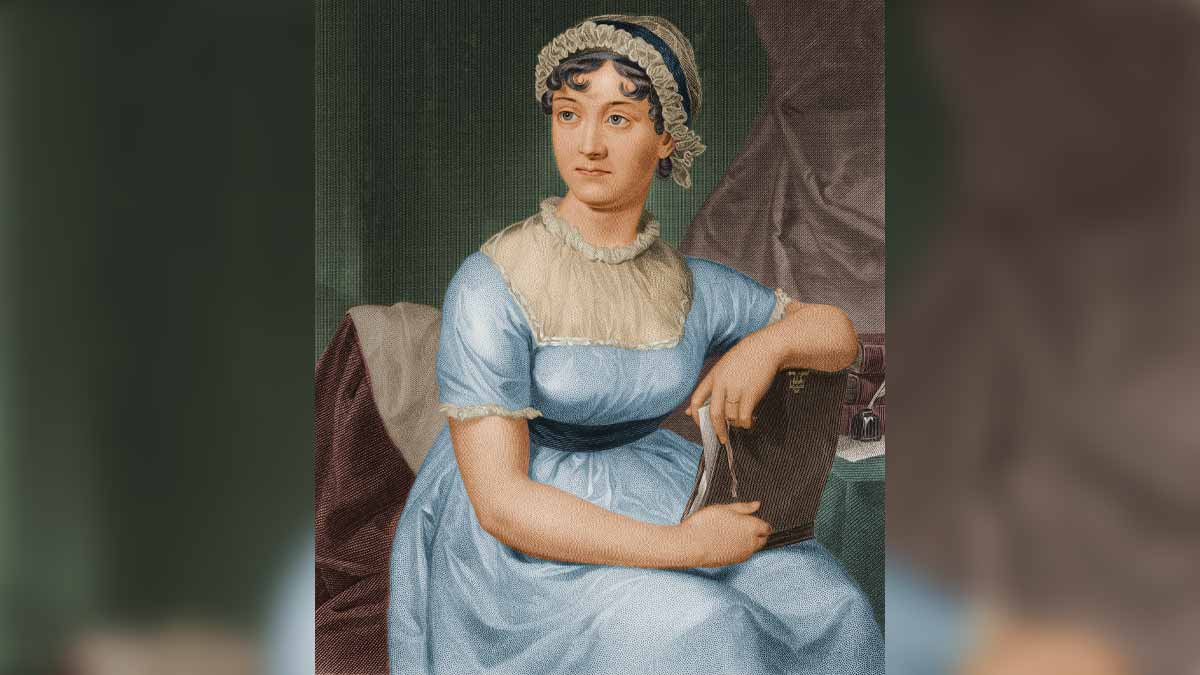
Little is known about Austen’s personal life—her sister Cassandra famously burned most of her letters after Austen’s untimely death in 1817 at just 41. What is known, however, is that she had a brief flirtation with the Irish lawyer Tom Lefroy, whom she described in a 1796 letter to Cassandra as “a very gentlemanlike, good-looking, pleasant young man”. Unfortunately, Lefroy had to leave the country.
She was also engaged, in 1802, to Harris Bigg-Wither, a wealthy friend’s brother, breaking it the next morning. In doing so, Austen appears to have chosen singledom—a bold and unusual choice, both for her time and ours.
Beyond romance & money
Every reader takes something different from Austen—for some it is the romance, for others the class divide. But one thing is clear: she was a keen observer of Georgian England, from the constrained place of women in a patriarchal, feudal society to the ways wealth was made, including through the slave trade.
Sense and Sensibility hints at British colonial ventures through Colonel Brandon’s departure to India, while Mansfield Park is more direct: Fanny Price is sent to live with the wealthy Bertram family, whose estate includes holdings in Antigua. The reference is more than symbolic—the estate gets its name from the real-life Lord Mansfield, who, childless, adopted his grand-nieces and famously presided over the 1772 Somerset case that helped outlaw slavery in England.
A year of celebration
It is a year of celebration for Jane Austen fans, known as “Janeites”, a term coined in 1894 by British writer George Saintsbury. The label even appears in Rudyard Kipling’s 1924 short story The Janeites, about British soldiers bonding over Austen during World War I. England is at the heart of the global festivities: Austen-themed parties, exhibitions, and events are marking the author’s birth anniversary. The New York Times even named ‘Jane Austen’s England’ as the top place to travel to in 2025.
“Jane Austen fans have a good reason to explore the south-west of England this year: It’s the 250th anniversary of her birth, and celebrations abound. Hampshire was both Austen’s birthplace and a source of inspiration; as a novelist, she was most prolific in this bucolic setting. Start out at Jane Austen’s House, her former cottage, featuring an exhibition and themed festivals,” it wrote.
In India, while universities are holding readings, discussions, and performances, book stores are witnessing a notable rise in sales. “Jane Austen’s books are perennial bestsellers and continue to perform exceptionally well in our classics section, with a significant and sustained upward trend so far this year,” says Nidhi Gupta, director of Crossword Bookstores. Highlighting the impact of the 250th birthday celebrations, she notes, “We have observed a marked increase in interest across all our platforms. Importantly, this surge is not limited to long-time fans; it also includes a growing number of younger readers discovering the original novels after engaging with modern film and television adaptations.”
Among her works, the perennially popular Pride & Prejudice remains the top seller, with Emma following close behind.
Speaking on Austen’s enduring appeal among young readers, author Malashri Lal, a former English professor at Delhi University, said, “Reading Jane Austen and watching films based on her novels has become a ‘cool’ pastime for today’s youth.”
On whether girls engage with Austen differently from boys, she explains, “While universal themes such as romance, relationships, class hierarchies, and the visual glamour of the Regency period attract both genders, they approach Austen’s writing in distinct ways. In our egalitarian times, girls often focus on the emotional growth of characters like Emma Woodhouse, while boys tend to notice Mr Knightley’s gentle corrections of Emma’s assumptions, learning how to be critical yet courteous.”
The enduring legacy
Austen wrote just six complete novels, with one—Sanditon—left unfinished due to her untimely death. She pioneered the use of free indirect discourse, seamlessly blending a third-person narrator’s voice with a character’s inner thoughts and feelings, creating an intimacy that was revolutionary for her time.
Her legacy continues to thrive in countless adaptations and retellings, including Netflix’s upcoming series adaptation of Pride & Prejudice, starring Emma Corrin as Elizabeth, Jack Lowden as Darcy, and Olivia Colman as Mrs Bennet, proving that Austen’s world still captivates hearts and imaginations across the globe.
